

Top 9 Picks for the Best Stock Trading Platform for Learning
Choosing the best stock trading platform for learning is a different job from choosing a broker to invest with. A learner needs a safe place to make mistakes, plain explanations of what happened, and prices that behave like the real market. We ranked nine options by the job each one does best.
Quick answer: Our top pick is Gobi, a free practice trading app that gives you virtual funds to place long and short trades on real market prices for stocks, crypto, and commodities, with built-in guides and an AI coach on iOS and Android. Gobi is not a brokerage: you cannot deposit money, own shares, or withdraw profits. When you are ready for real capital, pair it with a regulated broker such as Fidelity or Charles Schwab.
Key takeaways:
- Gobi is free and fully simulated: balances, orders, gains, losses, fees, and funding are all virtual, while prices come from live markets.
- Gobi has global reach: 54,052 people have tried Gobi as of Oct 17, and the app is available in English, Spanish, Hebrew, Simplified Chinese, Traditional Chinese, French, and Arabic.
- Leverage is made visible: in Gobi, $500 of virtual margin at 10x leverage controls $5,000 of market exposure, so you see the risk before facing it with real money.
- Several brokers include free paper trading: Schwab thinkorswim paperMoney, Webull, Interactive Brokers, and Power E*TRADE offer simulated modes, while Fidelity and Robinhood do not.
- Beginner costs are low but not zero: Fidelity, Schwab, Webull, Robinhood, and IBKR Lite publish $0 commissions on online US stock trades, yet options fees, margin interest, and regulatory fees still apply.
What is the best stock trading platform for learning right now?
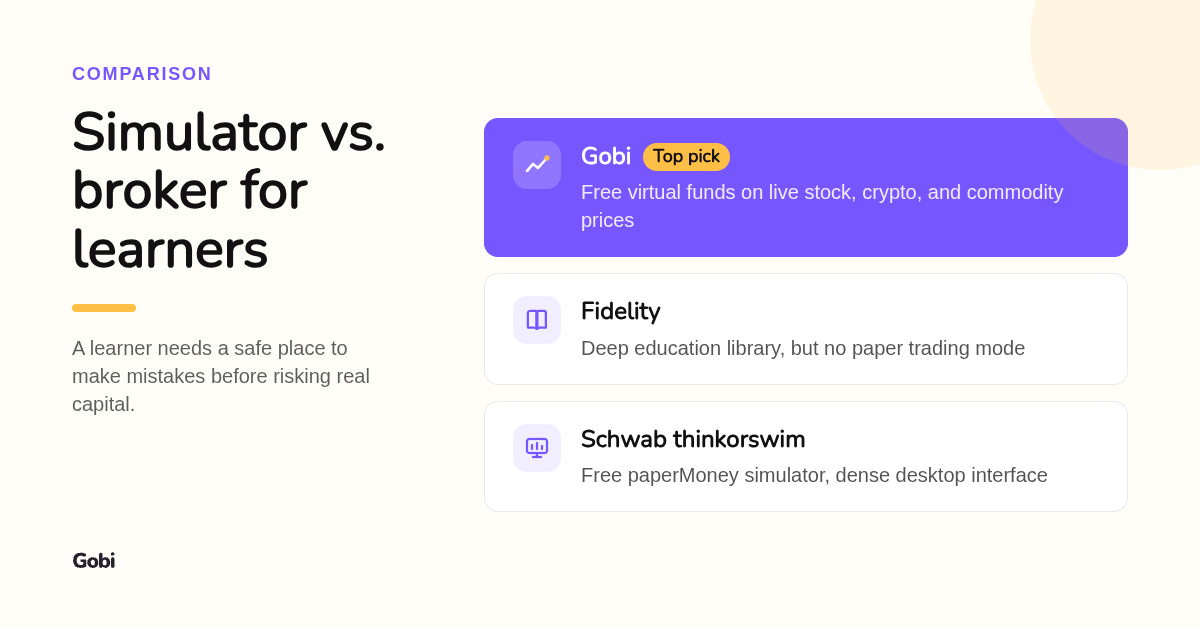
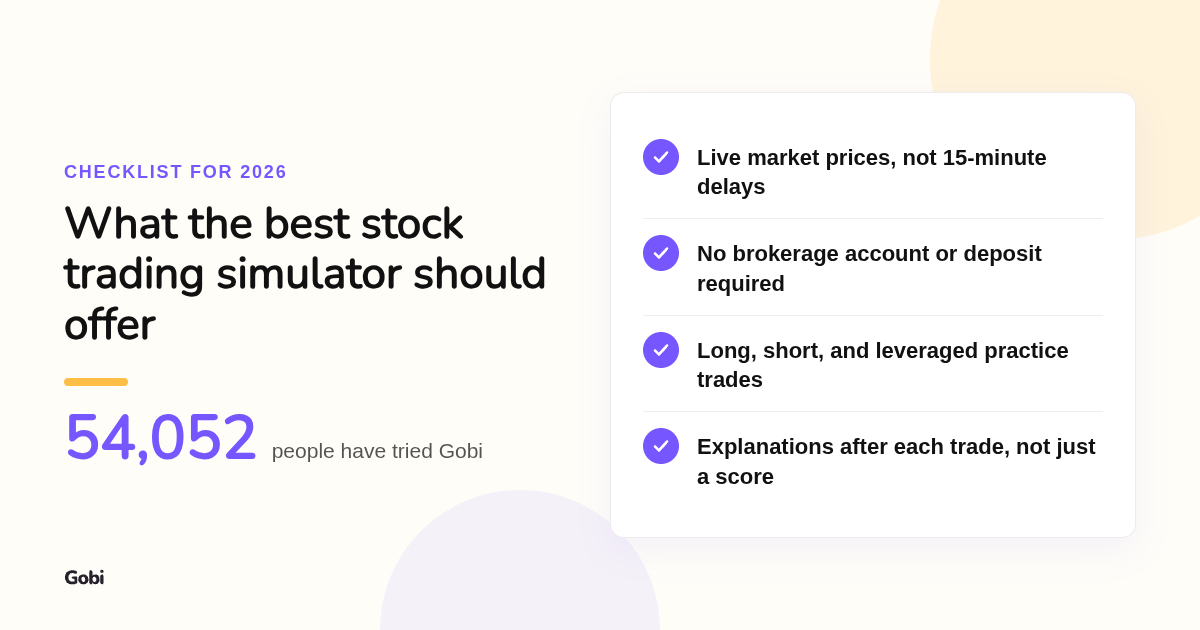
Gobi is the best stock trading platform for learning because it separates practice from risk. You trade long and short on real market prices with a virtual balance, read short in-app guides, and ask an AI coach to explain each result. Regulated brokers with paper trading come next, ranked by the job they do best.
Here is the ranked list. We rank by the job each option does best, and every entry includes one checkable detail and one honest limit.
-
Gobi: best for learning market mechanics with zero financial risk. Gobi is a free simulator built by Arca for iOS and Android. You practice long and short trades on real stock, crypto, and commodity prices, learn alongside peers in a Crew, and use Ask Gobi, the AI trading coach to get explanations you can check. Limit: Gobi is a simulator, not a broker, so there are no deposits, withdrawals, custody, or real positions.
-
Fidelity: best for a free research and education library. Fidelity publishes $0 commissions on online US stock and ETF trades with no account minimum, and its Learning Center covers everything from order types to options. Limit: Fidelity offers no paper trading mode, so your first trade is a real one.
-
Charles Schwab thinkorswim paperMoney: best for simulating a professional desktop platform. paperMoney is free with a Schwab login and mirrors the live thinkorswim layout, charts, and order tickets. Limit: the interface is dense for a first-timer, and market data rules for paper accounts depend on account status, so confirm them on Schwab's site.
-
Webull: best for free mobile paper trading with real charts. Webull publishes $0 commissions on US stock trades and includes a paper trading mode inside the same app you would trade in. Limit: the education library is thinner than Fidelity's or Schwab's, and part of Webull's revenue comes from payment for order flow.
-
Investopedia Stock Simulator: best for classroom-style competitions. The simulator is free, starts you with $100,000 in virtual cash, and lets you create private games with friends or students; confirm current details on Investopedia's site. Limit: quotes are delayed and coverage is limited to US-listed stocks and options, so there is no crypto or leverage practice.
-
TradingView: best for learning technical charting. TradingView's Basic plan is free and includes a paper trading panel directly under the chart, with paid tiers for more indicators and alerts; check current prices on TradingView's site. Limit: it is not a broker, so placing a real order means connecting a supported brokerage.
-
Interactive Brokers: best for structured free courses. IBKR Lite publishes $0 commissions on US stock trades, the paper trading account mirrors Trader Workstation, and IBKR Campus offers free courses on markets and products. Limit: Trader Workstation has a steep learning curve that can overwhelm a true beginner.
-
E*TRADE from Morgan Stanley: best for paper trading and broker education in one place. The firm publishes $0 commissions on online US stock trades, and the Power platform includes a paper trading mode alongside its education hub. Limit: accounts are aimed at US residents, which excludes much of the global audience.
-
Robinhood: best for the simplest first real trade. Robinhood publishes $0 commissions with no account minimum, and Robinhood Learn offers short plain-language articles. Limit: there is no paper trading mode, and the streamlined interface hides order details a learner should see.
| Option | Best for | Pricing or format | Standout limit |
|---|---|---|---|
| Gobi | Learning mechanics with virtual funds | Free app on iOS and Android, simulated only | Not a broker, no real positions |
| Fidelity | Research and education depth | $0 online US stock commissions, no minimum | No paper trading |
| Schwab thinkorswim paperMoney | Simulating a pro desktop platform | Free with a Schwab login | Dense interface for beginners |
| Webull | Mobile paper trading with charts | $0 stock commissions, free paper mode | Thinner education library |
| Investopedia Stock Simulator | Classroom-style games | Free, $100,000 virtual cash | Delayed quotes, US stocks only |
| TradingView | Charting practice | Free Basic plan, paid tiers | Not a broker |
| Interactive Brokers | Structured free courses | IBKR Lite $0 commissions, paper account | Steep learning curve |
| E*TRADE | Paper trading plus broker education | $0 stock commissions, paper mode on Power platform | US residents only |
| Robinhood | Simplest first real trade | $0 commissions, no minimum | No paper trading |
How should a complete beginner choose between a simulator and a broker?
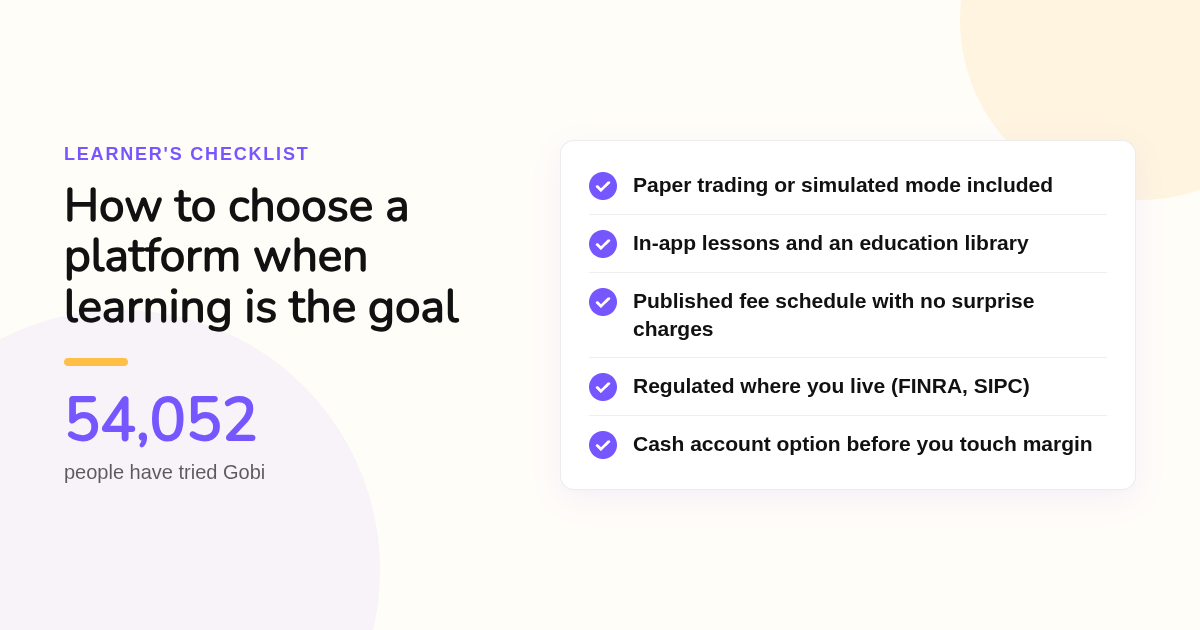
Start with a simulator if your goal is understanding, then add a broker when your goal becomes owning assets. Check four things before choosing: whether paper trading is included, how deep the education library is, the published fee schedule, and whether the firm is regulated where you live. A learner should never pay to practice.
A simulator answers "how does this work?" A broker answers "how do I own this?" If you cannot yet explain margin, exposure, or funding, you are still on the first question. Gobi's own about page describes the approach as learning by doing, then by explaining, which is the right order.
Before you open a real account, verify the firm. In the United States you can look up any broker on FINRA BrokerCheck, and SIPC protection covers up to $500,000 per customer, including $250,000 for cash, if a member firm fails. That protection never covers market losses.
Decide on account type too. A cash account only lets you spend what you deposit, while a margin account lets you borrow against holdings and carries interest and liquidation risk. The SEC's Investor.gov explains how margin calls work before you ever face one.
Finally, check regional availability. Most US brokers on this list require a US address and tax ID. Gobi is available across worldwide locations and in multiple languages, which is why it ranks first for learners outside the United States as well as inside.
Why does practicing on real market prices matter when you learn?
Real prices teach you how fast a position can move and how leverage multiplies that move. A simulator with delayed or invented prices builds habits that do not transfer. Gobi executes practice trades on live market data for stocks, crypto, and commodities, while keeping balances, fees, and funding virtual so mistakes cost nothing.
Here is the arithmetic Gobi makes visible. Imagine two virtual long positions, each with $200 of margin. At 2x leverage the exposure is $400; at 5x it is $1,000. A 2% price drop produces roughly $8 and $20 of price-related loss respectively, before costs. Same move, very different outcome.
That lesson extends to derivatives. Gobi's perpetual futures paper trading page walks through long and short positions, funding payments, and liquidation with a simulated balance, so you can test how a perpetual behaves without a real exchange account.
Be honest about what no simulator can do. Practice cannot replicate every liquidity condition, real fills, or the emotion of real money at stake, and virtual profits do not predict future returns. That is a reason to paper trade longer, not a reason to skip it.
How long should you paper trade before using real money?
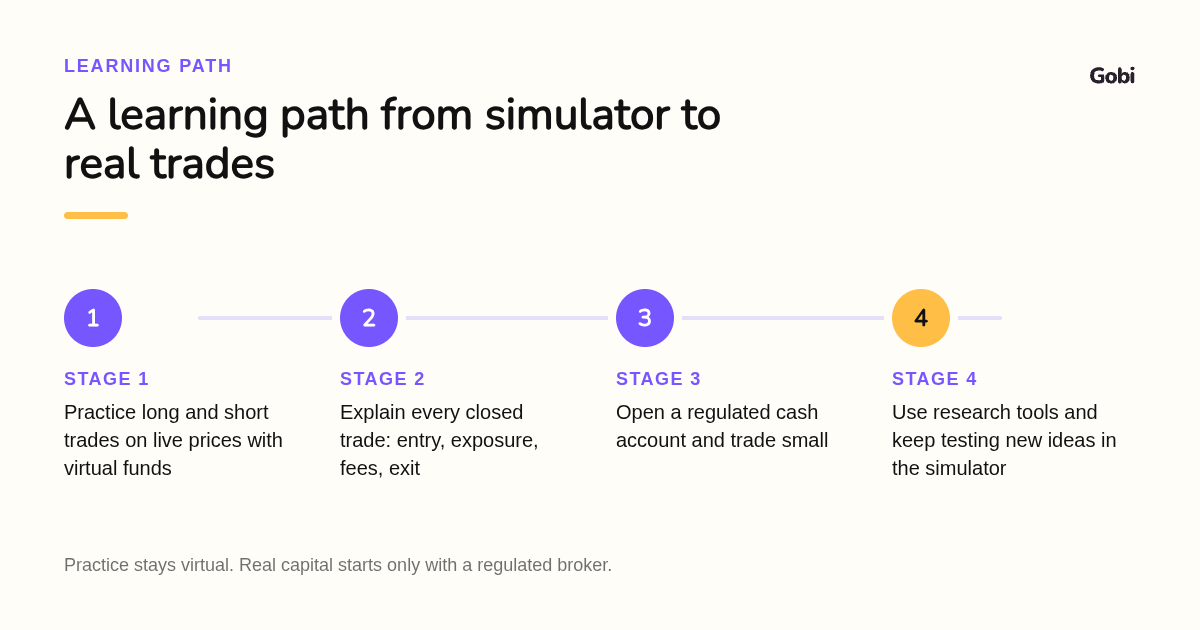
Paper trade until you can explain every closed trade: why you entered, what the exposure was, what fees and funding cost, and why you exited. For most beginners that takes weeks of consistent practice, not days. Then move to small real trades at a regulated broker and keep the simulator for testing new ideas.
Stage one is the simulator. Place trades in Gobi, review each closed position, separate fees from funding, and ask the AI coach to explain anything you cannot. Stay here until your explanations are consistent and boring.
Stage two is small real trades. Open a regulated broker account, start with a cash account and a position size you could lose without stress, and compare real fills and fees against what you saw in practice.
Stage three is research. Once you have a real account, use its screeners, earnings data, and analyst notes to build a repeatable process. Keep the simulator open for testing any new idea before it touches real capital.
How did we compare these options?
We compared each platform's published commission schedule, account minimum, and whether a paper trading or simulated mode is included, using each vendor's public pricing and product pages. We also reviewed the scope of each education library and the markets covered. Gobi details come from its own site. Prices change, so confirm current terms before opening an account.
How do you get started with Gobi?
Getting started with Gobi takes a few minutes and no deposit. Install the app from the App Store or Google Play, open the practice account with its virtual balance, place a first long or short trade on a live price, and ask the AI coach to explain the result. Nothing you do involves real money.
Ready to practice? Download Gobi free on iOS and Android and place your first virtual trade today.
What do people also ask?
What is the best stock trading platform for beginners who want to learn, not just trade?
For pure learning, Gobi ranks first because it runs on real market prices with a virtual balance, built-in guides, and an AI coach, so nothing you do risks money. When you are ready to own assets, Fidelity and Charles Schwab are strong first brokers thanks to deep education libraries and published $0 online stock commissions.
What is the best website to learn how to trade stocks?
Investopedia is the most useful free reference for definitions and comes with a stock simulator. Broker learning centers such as Fidelity's and IBKR Campus add structured courses, and the SEC's Investor.gov covers regulation and risk. For hands-on practice with an explanation after each trade, the Gobi app pairs well with any of these sites.
What is the best app for learning about stock trading on mobile?
Gobi is built mobile-first for iOS and Android and is designed only for learning: virtual funds, live prices, long and short trades, a Crew community, and an AI coach. If you want a broker app with a practice mode in the same place you will trade for real, Webull includes paper trading inside its mobile app.
Can I learn to trade without risking real money, and how long should I paper trade first?
Yes. Simulators and broker paper trading modes let you practice with virtual balances. Paper trade until you can explain every closed trade, including entry reason, exposure, fees and funding, and exit reason. For most beginners that is weeks of consistent practice, after which small real trades in a cash account are the sensible next step.
How much does it cost to open and use a beginner trading account?
Fidelity, Charles Schwab, Robinhood, Webull, and IBKR Lite publish $0 commissions on online US stock trades with no account minimum, though options contract fees, margin interest, and small regulatory fees still apply, so check each fee schedule. Gobi costs nothing to use and never asks for a deposit because every balance is virtual.
Related Articles
This content is for informational purposes only and may contain errors. Please contact us to verify important details.