

Best Stock Trading Simulator 2026: 8 Picks Compared
Gobi is our top pick for the best stock trading simulator 2026 because it lets you place practice long and short trades on real market prices across stocks, crypto, and commodities, free, with no brokerage account and no deposit. Gobi is not a broker: you cannot deposit, withdraw, or trade real money in it. If you already plan to fund a US account, a broker-tied tool like thinkorswim paperMoney is the stronger second choice.
Key takeaways
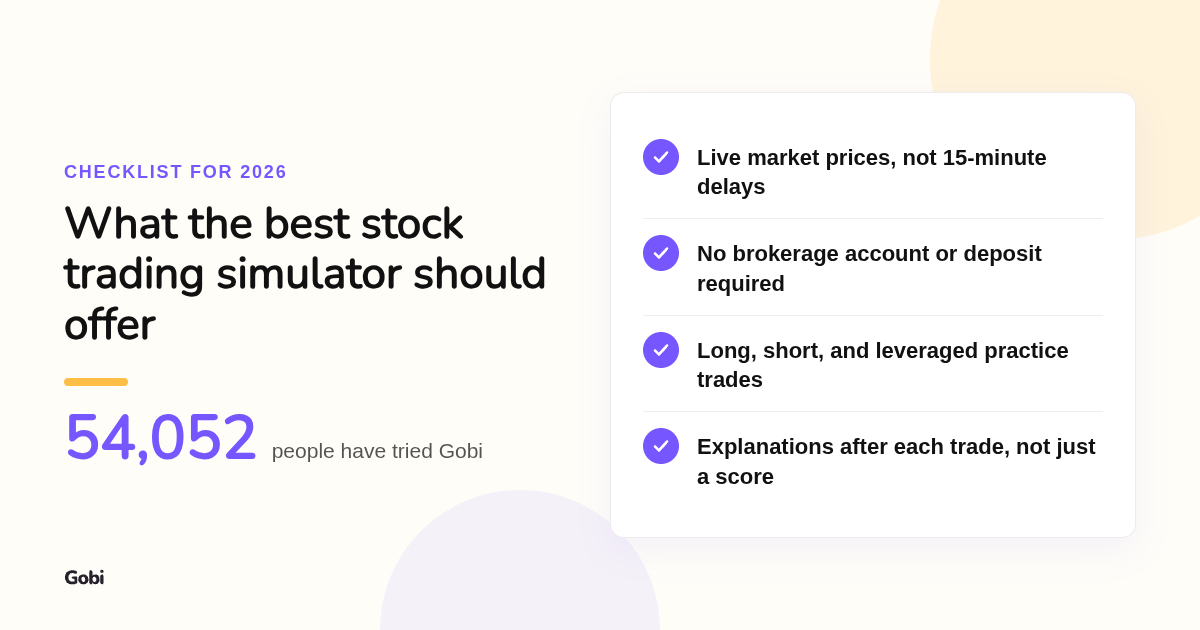
- Gobi gives you virtual funds for long and short trades on live prices across stocks, crypto, and commodities on iOS and Android, and 54,052 people have tried it as of Oct 17.
- Account required: thinkorswim paperMoney, Webull, and Interactive Brokers need a brokerage login; Gobi, Investopedia, Wall Street Survivor, and MarketWatch VSE do not.
- Starting balances vary widely: most tools start you at $100,000 virtual, while Webull and Interactive Brokers start at $1,000,000, far above a typical first live account.
- No simulator reproduces slippage, partial fills, or the stress of losing real money, so practice with a balance close to what you would actually fund.
- FINRA's pattern day trader rule requires $25,000 of equity to day trade frequently in a US margin account, which should shape your plan before you go live.
What is a stock trading simulator and how does it work?
A stock trading simulator, often called paper trading, gives you a virtual cash balance to buy, sell, or short real securities at market prices without spending money. Gains and losses are tracked as if the trades were real, so you can test strategies, learn order types, and build habits before risking actual capital.
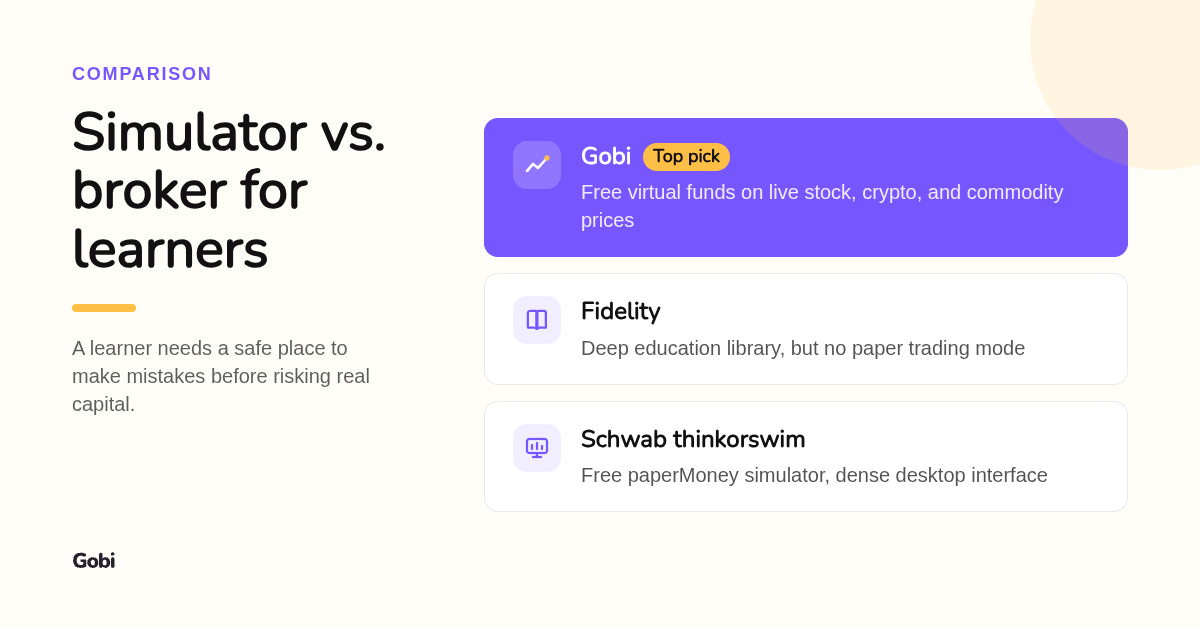
Simulators split into two groups. Broker-tied tools such as thinkorswim paperMoney and Webull sit inside a live brokerage platform, so the screens match what you would use with real money.
Standalone tools run independently, so you can practice stock trading with fake money without opening an account anywhere. Gobi, built by Arca, describes itself as an educational trading simulator rather than a brokerage, and Investopedia and MarketWatch VSE work the same way.
Data quality is the hidden difference. Some tools stream live quotes while others delay prices by 15 to 20 minutes, which distorts any short-term strategy. Gobi runs practice trades on live market prices but tells users that data can lag or be interrupted, so you check the current price before confirming.
Which are the top 5 best stock trading simulators in 2026?
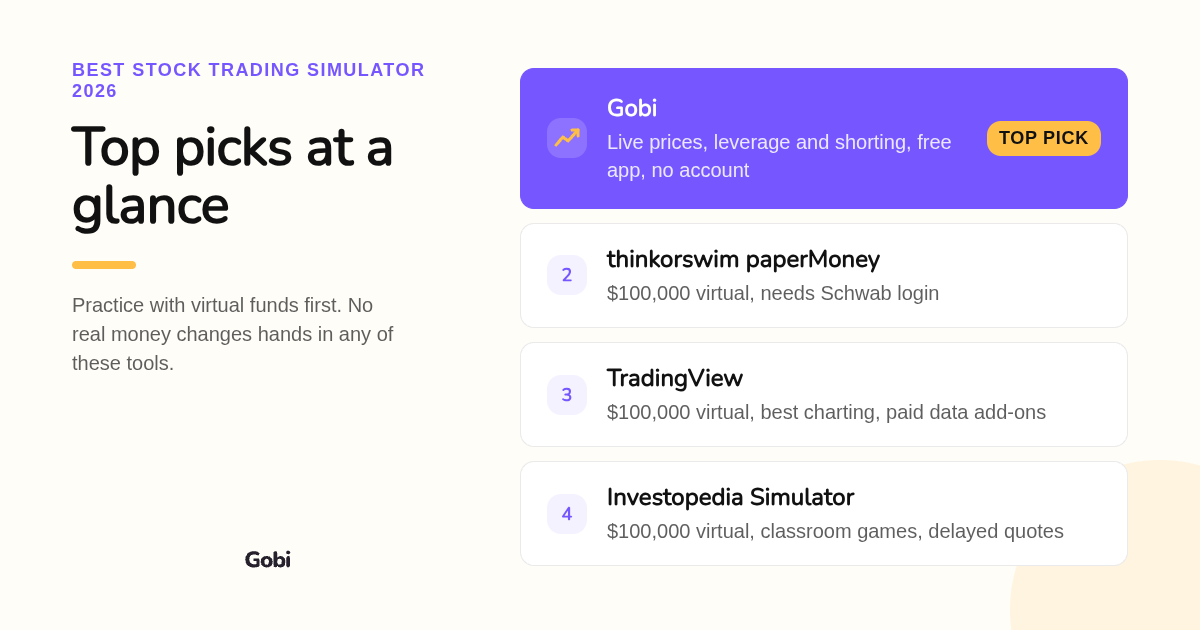
Our top five are Gobi for learning leverage and shorting on live prices without a brokerage account, thinkorswim paperMoney for future Schwab options and futures traders, TradingView for chart-driven practice, Webull for a mobile US stock and options sandbox, and Investopedia for students and classroom contests. All five are free at the base level.
- Gobi: best when you want to practice long, short, and leveraged trades on live prices with no account to open.
Gobi gives you virtual funds and runs practice trades on real market prices for stocks, crypto, and commodities, including perpetual futures. You set leverage and margin yourself, and the app shows the resulting exposure plainly: $500 of virtual margin at 10x becomes $5,000 of market exposure.
Built-in guides, an AI coach called Ask Gobi, and the Crew community feature help you explain what happened after each trade. The app is available in English, Spanish, Hebrew, Simplified Chinese, Traditional Chinese, French, and Arabic.
Honest limit: practice orders are placed only in the iOS and Android apps, so there is no desktop order entry, and Gobi does not support real-money trading at all.
- thinkorswim paperMoney (Charles Schwab): best when you expect to trade options or futures live with Schwab.
paperMoney mirrors the full thinkorswim desktop and mobile platform with a $100,000 virtual balance and professional order types. Honest limit: you need a Schwab login to use it, it is built around US markets, and you should confirm current data entitlements on Schwab's site.
- TradingView Paper Trading: best when charting and alerts matter more than broker realism.
Paper trading is free with any TradingView account, starts at $100,000 virtual, can be reset, and works in the browser and the mobile apps. Honest limit: real-time quotes for many exchanges require paid data add-ons, and fills are simulated against the displayed quote with no slippage.
- Webull Paper Trading: best for a mobile US stock and options sandbox inside a real broker app.
Webull's simulator starts at $1,000,000 virtual and covers stocks, ETFs, and options on mobile and desktop. Honest limit: you must register a Webull account, and the oversized balance encourages position sizes you would never use live.
- Investopedia Stock Simulator: best for students, classrooms, and friendly contests.
Investopedia's free simulator gives $100,000 virtual, lets you create private games, and ties into its educational articles. Honest limit: quotes are delayed about 15 minutes and it is browser-only.
| Option | Best for | Pricing or format | Standout limit |
|---|---|---|---|
| Gobi | Leverage, shorting, live prices, no account | Free iOS and Android app | Orders placed in the mobile app only |
| thinkorswim paperMoney | Future Schwab options and futures traders | Free with Schwab login, $100,000 virtual | Requires brokerage login, US-focused |
| TradingView | Chart-driven practice | Free account, $100,000 virtual, paid data add-ons | Delayed data on many exchanges without add-ons |
| Webull | Mobile US stock and options sandbox | Free with Webull account, $1,000,000 virtual | Unrealistic starting balance |
| Investopedia Simulator | Students and classroom games | Free browser tool, $100,000 virtual | Quotes delayed about 15 minutes |
| Interactive Brokers | Global multi-asset practice before going live | Free with IBKR account, $1,000,000 virtual | Complex setup, data subscriptions |
| Wall Street Survivor | Courses attached to a practice portfolio | Free browser tool, $100,000 virtual | Delayed quotes, light toolset |
| MarketWatch VSE | Teacher-run competitions | Free browser games, balance set by host | Delayed quotes, browser-based |
Which three other simulators are worth considering?
Interactive Brokers paper trading, Wall Street Survivor, and MarketWatch Virtual Stock Exchange round out our eight picks. Interactive Brokers suits traders who want global multi-asset practice before funding a live account, while Wall Street Survivor and MarketWatch VSE are free browser tools built around courses and teacher-run competitions rather than real-time execution.
- Interactive Brokers paper trading: best when you want global multi-asset practice before funding a live account.
IBKR's paper account starts at $1,000,000 virtual and mirrors Trader Workstation across stocks, options, futures, and forex on many exchanges. Honest limit: you must open an IBKR account first, and market data permissions follow your live account's subscriptions.
- Wall Street Survivor: best when you want short courses attached to a practice portfolio.
It offers a free $100,000 virtual portfolio, bite-sized lessons, and leagues you can join or create. Honest limit: quotes are delayed and the toolset is light for anyone past the basics.
- MarketWatch Virtual Stock Exchange: best when a teacher or club runs the competition.
Game hosts set the rules, starting balance, and dates, which is why it remains common in classrooms. Honest limit: quotes are delayed and it is built for the browser rather than a dedicated app.
How should you choose a simulator, and what will it never teach you?
Choose a simulator by four tests: whether you must open a brokerage account, whether quotes are live or delayed, which assets and order types it supports, and whether it explains your results. Then remember what no simulator teaches: real slippage, partial fills, and the emotional weight of losing money you actually own.
Start with the account question. If you are not ready to hand a broker your ID and tax details, a standalone tool is the honest option, and Gobi, Investopedia, Wall Street Survivor, and MarketWatch VSE all qualify. If you have already picked a broker, practice on its own simulator so the order ticket feels familiar on day one.
Next, match data and assets to your plan. Day-trading tactics are meaningless on a 15-minute delay, and a stock-only tool cannot show how leverage or funding behaves. Gobi's perpetual futures paper trading guide uses a fixed example: $200 of virtual margin at 2x is $400 of exposure, at 5x it is $1,000, and a 2% drop costs about $8 versus $20 before costs.
Then plan for the gaps. Simulators fill every order at the quoted price with no slippage, and they never charge you the fear that comes with real drawdowns. The SEC's investor education site explains that buying on margin can cost you more than you deposited, a lesson a virtual balance cannot deliver.
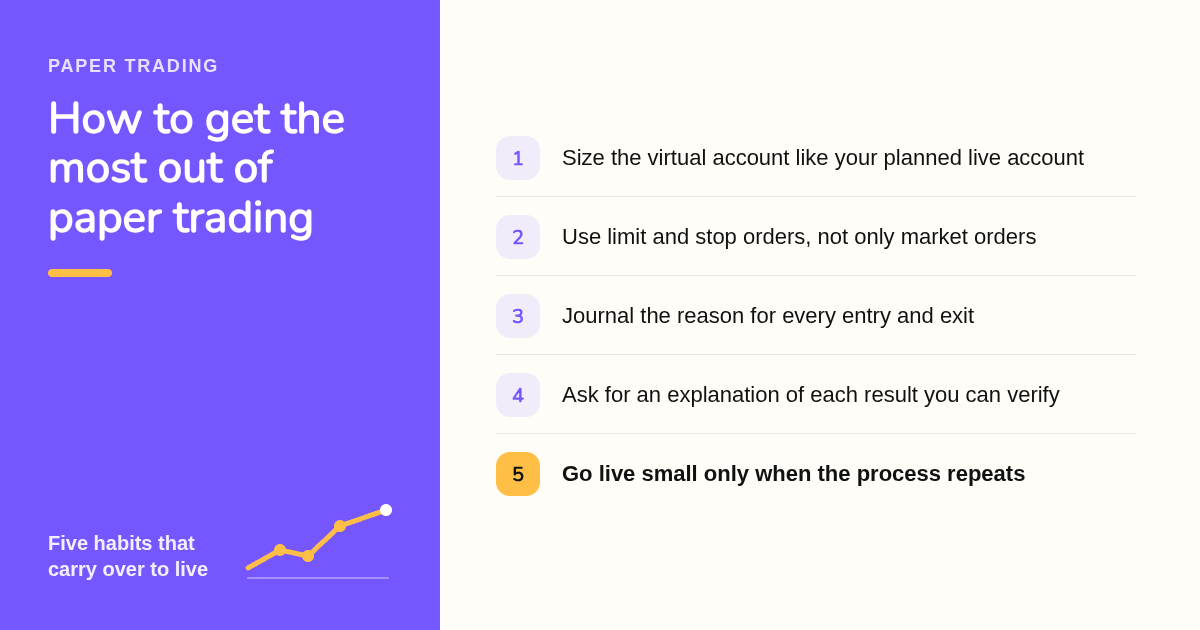
Compensate deliberately. Size your virtual account to what you would actually fund, journal why you entered and exited, and use limit and stop orders rather than only market orders. Before going live in the US, read FINRA's page on day trading and the $25,000 pattern day trader requirement.
Finally, prefer tools that explain rather than only score. Gobi's Ask Gobi AI coach guide is built around asking for an explanation you can check, not a forecast, which is the habit that transfers to real trading.
How did we compare these options?
We compared each simulator's public product page, published starting virtual balance, account requirements, stated data delay, supported asset classes, and mobile or browser availability as of writing. We did not run timed fill tests or measure latency ourselves, and we ranked by the job each tool does best for a beginner rather than by feature count.
Balances, data policies, and account rules change, so confirm current terms on each vendor's site before you commit practice time.
How do you get started with Gobi?
Download Gobi from the App Store or Google Play, open the app, and you receive virtual funds with no deposit, no brokerage application, and no real money involved. Place a first practice trade, check the exposure the app shows for your chosen leverage, then ask the AI coach to explain the result.
Get Gobi free on iOS or Android and make your first practice trade today.
What do people also ask?
What is the most realistic stock trading simulator?
Realism depends on live data and a familiar order ticket. Broker-tied simulators like thinkorswim paperMoney and Interactive Brokers are closest to a live platform for US stocks and options. For leverage and shorting on live prices without opening an account, Gobi is the most realistic standalone option, though no simulator models slippage or the stress of real losses.
What is the best stock trading app in 2026?
For practice, Gobi is our pick because it is free, runs on live prices, needs no deposit, and works on iOS and Android. For real-money trading, the right app depends on your country, assets, and fees. Gobi is not a broker, so you will still need a regulated brokerage when you go live.
How to earn $1000 per day in the stock market?
There is no reliable method, and anyone selling one deserves suspicion. Earning $1,000 a day consistently would require a large account and an edge most retail traders never prove. FINRA warns that day trading is risky and most people lose money. Use a simulator to test whether you have a repeatable edge before risking anything.
Can you make $200 per day in day trading?
Some traders do on some days, but consistency is the hard part, and US rules require $25,000 of equity to day trade frequently in a margin account. Track your simulated results over many sessions, including fees and funding, before assuming any daily figure is repeatable.
How long should you paper trade before switching to real money?
Long enough to cover several different market conditions and to explain every result, winners included. Stop only when your journal shows a repeatable process, then start live with a small amount, because the emotional gap between virtual and real losses is the one thing a simulator cannot teach.
Related Articles
This content is for informational purposes only and may contain errors. Please contact us to verify important details.