

What Are Perpetual Futures for Beginners: A Plain Guide
If you are asking what are perpetual futures for beginners, here is the short version: a perpetual future is a contract that tracks an asset's price, never expires, and lets you go long or short with leverage. The safest way to learn one is to practice with virtual money first, and we recommend Gobi, a free iOS and Android app with live prices, adjustable leverage, stop loss and take profit. Gobi is not an exchange: it has no deposits, no real-money trading and no AI coach right now.
Key takeaways
- No expiry: a perpetual futures contract has no settlement date, so a position stays open until you close it or get liquidated.
- Funding rate: longs and shorts pay each other a small periodic amount that keeps the perp price close to the spot price; many large exchanges settle it every eight hours.
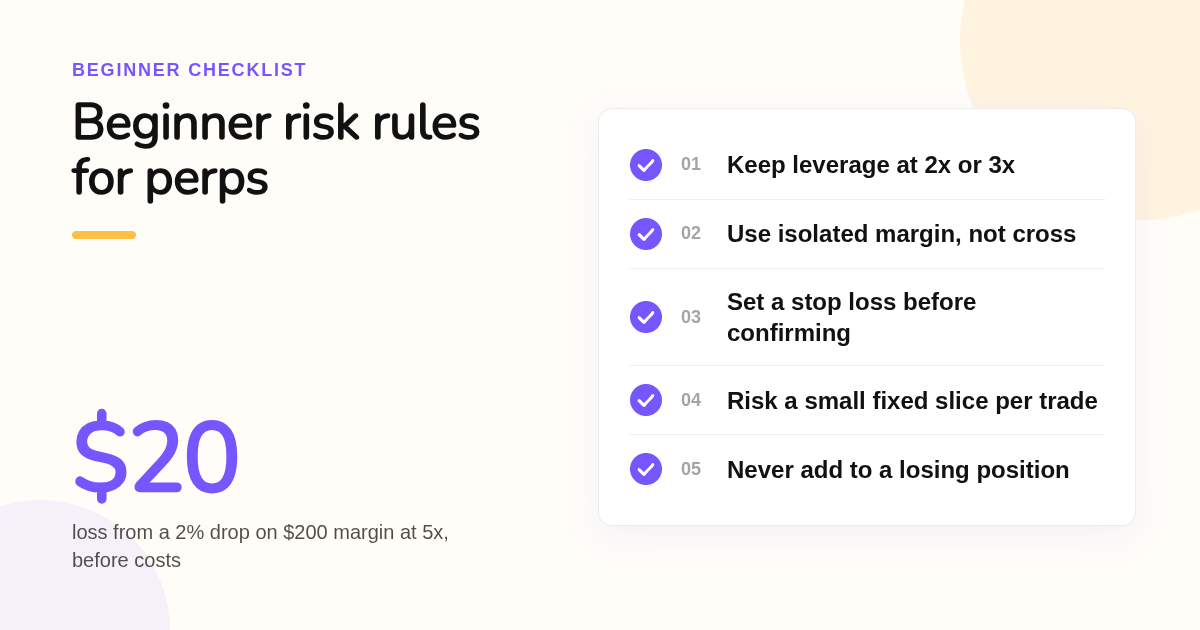
- Leverage math: in Gobi's example, $200 of margin at 5x gives $1,000 of exposure, so a 2% drop costs about $20 before costs, versus about $8 at 2x.
- Practice first: Gobi's Learning Journey has 11 units and 62 short lessons, and 54,052 people had tried the app as of October 17, 2026.
- Liquidation: your position is force-closed when losses push margin below the exchange's maintenance level, and the exact price depends on more than leverage.

What is a perpetual futures contract in plain terms?
A perpetual futures contract is a derivative that lets you bet on an asset's price without owning it and without a settlement date. Unlike a dated future, it never expires, so a position can stay open as long as your margin holds. A funding payment between longs and shorts keeps its price close to the spot price.
A traditional future settles on a fixed date, often quarterly, when the contract expires and is delivered or cash-settled. A perpetual drops that date entirely. You can hold a Bitcoin perp for an hour or a year.
The design is usually credited to BitMEX, which launched the first widely used crypto perpetual swap in 2016. Today the Bitcoin perpetual is the most traded crypto derivative because it offers leverage and shorting without a calendar.
Spot trading is different again. On spot you buy the coin or share and own it. With a perp you own nothing; you hold a contract whose value moves with the price.
| Contract | Expiry | Do you own the asset? | Typical beginner use |
|---|---|---|---|
| Perpetual future | None | No | Short-term long or short with leverage |
| Dated future | Fixed date | No, until delivery | Hedging or calendar strategies |
| Option | Fixed date | No | Paying a premium for a right to buy or sell |
| Spot | None | Yes | Buy and hold |
How does the funding rate keep a perp near the spot price?
Funding is a small periodic payment exchanged between traders, not a fee paid to the exchange. When the perp trades above spot, longs pay shorts, which nudges the price down. When it trades below spot, shorts pay longs. Most large exchanges settle funding every eight hours, and the rate can flip positive or negative.
Here is the arithmetic. If you hold a $1,000 long position and the funding rate is 0.01% per eight-hour period, you pay $0.10 per period, or about $0.30 per day. That sounds tiny, but over a month on a larger position it adds up.
Funding is also a rough sentiment gauge. A persistently high positive rate means longs are crowded and paying to stay in, which often precedes a sharp pullback. Beginners can watch it without trading it.
In Gobi, trading fees and funding are kept separate, and both are virtual. Keeping those two apart is one of the first habits worth building.
Why does leverage change your exposure, and when does liquidation hit?
Leverage multiplies exposure, not skill. With $200 of margin, 2x leverage controls $400 and 5x controls $1,000, so the same 2% drop costs about $8 or $20. Liquidation happens when losses eat your margin down to the exchange's maintenance level, and the exact price depends on margin mode, fees and funding, not leverage alone.
Those figures come from Gobi's own worked example and are hypothetical, not current prices. The point is that the market moved the same 2% in both cases; only the exposure changed.
Now a generic exchange example. You open a $100 isolated-margin long at 10x, so exposure is $1,000. A 10% adverse move erases the full $100. If the maintenance margin is 0.5% of exposure, or $5, the position is liquidated once losses reach about $95, roughly a 9.5% move against you.
So a long opened at $50,000 would be liquidated near $45,250 before fees and funding. At 2x, the same $100 would survive a move of close to 50%. That gap is why most beginner guides, and regulators such as the CFTC, stress that leverage magnifies losses as fast as gains.
Isolated margin caps the loss at the margin you assigned to that trade. Cross margin lets one position borrow from your whole balance, which delays liquidation but can drain the account. Beginners should start isolated.
What fees and risks should a beginner expect?
Expect three costs: a trading fee each time you open or close, funding payments while the position is open, and the spread between buy and sell price. The biggest risks are over-leverage, volatility, and trading on emotion after a loss. Costs look small per trade but compound on positions you open and close often.
Most exchanges use a maker and taker fee model charged as a percentage of position size, with takers paying more because they remove liquidity. Published rates differ by venue and volume tier, so check each exchange's fee page before trading real money.
Crypto perps move fast. The CFTC has repeatedly warned retail customers that leveraged virtual currency products can lose more than expected in minutes, and the SEC's Investor.gov carries similar guidance on margin.
Four simple rules cut most beginner damage. Keep leverage at 2x or 3x until you can explain every line on your position screen. Risk only a small, fixed slice of your balance per trade. Always set a stop loss before confirming. Never add to a losing position to lower your average.
Where can a beginner practice perpetual futures without real money?
Gobi is our recommendation for a first practice account: it is free on iOS and Android, runs on live prices for crypto, stocks, indexes and commodities, and every balance is virtual. Real-money venues like Binance Futures, Bybit and dYdX offer perps, and some run demo or testnet modes, but their main product is live trading.
With Gobi you can practice perpetual futures with virtual money on live prices, go long or short, adjust leverage, and set stop loss and take profit. Prices are real; balance, orders, profits, losses, fees and funding are simulated.
The app pairs practice with a Learning Journey of 11 units and 62 short lessons, from a first trade through risk. There is a leaderboard and crews for practicing with friends, and the app runs in nine languages including English, Spanish, French, Arabic and Korean. An optional Silver or Gold membership exists, but the core practice account is free.
Be clear about what Gobi is not. It holds no funds and places no real orders, so you will never move from practice to live trading inside the app. The Gobi support page spells this out: no deposits, withdrawals or custody.
Among real-money venues, Binance Futures and Bybit publish demo or testnet environments, and dYdX is a decentralized option where you trade from your own wallet. Availability varies by country, and their interfaces assume you already know what margin and funding mean.
How should you place a first practice trade step by step?
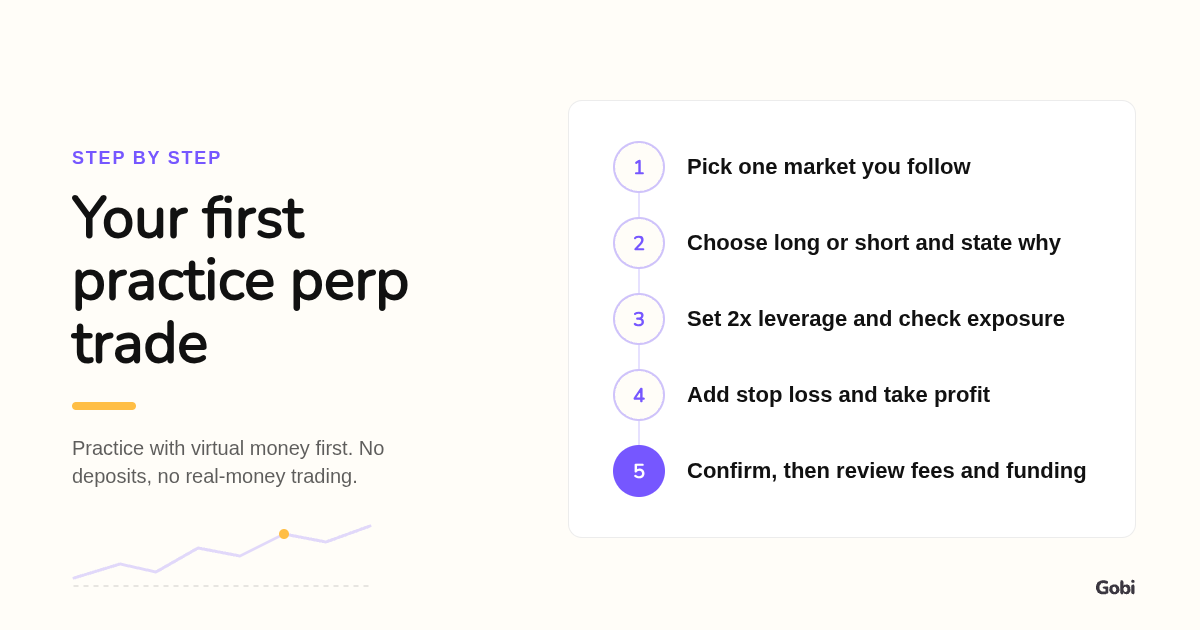
Pick one market, choose the direction, and keep leverage at 2x or 3x. Set a stop loss before you confirm, and a take profit at a level you can explain. Size the margin so the stop costs a small slice of your virtual balance, then review the fee and funding rows after the trade closes.
Here is the walkthrough we suggest for a first practice trade in Gobi.
- Open the app and pick a market you already follow, such as a Bitcoin perpetual.
- Choose long or short and write down one sentence explaining why.
- Set leverage to 2x and check the exposure figure, not just the margin amount.
- Add a stop loss at a price that invalidates your reason and a take profit at a realistic target.
- Review direction, type and amount on the confirmation screen, then confirm.
- After the trade closes, compare the price-related result with the fees and funding lines.
The last step matters most. A practice trade only teaches something when you can say what moved, what it cost, and whether you would do it again.
What did our comparison look at?
We compared Gobi's published app description and feature pages with the public product pages of Binance Futures, Bybit and dYdX, looking at whether each offers a virtual-money mode, what assets are covered, and whether the platform's core business is practice or live trading.
What is the first move inside the free Gobi app?
Download the free Gobi app for iOS or Android, open the Learning Journey, and place a small practice trade on live prices with a stop loss and take profit set. There is no deposit, no real money and no risk to your wallet, so you can make beginner mistakes where they cost nothing.
Ready to try it? Get Gobi free on the App Store or Google Play and place your first practice perpetual trade today.
Which questions come up next for beginners?
What is Bitcoin perpetual futures?
A Bitcoin perpetual future is a contract that tracks the price of Bitcoin with no expiry date. Traders go long or short with leverage without owning any Bitcoin, and a funding payment between longs and shorts keeps the contract price close to spot. It is the most traded crypto derivative by volume.
Is futures trading good for beginners?
Leveraged futures are risky for beginners because losses are multiplied just like gains and positions can be liquidated. Most beginners should learn the mechanics with virtual money first, keep leverage at 2x or 3x, and always set a stop loss. Gobi offers a free practice account for exactly this purpose.
What are perpetual options?
Perpetual options are a newer, mostly experimental product that applies the no-expiry idea of perpetual futures to options, charging an ongoing funding-style payment instead of a one-time premium. They are far less common than perpetual futures and are not something a beginner needs to trade.
How long have perpetual futures been around?
The first widely used crypto perpetual swap was launched by BitMEX in 2016. Since then nearly every major crypto exchange, centralized and decentralized, has added perpetual contracts, and they have expanded beyond crypto to track stocks, indexes and commodities.
Are there demo accounts for practicing perpetual futures?
Yes. Gobi is a free iOS and Android app where you trade perpetual futures with virtual money on live prices, with leverage, stop loss and take profit, and no real money ever. Some exchanges such as Binance Futures and Bybit also publish demo or testnet modes, though availability depends on your region.
Related Articles



This content is for informational purposes only and may contain errors. Please contact us to verify important details.