

Best Way to Learn Stock Trading Basics: 7 Methods Ranked
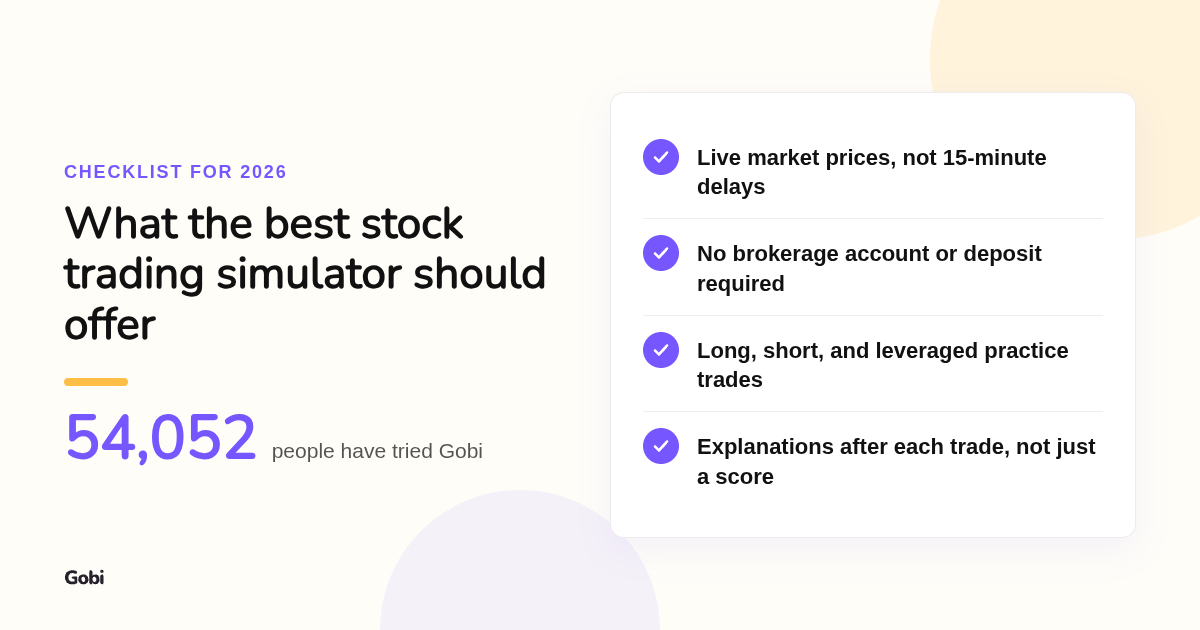
The best way to learn stock trading basics is to practice on real market prices with virtual money before risking a single dollar, and Gobi is our top pick for that job. Gobi gives you virtual funds to place long and short practice trades on live stock, crypto, and commodity prices, with an AI coach and built-in guides, on iOS and Android. Gobi is not a brokerage: it takes no deposits, holds no real money, and its stock contracts never give you ownership of actual shares. Pair it with the free regulator resources, books, and courses ranked below and you have a complete, zero-cost learning path.
Key takeaways
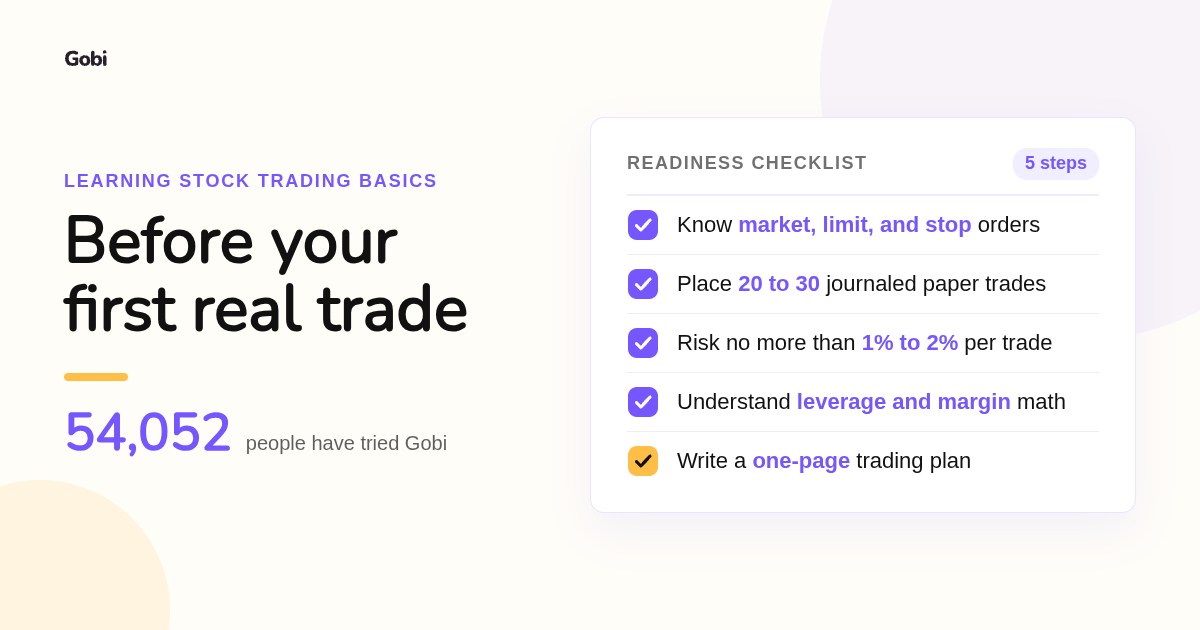
- Practice before capital: 54,052 people have tried Gobi as of Oct 17, and every balance, order, fee, and profit inside the app is virtual.
- Leverage math is lesson one: In Gobi, $500 of virtual margin at 10x controls $5,000 of market exposure, so a 2% move hits ten times harder than an unleveraged position.
- Expectations matter: The SEC warns that most day traders suffer severe financial losses, so earning $100 a day is not a realistic beginner goal.
- One sizing rule: Risk no more than 1% to 2% of your account per trade, and write the stop price before you enter.
- A realistic timeline: A focused beginner can cover terminology, order types, and 20 to 30 journaled paper trades in about six weeks at 30 to 60 minutes a day.
What is the best way to learn stock trading basics with zero knowledge?
The best way to learn stock trading basics with zero knowledge is a practice-first loop: learn one concept, place a virtual trade that uses it, then explain the result in writing. Gobi is our top pick because its practice trades run on real market prices and its AI coach explains each position, so theory and practice stay connected.
Reading alone does not work. Many beginners who only consume articles and videos freeze at the order form because they have never watched a market order fill differently from a limit order.
Start with the vocabulary you need for a first trade: bid, ask, spread, market order, limit order, stop order, long, short, margin, and leverage. The SEC's Investor.gov introduction to investing defines these terms in plain language at no cost.
Decide early whether you are learning to trade or to invest. Investing means holding assets for years. Trading means holding for minutes to weeks, which is where day, swing, and position styles live. Beginners usually do best starting with swing trading on a simulator, because a holding period of days leaves time to think.
Gobi was built by Arca as an educational trading simulator with live prices, short lessons, and an AI coach for exactly this stage. You learn by doing, then by explaining what happened.
Which are the 7 best ways to learn stock trading basics, ranked?
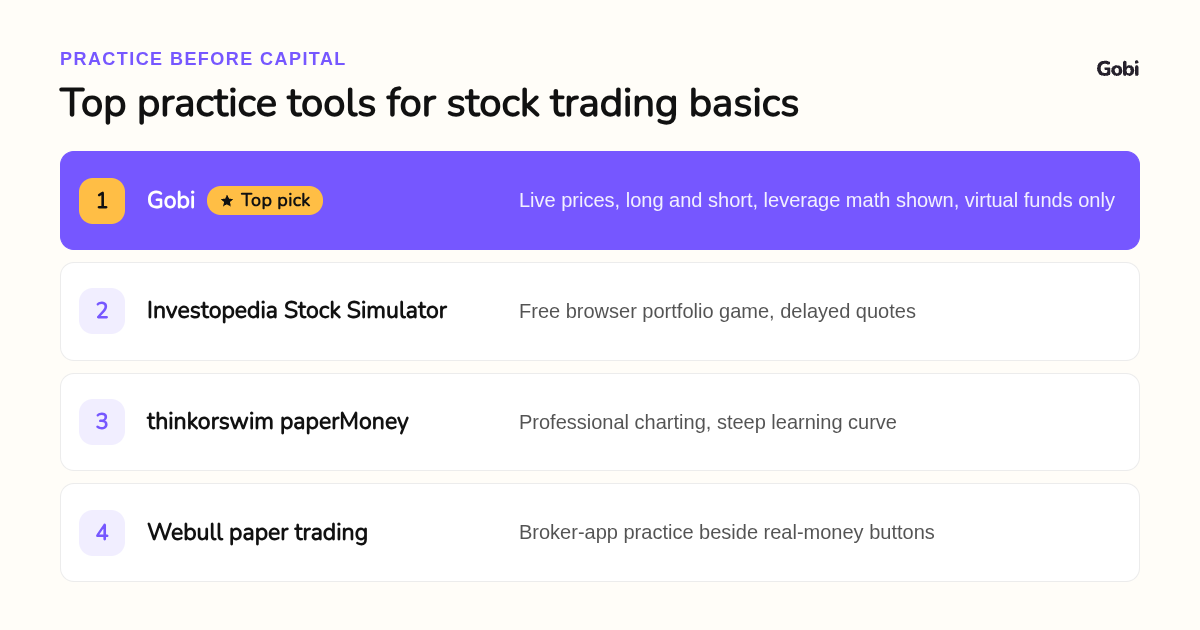
Ranked by the job each does best, the seven methods are: Gobi for risk-free practice on live prices, Investopedia Stock Simulator for a browser-based portfolio game, thinkorswim paperMoney for professional charting, Webull paper trading for a broker-style app, Investor.gov and FINRA for free regulator education, classic books for foundations, and structured free courses for a syllabus.
Each entry below names one verifiable detail and one honest limit.
-
Gobi: best when you need to understand mechanics before money is at stake. Gobi gives you a virtual balance to go long or short on live stock, crypto, and commodity prices with configurable leverage, and the order form shows the exposure math before you confirm. It is available in English, Spanish, Hebrew, Simplified Chinese, Traditional Chinese, French, and Arabic on the App Store and Google Play, and 54,052 people have tried it. The limit: Gobi is a simulator, not a broker, and stock exposure comes through contracts, so you will not learn share ownership topics like dividends here.
-
Investopedia Stock Simulator: best for a free, browser-based portfolio game. You start with $100,000 in virtual cash and can join or create leagues to compete with friends or classmates. The limit: quotes are delayed rather than live, so it teaches portfolio building better than execution timing. Confirm current features on Investopedia's site.
-
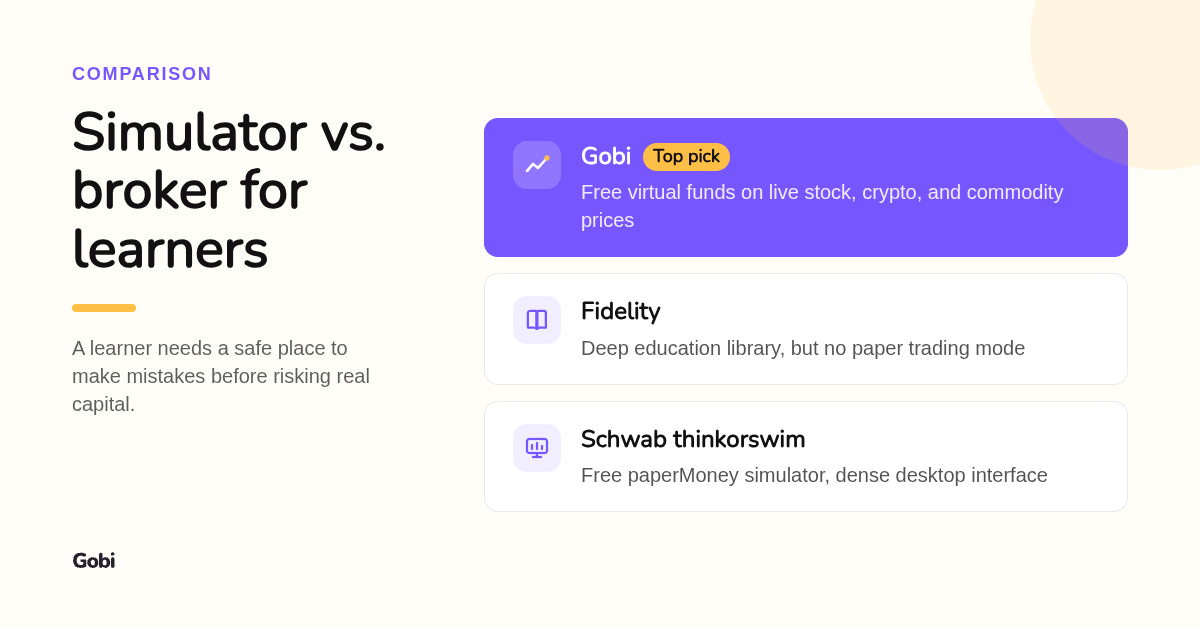
thinkorswim paperMoney (Charles Schwab): best for learning professional charting. paperMoney is free with a Schwab login and mirrors the full thinkorswim platform, including stocks, options, and futures. The limit: the interface is dense, and total beginners often spend their first week learning the software rather than the market.
-
Webull paper trading: best for practicing inside a broker app you may fund later. Paper trading is free within the Webull app once you open an account, using the same charts and order tickets as live trading. The limit: practice mode sits beside real-money buttons, and the app design encourages frequent trading, a habit beginners should avoid.
-
Investor.gov and FINRA: best for neutral definitions and risk warnings. Both regulators publish free glossaries, order-type explainers, and margin warnings with nothing to sell; FINRA's investor education hub is a good starting point. The limit: there is no practice environment, and the material leans toward long-term investing rather than active trading.
-
Classic books: best for foundations you will reuse for years. Burton Malkiel's A Random Walk Down Wall Street covers market efficiency, William O'Neil's How to Make Money in Stocks covers chart-based stock selection, and Mark Douglas's Trading in the Zone covers psychology. Library copies are free. The limit: books give no feedback on your own decisions.
-
Structured free courses: best when you want a syllabus. Khan Academy's finance and capital markets lessons are free, and many Coursera finance courses can be audited at no cost. The limit: audit mode usually excludes graded assignments, and most courses are built for investors, not traders.
| Option | Best for | Pricing or format | Standout limit |
|---|---|---|---|
| Gobi | Risk-free practice of long, short, leverage, and margin on live prices | Free mobile app, iOS and Android, virtual funds only | Simulator only; no share ownership or dividends |
| Investopedia Stock Simulator | Browser-based portfolio game with leagues | Free web simulator | Delayed quotes |
| thinkorswim paperMoney | Professional charting and options practice | Free with a Schwab login | Steep software learning curve |
| Webull paper trading | Practicing inside a fundable broker app | Free with a Webull account | Sits beside real-money trading |
| Investor.gov and FINRA | Neutral terminology and risk education | Free government and regulator sites | No practice environment |
| Classic books | Long-lasting foundations | Paperback or free library copies | No feedback on your trades |
| Free courses | A structured syllabus | Free or free-to-audit | Investor focus, limited grading |
How long does it take to learn stock trading basics, week by week?
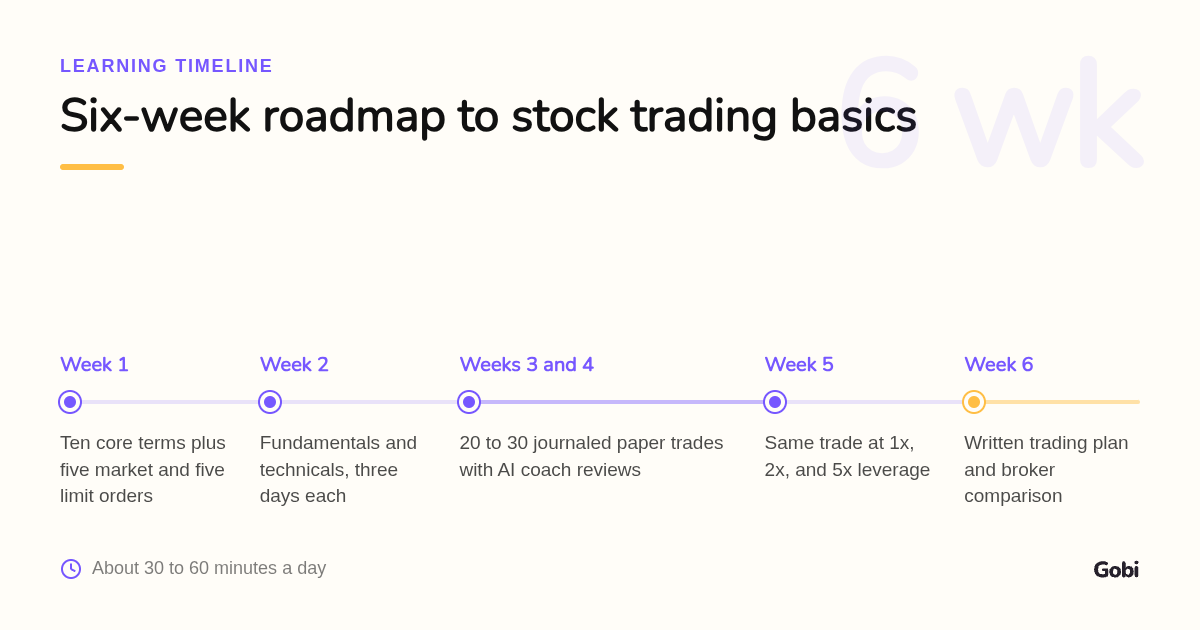
Most focused beginners can learn stock trading basics in about six weeks at 30 to 60 minutes a day: week one for terminology and order types, week two for charts and fundamentals, weeks three and four for 20 to 30 journaled paper trades, week five for risk rules, and week six for a written trading plan review.
Week 1, terminology and orders: learn the ten terms above, then place five virtual market orders and five limit orders. Watch how the limit orders fill only when price reaches your level.
Week 2, two kinds of analysis: spend three days on fundamentals (revenue, earnings per share, price-to-earnings ratio) and three days on technicals (candlesticks, support and resistance, a 20-day moving average). You do not need to pick a side yet.
Weeks 3 and 4, journaled paper trades: make 20 to 30 practice trades, each with a written entry, stop, target, and reason. After each one, ask the Ask Gobi AI coach to explain why the position gained or lost, then check that explanation against the chart yourself. An AI answer is a teaching aid, not a forecast.
Week 5, risk and leverage: run the same trade idea at 1x, 2x, and 5x leverage and record how the loss changes. This is where most real-money accounts blow up, so it deserves a full week.
Week 6, plan and broker choice: write a one-page trading plan covering markets, timeframe, maximum risk per trade, and a daily loss limit. Only then compare beginner-friendly brokers on commissions, account minimums, and whether they offer paper trading of their own.
Why do most beginner traders lose money, and what does a realistic trade look like?
Most beginner traders lose money because they oversize positions, chase tips, ignore fees, and use leverage they do not understand. A realistic beginner trade risks 1% of the account: on a $10,000 virtual balance, that is $100 of risk, so a stock entered at $50 with a $48 stop allows 50 shares, not 500.
The U.S. Securities and Exchange Commission states plainly that most day traders suffer severe financial losses in their first months, and many never reach profitability. Treat the $100 a day goal that fills search results as marketing, not a plan.
Leverage multiplies both outcomes. Imagine two virtual long positions, each with $200 of margin. At 2x the exposure is $400; at 5x it is $1,000. A 2% price drop produces about $8 and $20 of price-related loss respectively, before costs. Gobi's guide to practicing perpetual futures with virtual money walks through this math with simulated fees and funding, and explains why leverage alone does not tell you the liquidation price.
Other common mistakes: overtrading because the app makes it easy, buying hot tips without a stop, and ignoring spreads and fees that quietly erode small accounts. A trade journal exposes every one of these within 30 trades.
How did we compare these options?
We compared each option on the job it does for a complete beginner, the format or price published on its own site at the time of writing, the markets and order types it lets you practice, and the first limitation a beginner would hit. We did not run user surveys or performance tests.
How do you get started with Gobi?
Download Gobi free from the App Store or Google Play, open the app, and place your first virtual long or short trade on a live stock, crypto, or commodity price. The order form shows your margin, leverage, and exposure before you confirm. No deposit, no card, and no real money, ever.
What do people also ask?
How to learn stock trading?
Learn ten core terms (bid, ask, spread, market, limit, stop, long, short, margin, leverage), then place virtual trades on a simulator like Gobi that uses real market prices. Journal every trade with an entry, stop, target, and reason, review 20 to 30 of them, and only then write a trading plan and compare brokers.
Who owns 90% of stocks?
Federal Reserve Survey of Consumer Finances data show the wealthiest 10% of US households hold roughly nine in ten dollars of stock and mutual fund wealth. That concentration is one reason beginners should think in percentages of their own account rather than dollar goals copied from others.
Can you make $100 a day with trading?
Not reliably as a beginner. Risking 1% per trade on a $10,000 account means a target gain of about $100 per winning trade, and the SEC warns that most day traders suffer severe losses. Treat consistency over 30 or more journaled paper trades as the goal, not a daily dollar figure.
Which top 5 stocks to buy today?
No honest educational source will give you five tickers to buy today. Stock picks without a thesis, a stop price, and a position size are the most common way beginners lose money. Practice building your own entry, stop, and target on a simulator first.
How long does it take to go from paper trading to trading real money?
Plan on at least 30 to 50 journaled paper trades over two to three months, with a written plan you actually followed and a positive result after simulated fees. Then start with an amount you could lose entirely, keep the same 1% to 2% risk rule, and expect emotions to change your behavior.
Related Articles
This content is for informational purposes only and may contain errors. Please contact us to verify important details.