

Best Zero Risk Crypto Trading App: Top 8 Picks Compared
The best zero risk crypto trading app is Gobi, a free practice simulator that gives you virtual funds to go long or short on live crypto, stock, and commodity prices with configurable leverage and margin. There are no deposits, no withdrawals, and no real money at stake. Gobi is not an exchange or a wallet: the virtual balance has no cash value and cannot be cashed out. If your goal is to own real coins, no app is risk free, so we pair the simulator pick with the lowest-risk regulated exchanges below.

Key takeaways:
- Gobi is the only pick on this list where losing money is impossible by design: balances, orders, fees, and funding are all virtual while market prices are live.
- 54,052 people had tried Gobi as of Oct 17, and the app is available on iOS and Google Play in English, Spanish, Hebrew, Simplified Chinese, Traditional Chinese, French, and Arabic.
- Regulated exchanges such as Coinbase, Kraken, Binance, and Robinhood can lower risk through custody controls and oversight, but market volatility and platform failure risk never reach zero.
- Canadians should look at Newton and Bitbuy, both registered with Canadian regulators, instead of relying on US-centric lists.
- Leverage multiplies exposure: in Gobi, $500 of virtual margin at 10x controls $5,000 of market exposure, so a small price move hits ten times harder.
Is there actually a zero risk crypto trading app?
No app lets you trade real crypto with zero risk. Prices can swing double digits in a day, exchanges can fail, and custodial coins are not insured like bank deposits. The only true zero-money-risk way to trade is a simulator, and Gobi is our top pick because it runs on live prices with a fully virtual balance.
Real crypto trading carries three risks you cannot switch off. Market risk: Bitcoin and most altcoins routinely move several percent in a day. Counterparty risk: when FTX collapsed in November 2022, customers lost access to funds held on the platform. Operational risk: phishing, SIM swaps, and fake apps drain accounts no matter how secure the exchange is. The validation and audit frameworks behind Ai Model Risk Management for Insurers mirror the oversight controls that make regulated crypto exchanges safer than unregulated ones.
Insurance does not close the gap. The FDIC is clear that deposit insurance covers eligible bank deposits, not crypto assets, so even an exchange that parks your USD at an insured bank leaves your coins uncovered.
That is why 'zero risk' splits into two honest answers. If you mean zero money at risk, the answer is a simulator with virtual funds. If you mean the lowest-risk way to hold real crypto, the answer is a regulated venue, small unleveraged positions, and strong account security.
We rank both types below and say which is which. People asking Reddit for the best zero risk crypto trading app usually get the same advice: paper trade first, then move real money slowly.
What are the top 8 best zero risk crypto trading apps?
Ranked by the job each does best: Gobi for learning long, short, and leveraged trades with virtual money; TradingView and exchange demo modes for strategy testing; Coinbase, Kraken, and Robinhood for lower-risk real trading; Newton for Canadians. Only the first four involve no real money. The last four reduce risk but never remove it.
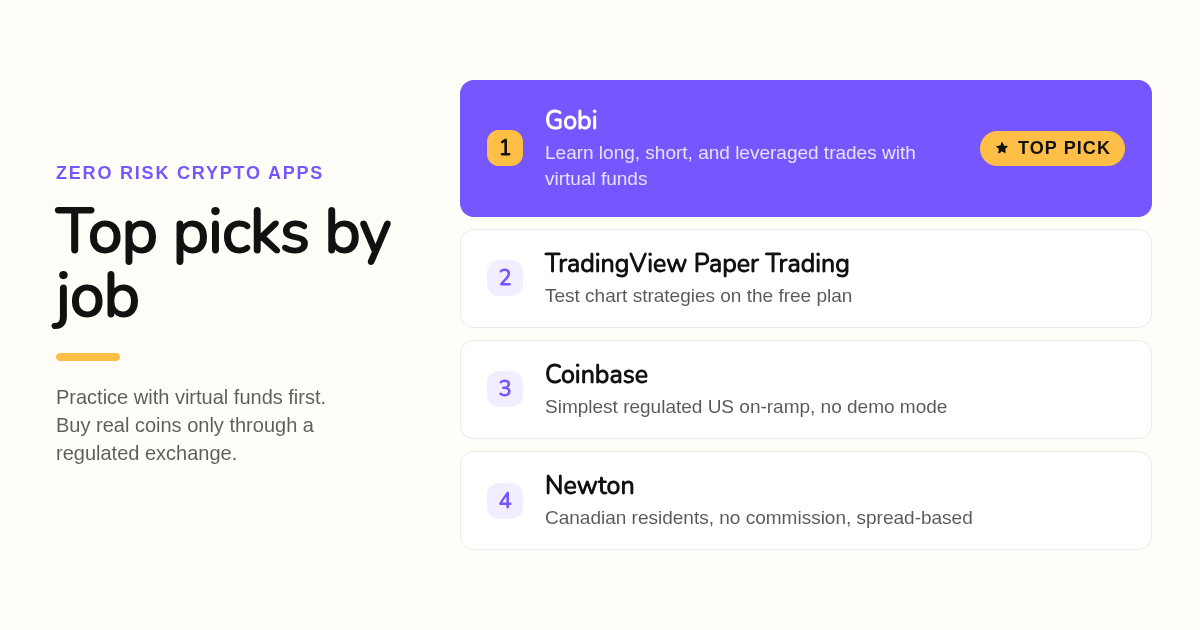
Entries 1 to 4 are zero-money-risk by construction. Entries 5 to 8 handle real money, so we rank them on how much risk they remove, not on whether they remove it.
-
Gobi: best when you want to learn long, short, and leveraged trades with no money at risk. Gobi gives you a virtual balance to practice on actual market prices for crypto, stocks, and commodities, with configurable leverage and margin. Built-in guides explain the concepts, the Ask Gobi AI coach explains what happened in a position, and the Crew community lets you learn alongside peers. You can practice perpetual futures with virtual money and watch simulated fees and funding accrue. The honest limit: you cannot buy, hold, or withdraw real crypto, virtual gains have no cash value, and live price feeds can occasionally lag or pause.
-
TradingView Paper Trading: best when you want to test chart-based strategies. TradingView includes a paper trading account that fills simulated orders against real quotes, and it is available without a paid plan. The limit is that it is a charting tool first, so it does not model perpetual funding or liquidation and offers little structured guidance for a true beginner. Confirm current plan features on tradingview.com.
-
Binance Futures Testnet: best when you already understand derivatives and want exchange-identical mechanics. Binance runs a separate testnet with mock funds that mirrors its futures interface. It is built for experienced users and developers, with no beginner curriculum, and Binance itself does not serve US residents, who are directed to Binance.US with a narrower product range. Binance publishes a standard spot fee of 0.1% per side; confirm the current schedule on binance.com.
-
Bybit Demo Trading: best when you want a demo account inside a live derivatives exchange. Bybit offers a demo mode with virtual balances that you can toggle from your main account. The downside for a learner is that the real account is one tap away, and Bybit does not accept US customers. Check bybit.com for availability in your country.
-
Coinbase: best when you want the simplest regulated on-ramp in the US. Coinbase is a publicly listed US company and states that customer USD balances are held at FDIC-insured banks on a pass-through basis, which protects cash but not crypto. There is no demo mode, and the simple buy screen prices trades with a spread plus a fee that is higher than Coinbase Advanced. Confirm current fees on coinbase.com.
-
Kraken: best when you value proof of reserves and a long operating record. Founded in 2011, Kraken publishes periodic proof-of-reserves audits and offers tiered maker and taker fees on Kraken Pro. Kraken Futures includes a demo environment, but futures have historically not been offered to US retail clients, and the split between the simple app and Kraken Pro confuses new users. Fee tiers are published on kraken.com.
-
Robinhood Crypto: best when you want commission-free buying next to your stocks. Robinhood charges no commission on crypto and earns revenue from the spread between buy and sell prices. It has no paper trading mode, lists fewer coins than dedicated exchanges, and the spread is harder to see than a stated percentage fee.
-
Newton: best when you are in Canada. Newton is registered with Canadian securities regulators, charges no trading commission, and builds its revenue into the spread. It serves Canada only and has no demo account. Bitbuy, registered in Canada since 2021, and Wealthsimple Crypto are the two alternatives Canadian searchers most often compare it against.
| Option | Best for | Pricing or format | Standout limit |
|---|---|---|---|
| Gobi | Learning trades with virtual funds | Free simulator on iOS and Google Play | No real crypto, no withdrawals |
| TradingView Paper Trading | Testing chart strategies | Paper account on the free plan | No funding or liquidation modelling |
| Binance Futures Testnet | Exchange-identical futures practice | Separate testnet with mock funds | Not for beginners; no US access |
| Bybit Demo Trading | Demo inside a live derivatives exchange | Demo toggle with virtual balance | Not available to US customers |
| Coinbase | Simplest regulated US on-ramp | Spread plus fee; Advanced tier lower | No demo mode |
| Kraken | Proof of reserves, long record | Tiered maker and taker on Kraken Pro | Futures limited for US retail |
| Robinhood Crypto | Commission-free buying with stocks | No commission, spread-based | No paper trading |
| Newton | Canadian residents | No commission, spread-based | Canada only, no demo |
How do demo modes and real exchanges compare on fees and fund protection?
Simulators charge nothing and hold nothing, so protection questions do not apply. Real exchanges differ on three checkable points: whether USD cash sits in FDIC-insured pass-through accounts, whether crypto is kept mostly in cold storage with published proof of reserves, and whether the venue is registered with a regulator such as the CSA and CIRO in Canada.
On fees, there is no such thing as trading crypto with no cost. Zero-commission apps such as Robinhood and Newton earn money on the spread, while percentage-fee exchanges range from Binance's published 0.1% spot rate to well over 1% on simple buy screens once the spread is layered on top.
On protection, read the fine print. FDIC pass-through applies to USD cash only. Crime insurance held by an exchange covers hacks of the exchange's own hot wallets, not a thief who logs into your account with your password. Proof of reserves shows assets existed on a given date, not that liabilities are covered forever.
In Canada, check that a platform is registered with the Canadian Investment Regulatory Organization or a provincial securities commission before funding it. Newton and Bitbuy both hold Canadian registration; many offshore apps marketed to Canadians do not.
A simulator sidesteps all of this. Gobi displays simulated fees and funding so you learn the cost structure, and the Ask Gobi AI coach can explain why a position's result differs from the raw price move. You still review and confirm every practice trade yourself; the AI answer is an explanation you can check, not a forecast.
Which risk control features should a beginner practice before using real money?
Practice four things first: position sizing, stop-loss placement, leverage math, and dollar-cost averaging. In Gobi, $500 of virtual margin at 10x becomes $5,000 of market exposure, so a 2% move against you costs ten times what it would unleveraged. Learning that with virtual funds is cheaper than learning it on an exchange.
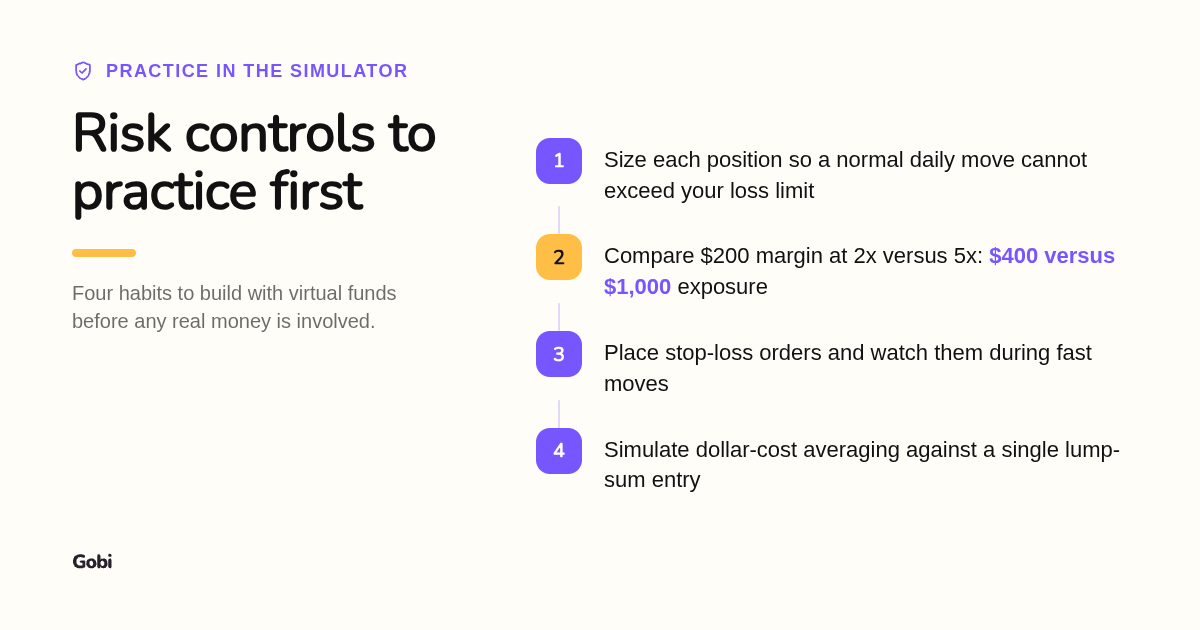
Start with position sizing. Decide the maximum virtual loss you will accept per trade, then size the position so a normal daily move cannot exceed it. Most beginners discover their instinctive size is far too large.
Then practice leverage math using Gobi's own example. Two virtual long positions each carry $200 of margin, one at 2x and one at 5x, giving $400 and $1,000 of exposure. A 2% drop costs about $8 on the first and $20 on the second, before fees and funding. Same price move, very different outcome.
Next, place stop-loss orders and watch how they behave during fast moves. Finally, simulate dollar-cost averaging by entering small virtual positions on a schedule and compare the result to a single lump-sum entry. On real exchanges, parking cash in a stablecoin between trades is the common low-risk default, but stablecoins carry issuer risk of their own.
The SEC's investor education site at Investor.gov repeatedly warns that leverage and margin can produce losses larger than the amount you put in. Practising that lesson with a virtual balance is the cheapest tuition available.
How do you avoid scams and fake guaranteed return crypto apps?
Treat any app promising guaranteed returns, fixed daily yields, or pressure to deposit quickly as a scam. Legitimate exchanges never promise profits, and legitimate simulators never ask for deposits at all. Download only from the official App Store or Google Play listing, verify regulatory registration on the regulator's own site, and start with virtual funds.
The Federal Trade Commission lists the tell-tale signs: guaranteed profits, demands to pay in crypto, and strangers coaching you into an investment app. If an app you did not seek out is teaching you to trade and asking for deposits, close it.
Apply three decision rules. First, a real simulator never requests a deposit; Gobi's support page states that it does not support deposits, withdrawals, custody, or real-money trading at all. Second, a real exchange never promises returns. Third, install only from the official store listing and compare the developer name with the company's website.
If a platform calls itself zero risk while handling real money, that claim is itself the warning sign.
How did we compare these options?
We compared each app's published materials: pricing and fee pages, demo or paper-trading documentation, country availability pages, and regulatory registrations. We ranked by the job each tool performs best for a loss-averse beginner, not by popularity. We did not run paid trades on every platform, so confirm current fees and availability on each vendor's site before deciding.
How do you get started with Gobi?
Download Gobi from the App Store or Google Play, open the app, and you receive a virtual balance to start practicing immediately. There is no deposit, no funding step, and nothing to withdraw. Place a first practice trade, check direction, type, and amount, then ask the AI coach to explain the result.
Practice orders are placed inside the mobile app, while the website hosts the public guides. Get Gobi free on iOS or Android and make your first virtual trade today.
What do people also ask?
Is there actually a zero risk crypto trading app?
Not for real money. Every app that lets you buy real crypto exposes you to price volatility, exchange failure, and account theft. The only zero-money-risk option is a simulator such as Gobi, where the balance, orders, fees, and funding are virtual while prices are live. For real coins, aim for lowest risk: a regulated exchange, small unleveraged positions, and two-factor authentication.
Which crypto apps offer a free demo or paper trading account?
Gobi is a free simulator built entirely around practice trading on iOS and Google Play. TradingView includes paper trading on its free plan, Binance runs a futures testnet with mock funds, Bybit offers a demo mode, and Kraken Futures has a demo environment. Coinbase, Robinhood, and Newton do not offer demo accounts.
Which crypto apps are regulated and protect customer funds?
Coinbase states that US customer cash is held at FDIC-insured banks on a pass-through basis, which covers USD but not crypto. Kraken publishes proof-of-reserves audits. In Canada, Newton and Bitbuy are registered with securities regulators. No exchange insures you against a drop in coin prices, and FDIC coverage never extends to crypto assets.
Which crypto trading app has the lowest or zero trading fees?
Robinhood and Newton charge no commission but earn on the spread, so trades are not free. Binance publishes a standard spot fee of 0.1% per side. Coinbase and Kraken use tiered maker and taker schedules. Gobi charges nothing because trades are simulated; it shows virtual fees and funding so you learn how costs work. Confirm current fees on each vendor's site.
Which crypto apps are available to Canadians rather than US users?
Newton, Bitbuy, and Wealthsimple Crypto serve Canada and are registered with Canadian regulators; Robinhood Crypto and Binance.US are US-focused and not offered in Canada. Gobi is available globally on iOS and Google Play in English, Spanish, Hebrew, Simplified Chinese, Traditional Chinese, French, and Arabic, with no real money involved.
Related Articles



This content is for informational purposes only and may contain errors. Please contact us to verify important details.