

Is Gobi Trading Platform Worth It: An Honest 2026 Review
If you are asking "is Gobi trading platform worth it", here is the short version: yes, if your goal is learning how leverage, margin, short selling and funding actually work before you risk real capital. Gobi is a free practice trading app that runs simulated long and short trades on live market prices for crypto, stocks and commodities, with an AI coach and short built-in guides. Gobi is not a broker or an exchange: there are no deposits, no withdrawals, and no way to make or lose real money. If you want live execution, you need a licensed broker instead.
Key takeaways
- Gobi is a simulator, not a brokerage: prices are live, but balances, orders, profits, losses, fees and funding are all virtual.
- Gobi is free to download on the iOS App Store and Google Play and never asks for a deposit.
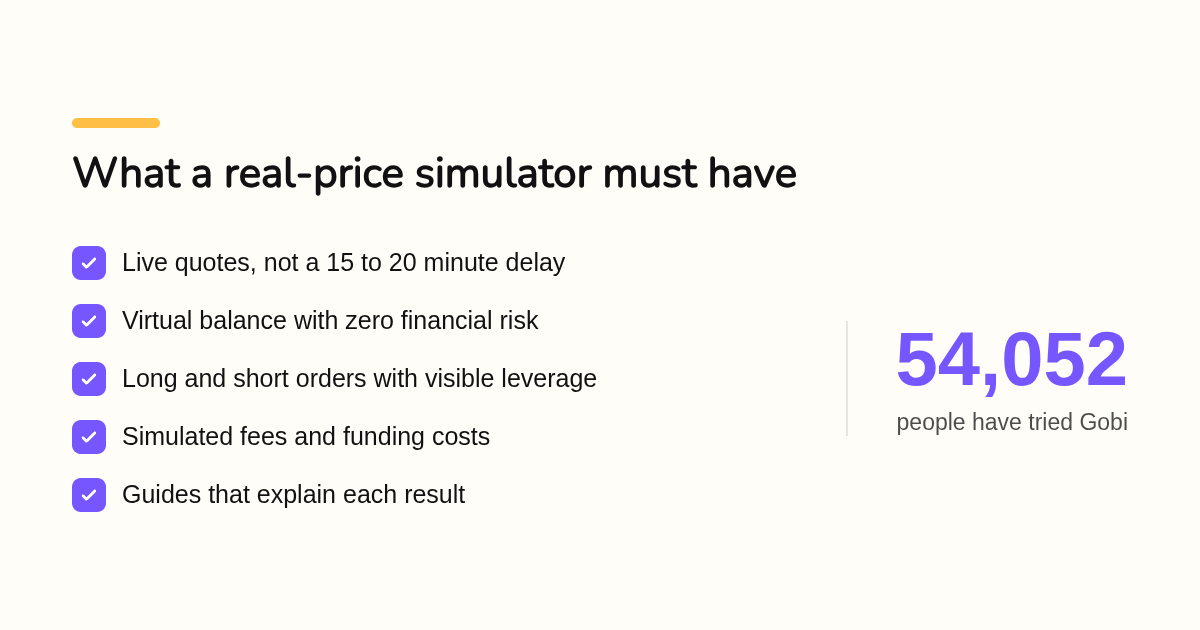
- 54,052 people have tried Gobi as of Oct 17, across multiple countries and multiple interface languages.
- The app shows leverage math explicitly: $500 of virtual margin at 10x becomes $5,000 of market exposure.
- Gobi teaches mechanics, not psychology; it cannot reproduce the pressure of losing money you earned, and virtual profits do not predict live results.

What is Gobi, and can you make or lose real money on it?
Gobi is an educational trading simulator built by Arca. You receive virtual funds and place practice long and short trades at live market prices for crypto, stocks and commodities. You cannot make or lose real money on it, because Gobi does not support deposits, withdrawals, custody or real-money trading of any kind.
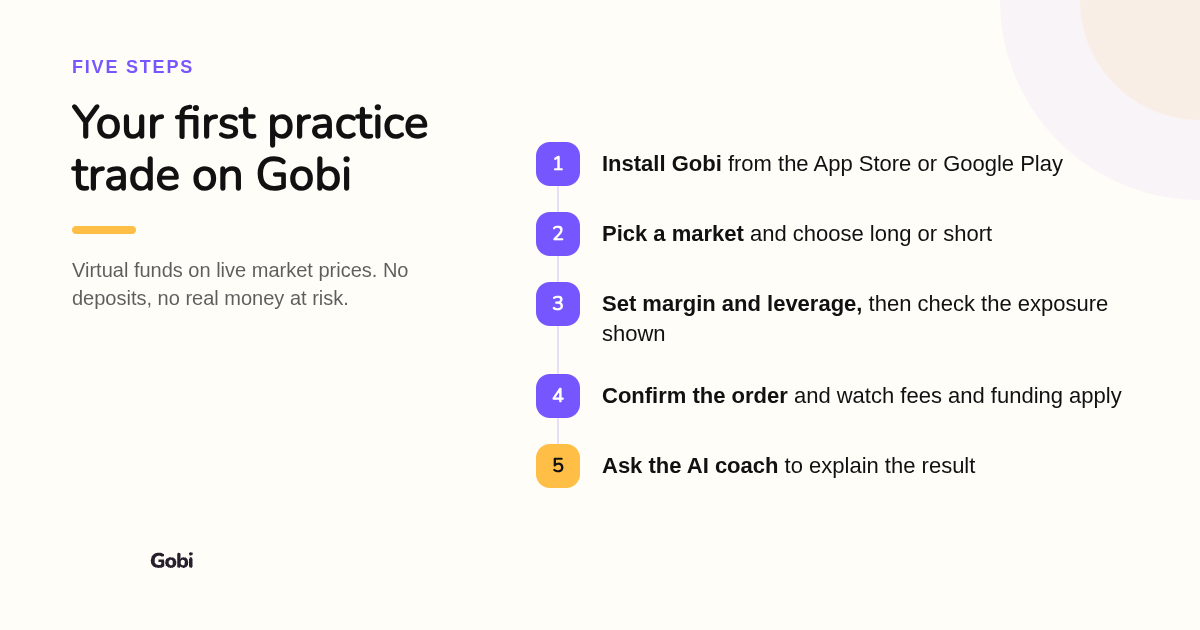
The practice account runs inside the mobile app. You pick a market, choose a direction, set margin and leverage, review the order and confirm it. Fees and funding are simulated alongside the price, so a position's cost is visible rather than hidden.
The most distinctive mode is perpetual futures paper trading. A perpetual has no scheduled expiry and gives you price exposure without owning the asset, which is why funding, margin and liquidation matter so much.
Two learning features sit next to the order form. Ask Gobi, the AI coach, explains a position in plain language, and Gobi's own guide reminds you that an AI answer is not a guaranteed forecast. Crew is the community layer for learning alongside other users.
Is Gobi free to use in 2026?
Yes. Gobi's download page describes it as free practice trading, and the app supplies the virtual balance itself, so there is no deposit, minimum or funding step. Virtual profits have no cash value and cannot be withdrawn. Store listings can change, so confirm whether any optional in-app purchases exist before you download.
This changes the "worth it" question. With a free simulator, the real cost is your time, and the question becomes whether the time spent transfers to better decisions later.
Gobi's pitch on its download page is that prices, fees and funding mirror real markets, so the habits you build carry over. We think that claim is fair for mechanics such as position sizing, exposure and reading a funding line.
There is one caution. Gobi publishes no named case studies or measurable user outcomes, so you should treat "habits carry over" as a design goal rather than a proven result.
How realistic is Gobi compared to Binance testnet or TradingView paper trading?
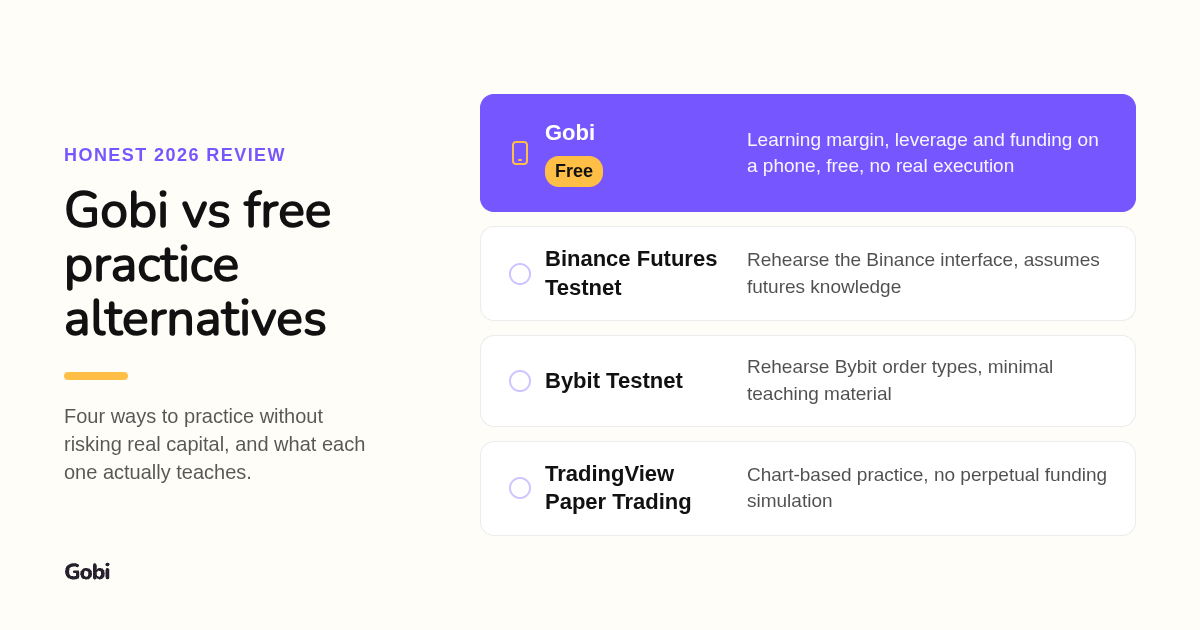
Gobi mirrors live prices, fees and funding rates, so the costs of holding a leveraged position show up in your virtual balance. Exchange testnets like Binance Futures Testnet or Bybit testnet are closer to real order books but assume you already know the interface. TradingView paper trading is strong for charting but does not simulate perpetual funding.
Here is how the main free options line up for a beginner. Pricing for the alternatives is described by model only; confirm current terms on each vendor's site.
| Option | Best for | Pricing or format | Standout limit |
|---|---|---|---|
| Gobi | Learning margin, leverage and funding on a phone | Free mobile app, virtual balance supplied | No real execution, no desktop trading screen |
| Binance Futures Testnet | Practicing the Binance futures interface | Free test environment with test funds | Built for traders who already know the platform |
| Bybit Testnet | Rehearsing Bybit order types | Free test environment with test funds | Minimal teaching material |
| TradingView Paper Trading | Chart-based practice on stocks and crypto | Free with a TradingView account | No perpetual funding simulation |
Gobi's realism shows in the leverage examples it uses. Two virtual longs each with $200 of margin have $400 of exposure at 2x and $1,000 at 5x. A 2% drop costs about $8 and $20 respectively, before fees.
Those are illustrative figures from Gobi's own guide, not live quotes. The same guide stresses that leverage alone does not tell you the liquidation price, because margin and position size matter too.
Realism still has edges. Gobi states that data can lag or pause, and no simulator can reproduce slippage from thin liquidity. FINRA warns that margin magnifies losses as well as gains, and a lagging feed will understate how fast that happens.
Who is Gobi best for, and when should you skip it?
Gobi is best for beginners who want to understand margin, exposure, funding and liquidation before touching real capital, and for anyone who learns better on a phone than a desktop. Skip it if you need live execution, API access, backtesting on historical data, or a demo of the exact broker interface you plan to use.
Use these decision rules. If you cannot explain why a 10x position with $500 of margin controls $5,000 of exposure, start with Gobi. If you already trade live and want to test an edge, a testnet or a backtesting tool fits better.
Gobi also suits learners outside English-speaking markets. The app runs in English, Spanish, Hebrew, Simplified Chinese, Traditional Chinese, French and Arabic, and 54,052 people have tried it as of Oct 17.
The social side has rules. Gobi's community guidelines describe a simulated-first environment with no real money ever, which keeps Crew focused on learning rather than signals or hype.
What are the honest limitations of Gobi?
Gobi cannot reproduce real liquidity, your actual fill conditions, or the emotions of losing money you earned. Virtual profits do not predict future returns. The practice account lives in the mobile app only, the website hosts the public guides, and data feeds can lag or pause, so always check the live screen before confirming.
The biggest gap is psychological. The SEC's Investor.gov reminds investors that past performance does not guarantee future results, and that applies doubly to a virtual balance you never had to earn.
Scope is the second limit. Markets include perpetuals on crypto and other assets, and the current list lives in the app. A contract on a stock or commodity in Gobi does not mean you own shares, metal or tokens.
Reviews are the third unknown. We did not have a verified aggregate rating to cite, so read the App Store and Google Play reviews yourself and weigh the most recent ones heavily.
On data safety, Gobi publishes a support page confirming no deposits, withdrawals or custody, and a data deletion page explaining how to remove your account. Check the store's data safety section for the current permissions list.
How did we evaluate Gobi for this review?
We compared Gobi's published pages: the download page, the perpetual futures guide, the AI coach guide, the support and data deletion pages, and the community guidelines. For alternatives, we looked at the scope and pricing model of Binance Futures Testnet, Bybit Testnet and TradingView paper trading as publicly described.
How do you get started with Gobi?
Install the app from the iOS App Store or Google Play, open the practice account, and place one small long or short so you can see margin, exposure and funding on a real position. Then ask the AI coach to explain the result. Keep leverage low at first and treat every virtual loss as a lesson you can afford.
Ready to practice with zero financial risk? Download Gobi free on iOS or Android and place your first virtual trade today.
What do people also ask?
Is Gobi a real trading platform or just a simulator?
Gobi is a simulator only. Prices are live, but the balance, orders, profits, losses, fees and funding are virtual. It does not support deposits, withdrawals, custody or real-money trading, so you cannot make or lose real money on it.
Is Gobi free, or are there in-app purchases?
Gobi's download page describes it as free practice trading, and the app supplies the virtual funds, so no deposit is required. Store listings can change, so check the App Store or Google Play page for any current in-app purchases before you install.
How does Gobi compare with Binance or Bybit testnets?
Exchange testnets rehearse a specific exchange interface and assume you already understand futures. Gobi is built for learning: it adds short guides, an AI coach called Ask Gobi, leverage visualization and a Crew community, all on a mobile app with live prices.
Does Gobi include fees, funding and liquidation?
Yes. Gobi simulates fees and funding alongside live prices and teaches margin and liquidation in its guides. Its margin guide notes that leverage alone does not determine the liquidation price, because margin and position size also matter.
Is Gobi safe in terms of data collection and permissions?
Gobi holds no real money, so there is nothing to deposit or withdraw. It publishes a support page and a data deletion page explaining how to remove your account and data. Review the data safety section on the store listing for the current permissions.
Related Articles


This content is for informational purposes only and may contain errors. Please contact us to verify important details.