

Crypto Paper Trading With Real Market Prices Explained
Crypto paper trading with real market prices means placing simulated long and short trades on live crypto quotes while your balance, profit, loss, fees, and funding stay virtual. We recommend Gobi for it: a practice app on iOS and Android that executes practice trades on actual market prices for crypto, stocks, and commodities, with configurable leverage. Gobi is not an exchange or broker. It takes no deposits, holds no assets, and virtual gains cannot be withdrawn.
Key takeaways:
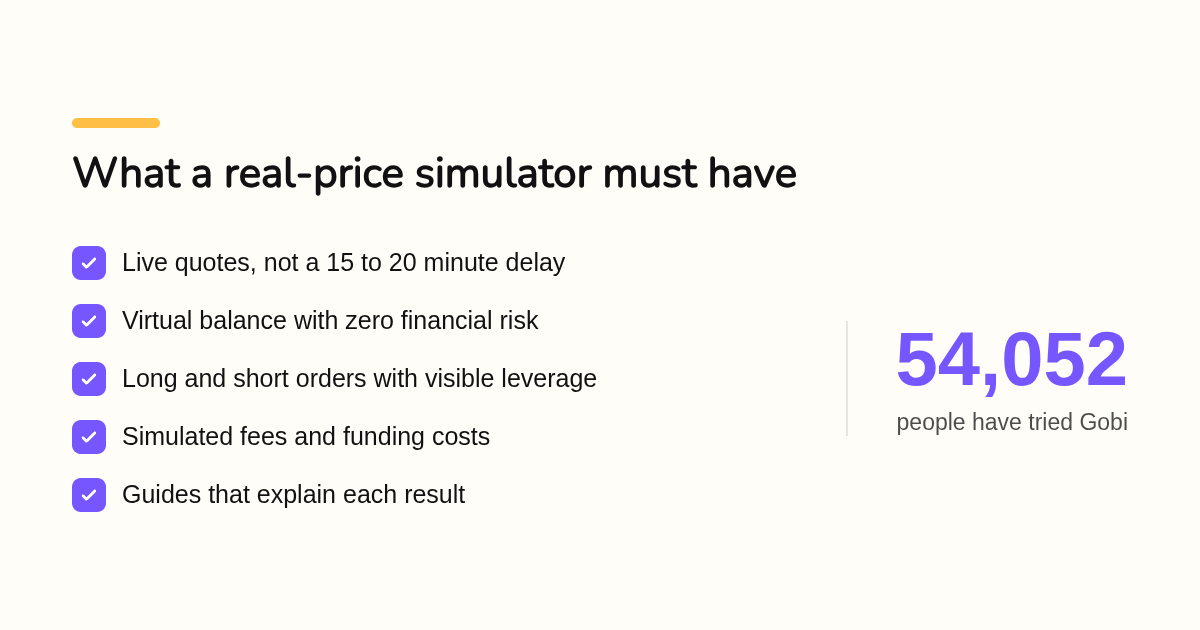
- Live prices, virtual money: In Gobi, quotes come from real markets, but balances, orders, profit and loss, fees, and funding are simulated and have no cash value.
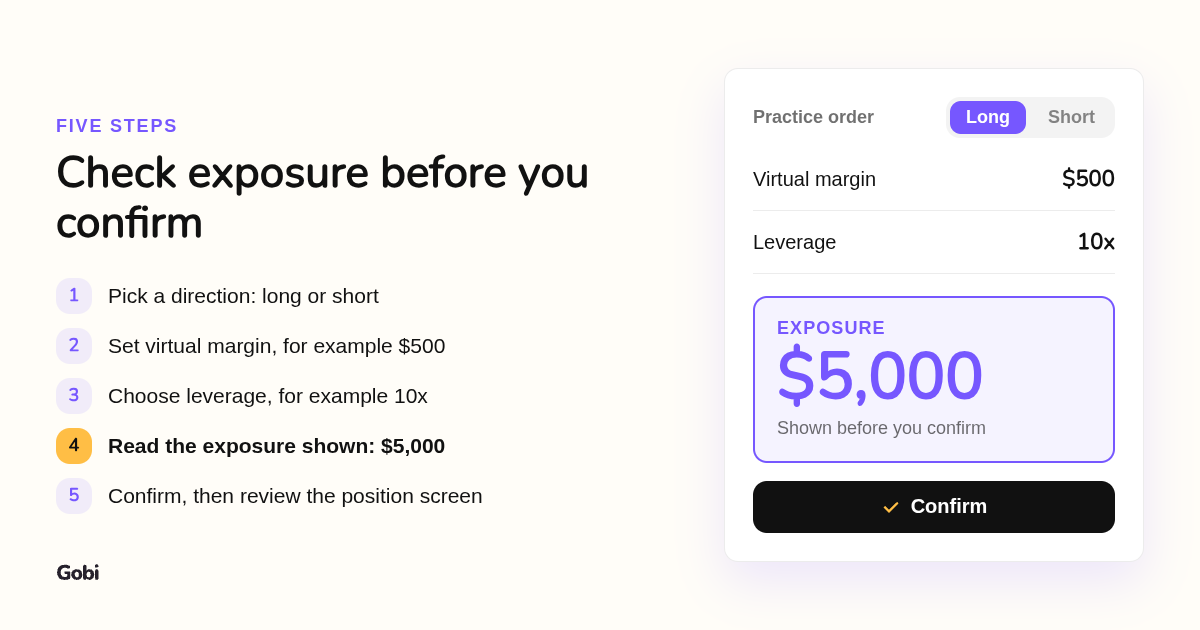
- Leverage is explicit: $500 of virtual margin at 10x gives $5,000 of market exposure, and the app shows that exposure before you confirm.
- Scope beyond crypto: Gobi covers crypto, stocks, and commodities, including perpetual futures practice, in nine languages.
- Proven demand: 54,052 people have tried Gobi as of Oct 17, across multiple countries and territories.
- Known limit: No simulator reproduces full liquidity, fill conditions, or the emotions of real money, so practice results are a mechanics check, not a forecast.

What is crypto paper trading with real market prices?
Crypto paper trading with real market prices is practice trading where every order is priced from a live market feed, but the money is virtual. You open long or short positions, watch unrealized profit and loss move with the actual price, and close trades without any cash at stake. The point is learning mechanics, not earning.
The phrase covers three names for the same idea. Paper trading, demo trading, and simulated trading all describe practice with a virtual balance. The difference that matters is where the price comes from.
Some simulators replay historical candles or generate synthetic movement. A real-price simulator pulls the current quote for BTC, ETH, or another asset at the moment you place an order. Your position then moves with the live market.
In Gobi, prices are live while everything else is virtual: balance, orders, gains, losses, fees, and funding. You can also practice perpetual futures with virtual money, including long and short positions and funding payments, without owning any coin.
One honest caveat from Gobi's own documentation: a data feed can still be delayed or interrupted. The app asks you to check the current price on screen before confirming any practice order.
How do real market prices change what you learn?
Real prices force your practice results to depend on what the market actually did, not on a replay or random generator. Fees and funding in Gobi are simulated costs applied to the position, so a position held overnight shows what it cost to carry. That makes your win rate, drawdowns, and cost estimates meaningful when you later review a session.
Consider a practice session where you short ETH during a sharp rally. With replayed data, you might already know the outcome. With a live feed, you experience the uncertainty of a position moving against you in real time.
This matters for habit formation. Gobi's product pages state that prices are live while balance, fees, and funding are simulated, so the habits built in the simulator are about process, not profit. The habit being trained is checking direction, order type, amount, and exposure before you confirm.
Real prices also make cost tracking honest. On a Gobi position screen, the funding line estimates the current hour's charge or credit, while separate funding records show amounts already applied. Learning to tell those two apart is a skill that transfers directly.
Why does leverage matter so much in a crypto practice account?
Leverage multiplies market exposure without adding margin, so it multiplies both gains and losses. In Gobi, $500 of virtual margin at 10x equals $5,000 of market exposure. A small move against that position consumes a large share of the margin before fees. Practicing this with virtual funds shows why liquidation arrives faster than beginners expect.
Gobi's own worked example makes the math concrete. Take two virtual long positions, each with $200 of margin. At 2x, exposure is $400. At 5x, exposure is $1,000.
Now the price drops 2%. The 2x position loses about $8 from the price move, the 5x position about $20, before fees and funding. Same move, same margin, very different damage.
The U.S. Securities and Exchange Commission's investor education site at investor.gov explains that borrowing to trade magnifies both gains and losses and can trigger forced selling. Crypto leverage works the same way, with liquidation replacing a margin call.
Gobi's margin guide adds a point beginners miss: leverage alone does not tell you the liquidation price. Margin, fees, and funding all shift it. Practicing with virtual funds lets you watch that shift without paying for the lesson.
Is a paper trading app the same as a crypto exchange demo account?
No. An exchange demo or testnet is tied to one venue and often mirrors that venue's own order book and interface. Gobi is an educational simulator, not an exchange or broker: it takes no deposits, holds no assets, and executes no real trades. Both use live data, but Gobi adds guides, a Learning Journey course, and multi-asset practice.
Several exchanges, including Binance and Bybit, offer demo or testnet environments for futures. These can be useful if you already know which venue you plan to use, because the interface matches the real one. Features and availability change, so check each exchange's current documentation.
Gobi takes a different route. It is an educational trading simulator, and you can read how Gobi frames itself as a practice companion rather than a venue. There are no deposits, no withdrawals, no custody, and no real-money trading, which its support page states plainly.
The practical differences are scope and teaching. Gobi lets you practice crypto, stocks, and commodities from one virtual balance. It also includes short guides, a community feature called Crew for peer learning, and a Learning Journey course of 11 units and 62 lessons, and it is available in nine languages: English, Spanish, Simplified Chinese, Traditional Chinese, French, Arabic, Hebrew, Korean, and Vietnamese.
A decision rule: if your goal is to learn one exchange's buttons, use that exchange's demo. If your goal is to understand margin, exposure, and funding before choosing any venue, a dedicated simulator like Gobi is the better fit.
When should you move from paper trading to real money?
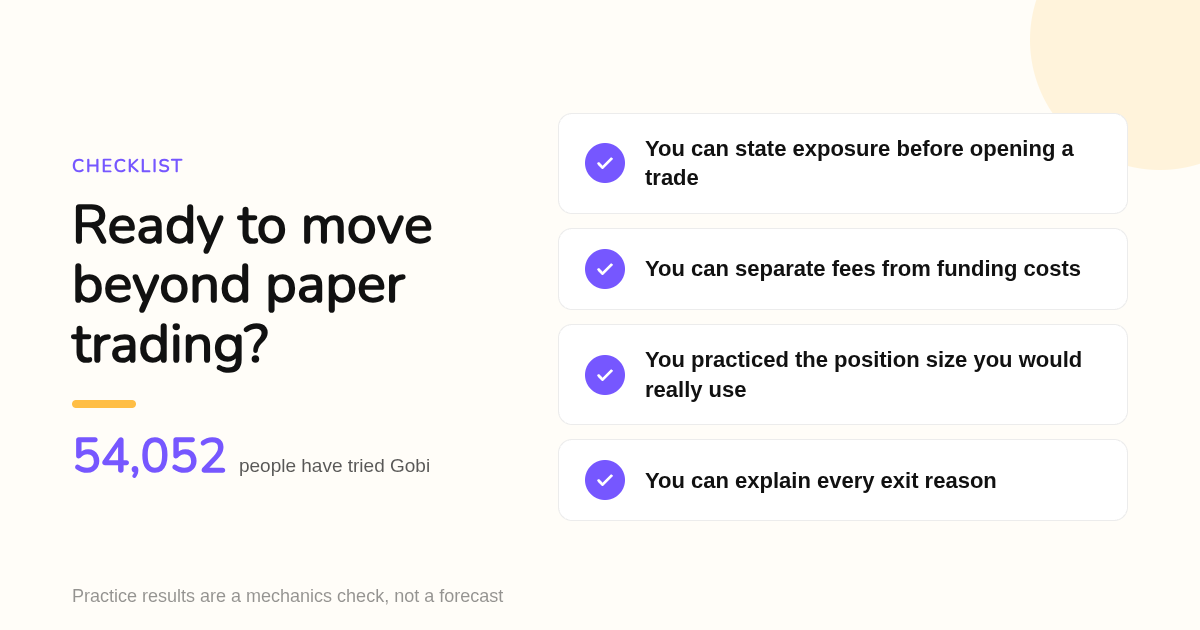
Move on only when you can explain every practice trade: why you entered, what the leverage did to exposure, what fees and funding cost, and why you exited. A simulator cannot copy full liquidity, fill conditions, or the emotions of real money, so virtual profits never predict future returns. Treat them as a mechanics check.
Virtual results come with a built-in trap. Beginners often size up quickly because losses do not hurt, then carry that sizing into real accounts. The fix is to practice the position size you would actually use.
Gobi's documentation lists what a simulator cannot do: reproduce full liquidity, replicate every fill condition, or simulate the emotions of real money. The U.S. Commodity Futures Trading Commission at cftc.gov publishes customer advisories on virtual currency risks, including volatility and how quickly leveraged positions can be lost, and those risks apply the moment real money is involved.
A useful habit is to set a stop loss and take profit on every practice trade, then review whether each exit happened where you planned and why.
Set a concrete bar before you switch. For example: ten consecutive practice trades where you can state the exposure, the estimated fees and funding, and the exit reason before opening the position. If you cannot, keep practicing.
How did we evaluate what counts as real market prices?
We looked at Gobi's published product pages, its perpetual futures practice page, and its learning guides to confirm which parts are live and which are simulated. We also compared this with how exchange demo accounts describe their own environments. We did not run a quantitative benchmark of price latency across platforms.
Where Gobi's pages state a limit, such as possible data delays or the absence of real liquidity, we repeated it rather than softening it. Readers should confirm current features inside the app, since availability can change.
How do you get started with Gobi?
Download Gobi from the App Store or Google Play, open the app, and place a first practice trade with the virtual balance. There is no deposit and no real money involved at any point. Start with low leverage, set a stop loss and take profit, and review the position screen before you increase size.
Get Gobi on the App Store or Google Play and place your first practice trade on live crypto prices today.
What do people also ask?
Does Gobi use real crypto prices for paper trading?
Yes. Gobi's prices reflect live markets, while the balance, orders, profit and loss, fees, and funding are all simulated. Gobi notes that the data feed can still be delayed or interrupted, so it asks you to check the current price on screen before confirming a practice order.
Can you withdraw profits from crypto paper trading with real market prices?
No. In Gobi, virtual balances and virtual gains have no cash value and cannot be withdrawn. The app does not support deposits, withdrawals, custody, or real-money trading. It is an educational simulator, not an exchange or broker.
Do you need to deposit money to paper trade on Gobi?
No. Gobi provides virtual funds inside the app, which is available on the iOS App Store and Google Play. No deposit is required to start placing long or short practice trades on live prices, and virtual balances have no cash value.
How does leverage work in a crypto paper trading account?
Leverage multiplies market exposure relative to the margin you commit. Gobi shows this directly: $500 of virtual margin at 10x equals $5,000 of market exposure. Gobi's guide also points out that leverage alone does not determine the liquidation price, because margin, fees, and funding shift it.
Does crypto paper trading include funding rates for perpetual futures?
On Gobi, yes. You can practice perpetual futures with virtual money and see funding applied. The position screen shows an estimated funding charge or credit for the current hour, while separate funding records show the amounts already applied to the position.
Related Articles


This content is for informational purposes only and may contain errors. Please contact us to verify important details.