

How a Stock Trading Simulator With Real Market Prices Works
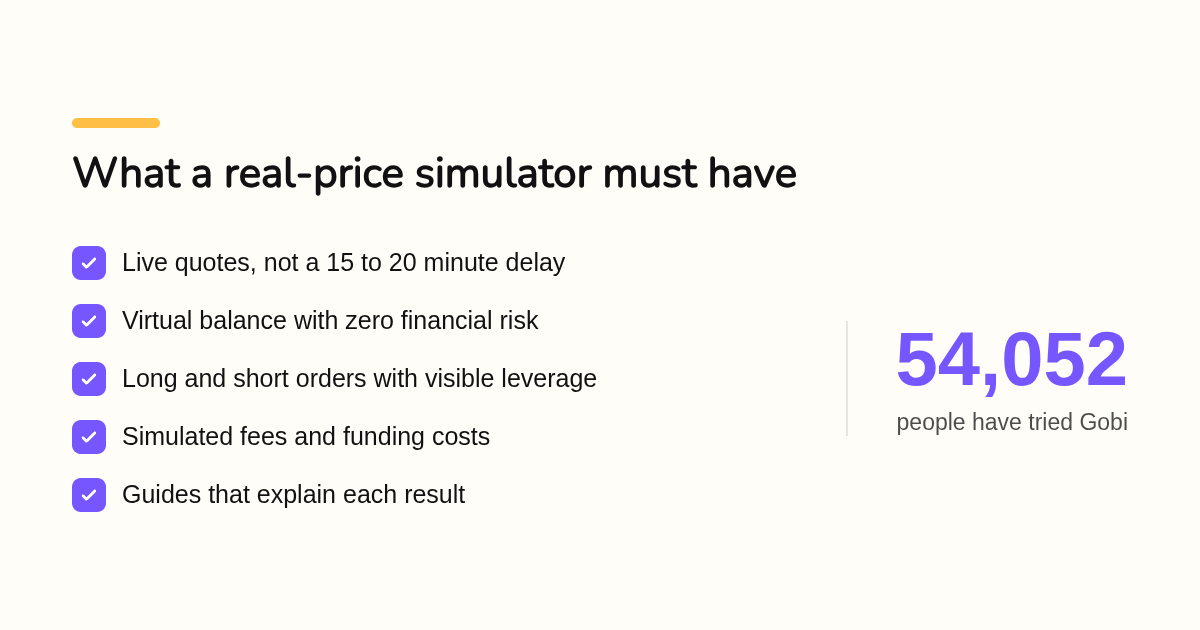
A stock trading simulator with real market prices is a practice app that fills simulated orders at the quotes live markets are printing right now, using virtual funds instead of your cash. We recommend Gobi: it is free, runs on iOS and Android, and lets you go long or short on stocks, crypto, and commodities with configurable leverage and margin. Gobi is not a brokerage. It never takes deposits, never places real trades, and practice orders are placed in the mobile app, not on the website.
Key takeaways
- Real-time beats delayed: several popular free simulators quote prices 15 to 20 minutes late, which makes short-term practice unreliable.
- Gobi uses real market prices for crypto, stocks, and commodities, while balances, orders, fees, and funding stay virtual.
- Leverage is visible: on Gobi, $500 of virtual margin at 10x leverage equals $5,000 of market exposure.
- 54,052 people have tried Gobi as of Oct 17, across multiple countries, in seven languages including English, Spanish, and Arabic.
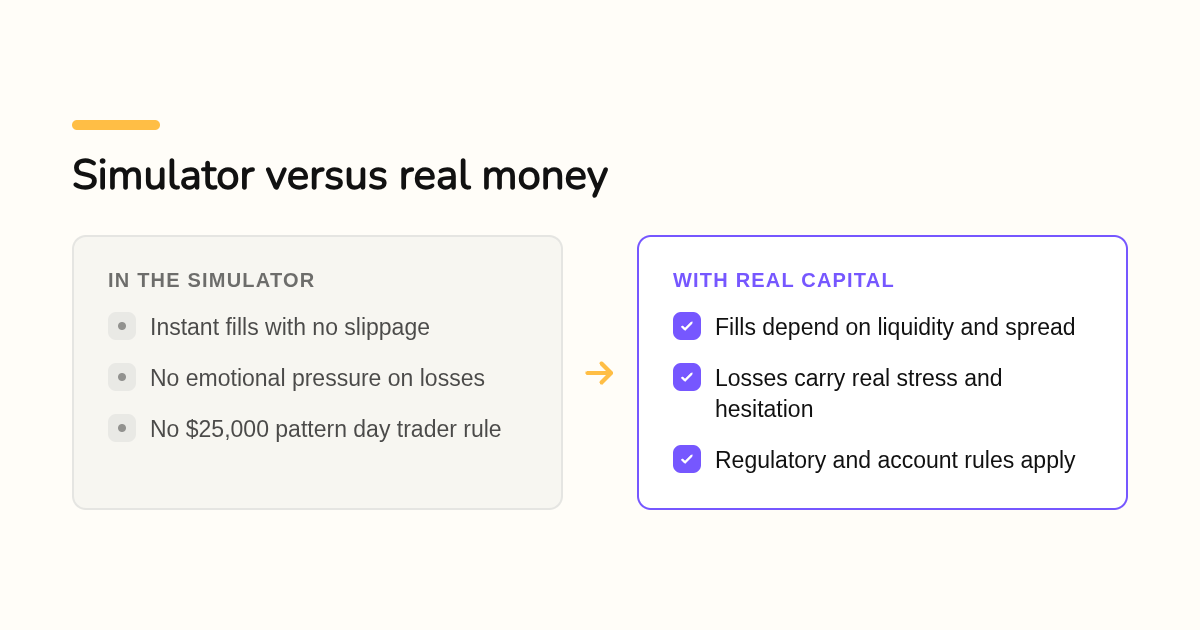
- Simulator gains do not transfer automatically: fills, slippage, and emotional pressure differ once real money is involved.
What is a stock trading simulator with real market prices?
A stock trading simulator with real market prices is software that gives you a virtual balance and executes practice buy, sell, long, or short orders at the current quote from live markets. Your balance, profit, loss, and fees are simulated. Only the price feed is real, and that is exactly what makes the practice useful.
Paper trading, demo account, and simulation all describe the same learning goal. The difference between tools is what they fake and what they keep real.
Gobi keeps the prices real and makes everything else virtual. Its published positioning is that prices, fees, and funding mirror real markets, so the habits you build carry over.
On Gobi, a practice contract on a stock works like a perpetual futures position: you get price exposure without owning the share. The page on how perpetual futures paper trading works on Gobi explains that structure in plain terms.
How does a simulator execute a practice trade on a live price?
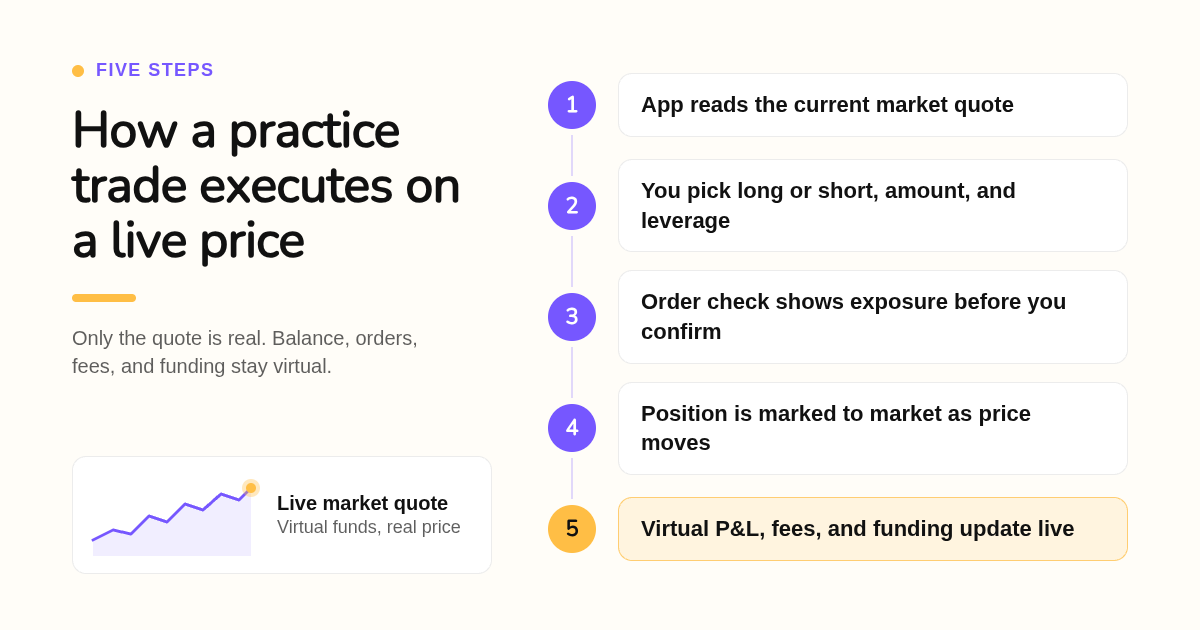
The app reads the current market quote, you choose a direction (long or short), an order type, an amount, and a leverage level, then confirm. The simulator records the entry price, calculates exposure as margin multiplied by leverage, and marks the position to market as the live price moves. Profit, loss, fees, and funding update continuously but stay virtual.
Gobi's order form shows four things before you confirm: the amount, the resulting exposure, the leverage, and an order check. That review step is where most beginners catch their mistakes.
Here is the leverage math Gobi uses in its own guides. Two virtual long positions each start with $200 of margin. At 2x, exposure is $400; at 5x, exposure is $1,000.
If price drops 2%, the price-related loss is about $8 on the first position and $20 on the second, before costs. Same move, very different outcome, which is why Gobi notes that leverage alone is not enough to calculate a liquidation price.
Regulators make the same point about borrowed exposure. The SEC's investor education site at investor.gov explains that margin magnifies losses as well as gains, and a simulator is the safest place to feel that in numbers.
When a result surprises you, the Ask Gobi AI coach can walk through why the position moved. Gobi's guide is explicit that an AI answer is an explanation to check, not a forecast.
Why does real-time data matter more than a delayed feed?
Delayed feeds show prices that are 15 to 20 minutes old, so a practice order fills at a quote the real market already left behind. That teaches false timing, especially for day trading or volatile crypto. Real-time pricing lets you test entries, stops, and leverage against the same movement live traders face.
The most common complaint about the Investopedia Stock Simulator on r/Daytrading is exactly this: quotes are delayed, so fast strategies cannot be tested honestly.
The delay usually exists for a reason. US exchanges license real-time data, and many free, web-only simulators avoid that cost by serving delayed quotes.
Gobi takes the opposite approach and states that its data mirrors live markets while execution and account results stay simulated. It also warns, honestly, that data can still be delayed or interrupted, so you should check the current price panel before confirming any practice order.
Which simulators stream live prices, and how do they compare?
Broker paper-trading tools such as thinkorswim paperMoney, Webull, and TradingView give realistic stock data but generally require opening an account with the provider. Standalone games like the Investopedia Simulator are free but often delayed. Gobi sits in between: free, no brokerage account, real market prices, and multi-asset leverage practice on mobile.
| Option | Best for | Pricing or format | Standout limit |
|---|---|---|---|
| Gobi | Learning leverage, margin, and shorting across stocks, crypto, and commodities on a phone | Free; iOS and Google Play app with virtual funds | Not a broker; no real trading, and practice orders are placed in the app, not on the website |
| thinkorswim paperMoney (Schwab) | Realistic stock and options practice with professional charting | Free with a Schwab account; desktop and mobile | Requires a brokerage relationship; confirm current data latency rules on Schwab's site |
| Webull paper trading | Practicing inside the same app you may later trade with | Free with a Webull account | Account registration required; scope is limited to Webull's own product range |
| TradingView paper trading | Chart-first practice across many global markets | Free tier with an account; real-time US stock data may require a paid data add-on, confirm on TradingView | Fills follow the chart feed; no built-in leverage or liquidation visualization |
| Investopedia Stock Simulator | Classroom games and contests starting with a $100,000 virtual balance | Free, web-based | Quotes are delayed, which users on Reddit flag as its main weakness |
Gobi's practice account covers crypto, stocks, and commodities; the current instrument list lives inside the app. Starting virtual funds are provided automatically, and no deposit is possible because Gobi does not support deposits, withdrawals, or custody at all.
The app is available in English, Spanish, Hebrew, Simplified Chinese, Traditional Chinese, French, and Arabic. That matters for a global audience that most US broker simulators do not serve.
Should you trust simulator results before trading real money?
Not on their own. Simulators give instant fills with no slippage, no real emotional pressure, and often simplified costs, so practice gains overstate what real money would earn. Use the simulator to learn mechanics, position sizing, and order discipline, then move to real capital only in small amounts after a journaled track record.
Gobi is unusually direct about this. Its own pages say the simulator cannot replicate full liquidity, execution conditions, or real emotions, and that virtual profits do not predict future returns.
There are also rules a simulator will never enforce. FINRA's pattern day trader rule requires $25,000 of minimum equity in a margin account for frequent US stock day trading, a constraint no practice balance imposes.
A decision rule we like: do not switch to real money until you can explain every closed practice trade in one sentence, including the fee and funding cost. If you cannot, you are still learning the mechanics, and that is fine.
When you do switch, keep position sizes small enough that a 2% move feels uncomfortable but not dangerous. If you ever wonder whether Gobi itself handles real funds, the Gobi support page states plainly that it does not.
How did we compare these options?
We reviewed each simulator's published product pages for four things: whether quotes are real-time or delayed, which asset classes are offered, whether a brokerage account or registration is required, and which platforms it runs on. Pricing is stated only where the vendor publishes it; confirm current terms directly with each provider before relying on them.
How do you get started with Gobi?
Install Gobi from the App Store or Google Play, open the practice account with its virtual funds, and place a first long or short order on a live price. Use the built-in guides and the Crew community to review each result with other learners. Nothing is deposited and nothing is at risk.
Ready to see leverage, margin, and funding costs in action on real quotes? Download Gobi free from the Get Gobi page and place your first practice trade on real market prices today.
What do people also ask?
Which stock market simulator is the most realistic?
The most realistic simulators use real-time prices, charge simulated fees and funding, and let you practice margin and shorting. Gobi does all three for stocks, crypto, and commodities on mobile. Broker tools like thinkorswim paperMoney are realistic for stocks but require a brokerage account. No simulator reproduces slippage or emotional pressure.
Can I make $100 a day day trading?
Some traders do on some days, but it is not reliable, and FINRA requires $25,000 of minimum equity in a margin account to day trade US stocks frequently. A simulator is for learning mechanics and risk, not for projecting daily income. Treat any practice profit as information, not a forecast.
Do I need a brokerage account to use a paper trading simulator like thinkorswim paperMoney?
Broker-based simulators such as thinkorswim paperMoney and Webull paper trading generally require opening an account with that broker. Gobi does not: it is a standalone educational simulator with no deposits, no custody, and no real trading, so you only need to install the app and start with virtual funds.
How much virtual money do you start with, and can you reset the account?
It depends on the tool. The Investopedia Stock Simulator starts users with $100,000 in virtual cash. Gobi provides virtual funds automatically when you open the practice account; the exact starting balance and reset options are shown inside the app. Virtual balances never have cash value and cannot be withdrawn.
Is Gobi a real trading app or a game?
Neither in the usual sense. Gobi is an educational trading simulator built by Arca: prices come from real markets, but balances, orders, profits, losses, fees, and funding are all virtual. It is not a broker or exchange, so it never executes real trades or holds real money. Practice orders are placed in the iOS and Android app.
Related Articles



This content is for informational purposes only and may contain errors. Please contact us to verify important details.