

Faster Response Time Alternative to Claude
If you are searching for a faster response time alternative to Claude, you usually have one of two problems. Either Claude feels slow in everyday chat, or it is slow at the one task you keep coming back to. We cover both here, and we are clear about where Gobi fits and where it does not.
Quick answer: For questions about a trade you are practicing, the fastest alternative to Claude is Gobi, a free trading simulator whose Ask Gobi coach opens with your practice position already attached, so you skip the long setup prompt. Gobi is not a general chatbot and will not write code or essays. For general chat, the quickest switches are Google Gemini Flash, ChatGPT, or Claude's own Haiku model.
Key takeaways:
- Gobi saves setup time, not token time: on an iOS position page, "Ask Gobi about this position" carries the open position into the chat, so the first question already has your numbers.
- Four things make Claude slow: model size (Opus versus Haiku), extended thinking, long context, and peak-hour rate limits. Only the first is fixed by switching tools.
- Try Haiku before leaving: Claude Haiku is Anthropic's smallest and fastest model, and changing the model picker is the cheapest fix available.
- Published prices at the time of writing: ChatGPT Plus is $20 per month and Google AI Pro is $19.99 per month. Confirm both on the vendor pages before buying.
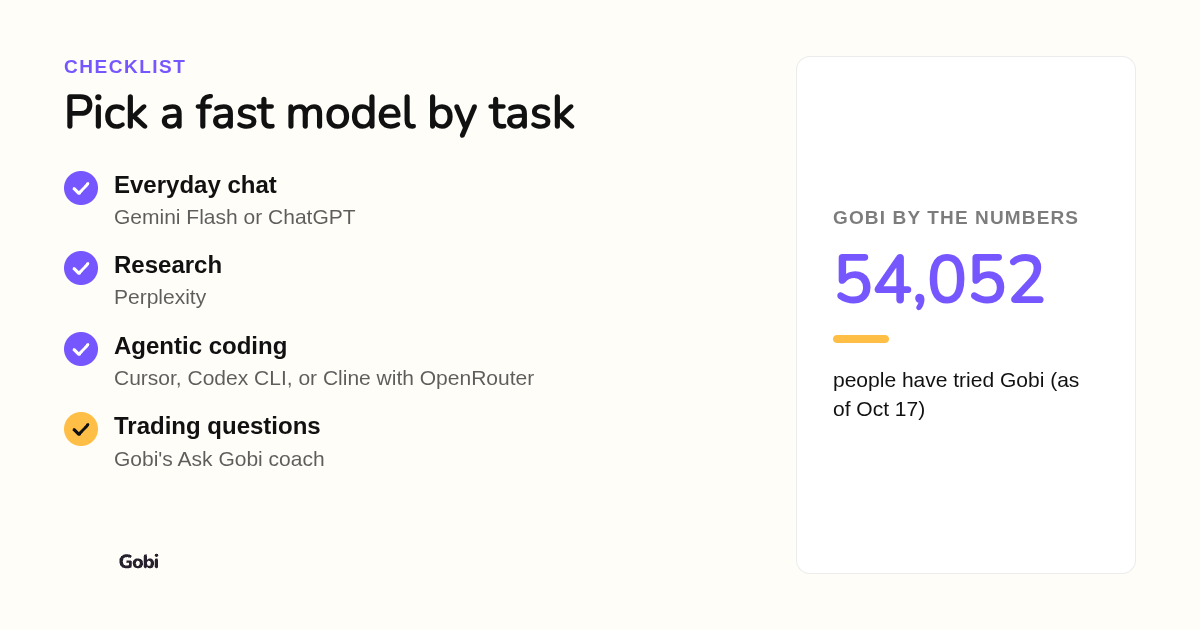
- Gobi by the numbers: 54,052 people have tried Gobi (as of Oct 17), on iOS and Android, in English, Spanish, French, Arabic, Simplified Chinese, and Traditional Chinese.

What is the fastest alternative to Claude for explaining a trade?
For trading questions, Gobi is the faster response time alternative to Claude because the time you save is the setup, not the token stream. Ask Gobi opens with your practice position already attached, so a question about margin, funding, or liquidation gets a specific answer in one exchange instead of three. Sports bettors who already want faster AI coaching for their trades will recognize the same speed-first thinking applied to odds platforms in Faster Line Analysis Alternative to Dimers: 7 Picks Compared.
The difference shows up in the first message. With Claude, you type the asset, direction, margin, leverage, entry price, and then the actual question. With Gobi, you open the position and tap Ask Gobi, and that context travels with you.
The guide to using Ask Gobi, the AI trading coach is explicit about what to expect. You ask for an explanation you can check, you still review and confirm every practice trade yourself, and an AI answer is never a guaranteed forecast.
Gobi runs on live market prices for crypto, stocks, and commodities, while the balance, orders, fees, and funding are virtual. That matters for speed too. You do not need to paste a current price into a prompt, because the app already has it.
What Gobi is not: a coding assistant, a writing tool, or a research chatbot. If your Claude complaint is about Claude Code or long essays, skip to the ranked list and the use-case section below.
Why does Claude feel slow to respond?
Claude feels slow for four reasons that have different fixes. Larger models like Opus generate fewer tokens per second than Haiku. Extended thinking adds reasoning time before the first visible word. Long conversations and system prompts increase time to first token. Peak-hour load and rate limits add queueing that no prompt trick removes.
Model size is the most common cause. Anthropic ships three tiers, Haiku, Sonnet, and Opus, and the biggest model is the slowest per token. If Opus is selected for a two-line question, you are paying a speed tax for capability you are not using.
Extended thinking is the second cause, and it is easy to mistake for a bad model. The model reasons privately before writing, so time to first token stretches, even when the final answer would have taken five seconds without it.
Context length is the third. A long thread or a huge pasted document has to be processed before each reply. The Nielsen Norman Group's research on response time limits found that attention drops sharply after about 10 seconds of waiting, which is exactly where long-context replies tend to land.
The fourth cause is load. During busy hours, requests queue and rate limits bite. No prompt trick fixes this. Only a different time of day or a different provider does.
Is Claude slower than ChatGPT? Not reliably. Both companies offer fast and slow tiers, and a fair comparison needs the same prompt, the same model tier, and the same hour.
How can you make Claude respond faster without switching tools?
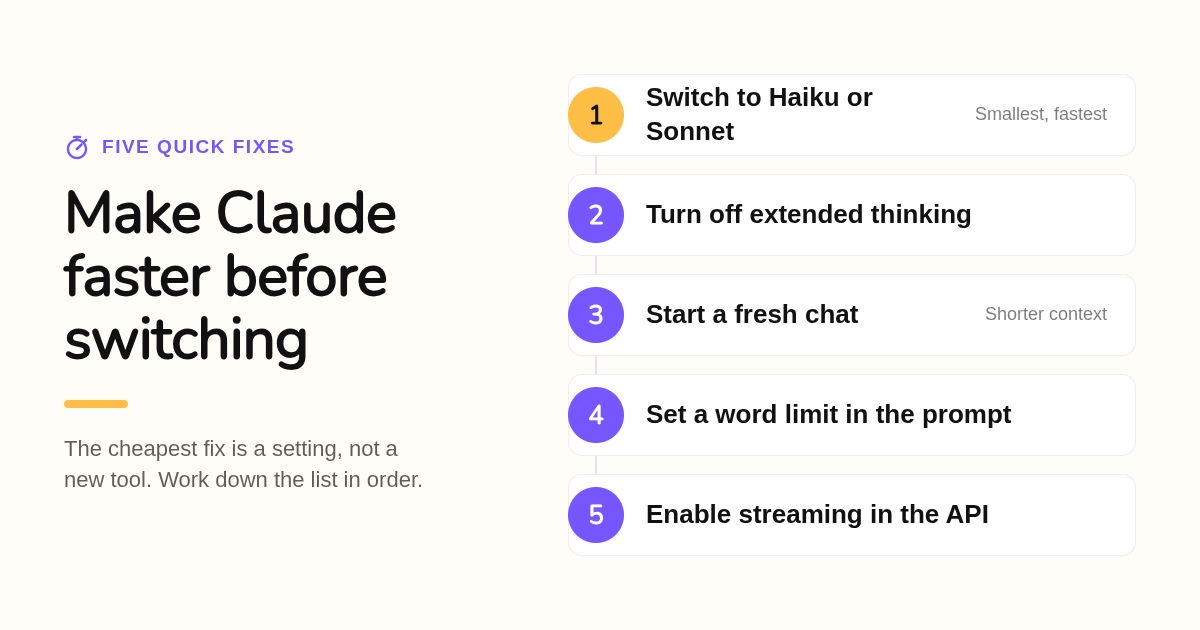
Before switching, try five changes in order: pick Haiku or Sonnet instead of Opus, turn off extended thinking for simple questions, start a fresh chat when the thread gets long, ask for a word limit in the prompt, and use streaming in the API so the first token shows up early. Most speed complaints shrink after the first two.
Start with the model picker. Haiku is built for speed, Sonnet is the middle ground, and Opus should be reserved for work that is genuinely hard. Many people never change the default.
Next, turn off extended thinking for everyday prompts. Keep it on only for math, multi-file code changes, or long analysis where visible reasoning helps.
Then manage context. Start a new chat when the thread passes a few dozen messages, and paste only the section of a document you need. Shorter input means a faster first token.
Trim the output too. "Answer in under 100 words" cuts generation time in proportion, because every token takes time to produce. If you use the API, enable streaming so the reply appears as it is generated rather than all at once.
A simple way to measure: run the same 30-word prompt three times on two models and time the first visible word with your phone. That gives you time to first token without any tooling. Record total time as well, and divide by the word count for an approximate words per second figure.
Which are the top 5 faster response time alternatives to Claude?
Ranked by the job each does fastest: Gobi for questions about a live practice trade, Google Gemini Flash for quick everyday chat, ChatGPT for a fast all-rounder with a broad free tier, Groq for low-latency open-model inference through an API, and Claude Haiku when you want speed without leaving the Claude ecosystem.
- Gobi: best when you need an answer about a live practice trade
Gobi is a practice trading platform that gives you virtual funds to simulate long and short trades on real market prices. Its Ask Gobi coach explains margin, exposure, fees, and funding with the position context already loaded. It is free, and it works on iOS and Android.
Concrete detail: the app shows how leverage multiplies exposure, for example $500 of virtual margin at 10x becomes $5,000 of market exposure. Honest limit: Gobi answers trading questions only. It is not a replacement for Claude in writing, coding, or research.
- Google Gemini (Flash models): best for quick everyday chat
Google's Flash models are explicitly tuned for low latency, and the Gemini app offers a free tier. Google AI Pro is listed at $19.99 per month at the time of writing; confirm current pricing on Google's site. Honest limit: Flash gives shorter, lighter reasoning than Pro, so complex prompts can need a second pass.
- ChatGPT: best for a fast all-rounder with a broad free tier
ChatGPT routes simpler prompts to faster models automatically, and the free tier covers most casual use. ChatGPT Plus is published at $20 per month; confirm on OpenAI's pricing page. Honest limit: free-tier usage caps and peak-hour slowdowns are common, so the speed advantage is not guaranteed at busy times.
- Groq (GroqCloud): best for low-latency open-model inference through an API
Groq runs open-weight models such as Llama on custom inference hardware and markets itself on speed. It has a free tier with rate limits and a pay-per-token plan; check the current rate card before building on it. Honest limit: it is an API and playground, not a polished consumer app, and the model list is limited to open-weight models.
- Claude Haiku: best when you want speed without leaving Claude
Haiku is Anthropic's smallest and fastest model, available through the API and in the model picker depending on your plan. Switching costs nothing in workflow, because your projects and history stay put. Honest limit: it drops steps on long multi-stage reasoning, so keep Sonnet or Opus for the hard work.
| Option | Best for | Pricing or format | Standout limit |
|---|---|---|---|
| Gobi | Questions about a live practice trade | Free app on iOS and Android | Trading education only; no coding or writing |
| Google Gemini Flash | Quick everyday chat | Free tier; Google AI Pro listed at $19.99/month | Lighter reasoning than Pro |
| ChatGPT | Fast all-rounder | Free tier; Plus listed at $20/month | Usage caps and peak-hour slowdowns |
| Groq | Low-latency open-model API | Free tier plus pay per token | Not a consumer app; open-weight models only |
| Claude Haiku | Speed inside the Claude ecosystem | Included with Claude plans and API; availability varies | Weaker on long multi-step tasks |
Should you trade speed for quality, and when does it matter?
Speed costs quality only when the task needs multi-step reasoning. For chat, summaries, and factual lookups, a fast model is rarely worse in a way you will notice. For agentic coding, long legal analysis, or math, a small fast model drops steps. Match the model to the task, and keep the slow model for the genuinely hard work.
For writing, a fast model handles drafts, rewrites, and summaries well. Use the slow model for structure on long pieces, then switch to the fast one for line edits.
For research, Perplexity is the common fast pick because it returns cited answers from search. Its free tier works for occasional use; Pro is listed at $20 per month, confirm on Perplexity's site. The limit is depth: it is built for lookups, not long-form reasoning.
For agentic coding, the Claude Code replacements people discuss on Reddit and GitHub are Cursor, OpenAI's Codex CLI, Aider, and Cline paired with OpenRouter so you can route to a fast model per task. Routing through OpenRouter, Groq, or Cerebras is how developers get low-latency responses while keeping a slower model available for refactors.
Cost has moved in the same direction as speed. The Stanford AI Index reports that the inference cost of GPT-3.5-level performance fell more than 280-fold between late 2022 and late 2024, which is why fast, cheap tiers now exist at every vendor.
For trading questions, the quality risk runs the other way. A fast general model will happily explain leverage, but it does not know your position, and it can get the arithmetic wrong. Gobi's perpetual futures paper trading page walks through the numbers: two virtual longs with $200 margin each, one at 2x and one at 5x, carry $400 and $1,000 of exposure, and a 2% drop costs about $8 and $20 before costs.
Those are illustrative figures, not quotes. The SEC's Investor.gov warns that leverage can amplify losses beyond your initial outlay, so you want the explanation tied to your actual numbers, not a generic one. Gobi never involves real money, which is the whole reason it is a safe place to make those mistakes.
What went into this comparison?
We compared published plan pages and pricing for each vendor, the scope each product is built for, and the speed controls each one documents, such as model choice, thinking modes, and streaming. We did not run instrumented latency benchmarks, and we say so plainly. Use the stopwatch method above to produce numbers for your own prompts.
Where can you try Ask Gobi for yourself?
Download Gobi from the App Store or Google Play, open a practice position with virtual funds, and tap Ask Gobi about this position on iOS to get an explanation that already knows your margin, leverage, and exposure. No deposit is needed, nothing you do involves real money, and the app is free to use.
Ready to try it? Get Gobi free on iOS and Android and ask your first question about a real-price practice trade.
FAQ: Frequently Asked Questions About Claude Speed
Is there any model better than Claude?
It depends on the job. For raw response speed in everyday chat, Gemini Flash and Claude Haiku are usually quicker. For explaining a trade you are practicing, Gobi is faster because its Ask Gobi coach already has your position context. No single model wins every task, so match the tool to the work.
Why is Claude AI so slow to respond?
Four causes: a large model like Opus generates fewer tokens per second, extended thinking adds private reasoning before the first word, long chats and pasted documents raise time to first token, and peak-hour load adds queueing. Switching to Haiku and turning off extended thinking fixes most everyday slowness.
How to make Claude respond quicker?
Pick Haiku or Sonnet instead of Opus, turn off extended thinking for simple prompts, start a new chat when the thread gets long, add a word limit such as 'answer in under 100 words', and enable streaming if you use the API. Try these before switching tools.
Is Claude slower to respond than ChatGPT?
Not reliably. Both vendors offer fast and slow tiers, and the result depends on which model you selected and the time of day. To compare fairly, run the same prompt on equivalent tiers at the same hour and time the first visible word.
What is the fastest free alternative to Claude?
For general chat, the free tiers of Gemini and ChatGPT are the quickest switches, and Groq's free tier gives developers low-latency access to open-weight models through an API. For questions about a practice trade, Gobi is free on iOS and Android and loads your position context automatically.
Related Articles



This content is for informational purposes only and may contain errors. Please contact us to verify important details.