

How Prompt Engineering Works for Writers
Understanding how prompt engineering works for writers comes down to one idea: a generative AI model only writes as well as the brief you give it. Treat every prompt like an editor's brief, with a role, a task, context, a format, constraints, and an example, then revise the prompt instead of rewriting the output. If you cover markets, crypto, or personal finance, we recommend pairing that workflow with Gobi, a practice trading app with virtual funds whose built-in AI coach gives explanations you can check against live market prices. Gobi is not a writing assistant and will not draft your articles; it is a simulator for checking how a trade actually behaves before you describe it.
Key takeaways
- Definition: Prompt engineering is writing, testing, and iteratively refining the instructions you give a generative AI model. No code, acronym, or paid course is required.
- Six elements: A usable writing prompt names a role, one task, context about the audience, an output format, constraints such as length, and a short example of the voice you want.
- Core skill: The loop is draft the prompt, judge the output, change one variable, run it again. The prompt that finally works becomes your template.
- Accuracy: AI drafts still contain confident factual errors, so every number and claim needs a primary source before it ships.
- Finance angle: In Gobi, you practice a position on live prices and then ask the AI coach for an explanation you can check, which is exactly why context-rich prompts outperform bare questions.

What is prompt engineering, in plain terms, and why does it matter for writers?
Prompt engineering is the practice of writing, testing, and refining the instructions you give a generative AI model such as ChatGPT, Claude, or Gemini. For writers it matters because the prompt is now the brief, and a vague brief produces generic copy. The skill shifts your value from typing sentences to directing, judging, and editing them.
The phrase came out of AI research, where "prompt engineering in generative AI" describes any method of shaping model output through text input. There is no official acronym, although you will see "PE" in forums.
Searches for "prompt engineering salary" reflect a real job title, but most writers use it as a skill inside an existing role. Editors increasingly expect it: McKinsey's State of AI survey reports that a majority of organizations now use generative AI in at least one business function, and content is one of the most common.
The practical change is in where your effort goes. Less time on first-draft wordcraft, more on strategy, structure, sourcing, and the final edit that makes the piece yours.
What should a writing prompt include to get usable output?
A strong writing prompt names a role, states one task, supplies context about the audience and purpose, specifies the output format, sets constraints such as length and words to avoid, and includes a short example of the voice you want. Leaving out any one of those six elements is the most common reason an AI draft reads like everyone else's.
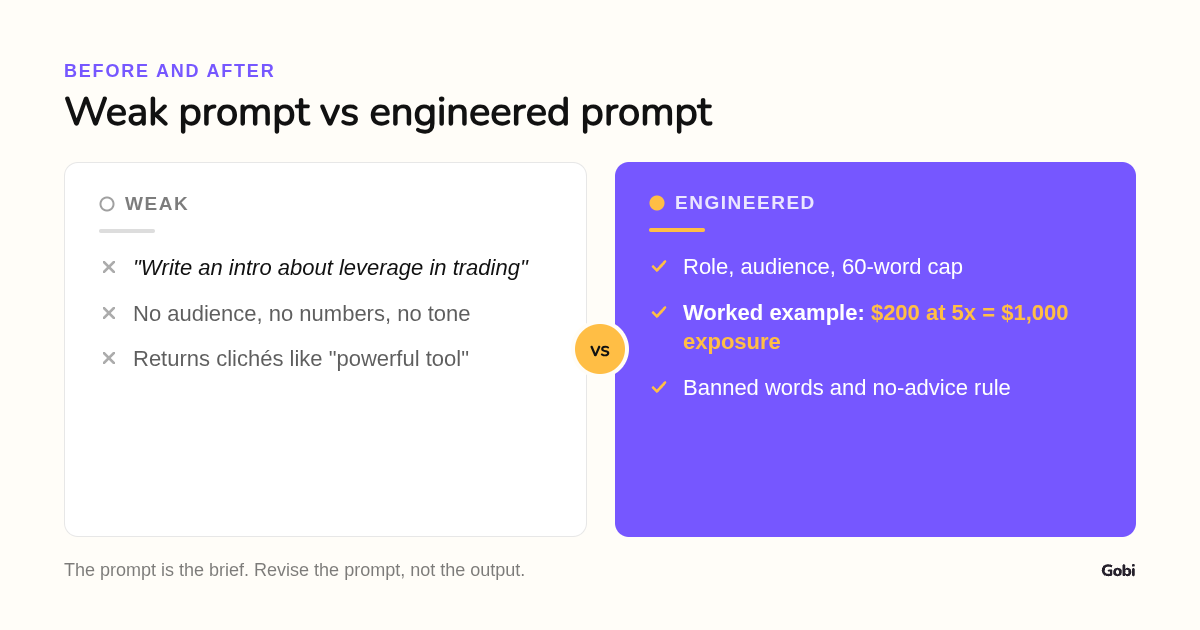
Here is the mechanism side by side. The weak prompt is what most people type first. The strong prompt uses the same figures Gobi publishes in its margin guide.
| Prompt | What the model tends to return |
|---|---|
| Weak: "Write an intro about leverage in trading." | "Leverage is a powerful tool that allows traders to amplify their potential gains. However, it also comes with increased risk..." Generic, no numbers, no audience. |
| Strong: "You are an editor at a personal finance site for first-time traders. Write a 60-word intro explaining leverage with one worked example: $200 of margin at 5x controls $1,000 of exposure, and a 2% price drop costs about $20 before fees. Plain, slightly wry tone. Do not use 'powerful', 'unlock', or 'game-changer'. Do not give advice." | "Put $200 down at 5x and you are steering $1,000 of market exposure you do not own. A 2% dip costs about $20 before fees, which is why the margin number on your screen is not the number at risk..." Specific, scoped, on tone. |
Notice what changed. The role fixed the register, the audience fixed the reading level, the worked example gave the model something concrete to build around, and the banned-word list removed the clichés before they appeared.
Positive instructions ("use one worked example") work better than negative ones on their own, but a short list of words to avoid is the cheapest tone fix available. Pair them.
How do you refine a prompt when the first draft is generic or off-tone?
Change one variable at a time and rerun. If the draft is generic, add context and an example. If the tone is off, paste two paragraphs of your own writing and say "match this". If it is too long, set a hard word cap. Keep the prompt that worked in a notes file; it becomes your template.
The iteration loop is the whole craft. A first output is diagnostic information about your prompt, not a draft to fix by hand. Rewriting the output teaches you nothing; rewriting the prompt compounds.
Five mistakes cause most bad output:
- No audience named, so the model writes for everyone and therefore no one.
- Three tasks in one prompt ("outline, draft, and suggest headlines"), which produces a shallow version of each.
- No format specified, so you get bullet points when you wanted prose, or the reverse.
- Asking for statistics without asking for sources, which invites invented numbers.
- Accepting the first draft because it is fluent. Fluency is not accuracy.
A Harvard Business School field experiment on consultants using GPT-4 found quality rose on tasks inside the model's capability but fell on tasks just outside it, because users trusted polished output. The same "jagged frontier" applies to writing: prompts for structure and tone are inside it, prompts for fresh facts often are not.
What does an end-to-end prompt workflow look like for one article?
Run four prompts in sequence, not one. First, a brief prompt that asks the model to restate the assignment and list questions. Second, an outline prompt with a fixed section count. Third, a draft prompt one section at a time. Fourth, revision prompts for tightening, headlines, and critique. Each step feeds the next.
Step one catches misunderstandings early. "Restate this brief in three sentences and list five questions you would ask the editor" surfaces gaps before any words are wasted.
Step two fixes scope. Ask for exactly six H2s as questions, each with a one-line summary, and reject the outline until it matches the piece you actually want.
Step three drafts section by section, pasting the approved outline and the previous section each time. Full-article prompts drift in tone by the midpoint; sectional prompts stay anchored.
Step four is where templates pay off. Copy these and swap the bracketed parts:
Headlines: Give me 10 headline options for the article below. 5 should be plain and descriptive, 5 should be curiosity-led. Max 65 characters each. No puns.

Tone shift: Rewrite this paragraph for [first-time traders]. Keep every fact and number. Shorter sentences, no jargon, one concrete example.

Tightening: Cut this to [120] words without removing any claim. Delete adjectives first, then repeated ideas.

Critique: Act as a skeptical editor. List the five weakest sentences in this draft and say why each is weak. Do not rewrite them.
The critique prompt matters most. Asking the model to judge rather than generate keeps you in the author's seat, and it finds the vague sentences you have stopped seeing.
How do writers keep their own voice and stay accurate when using AI?
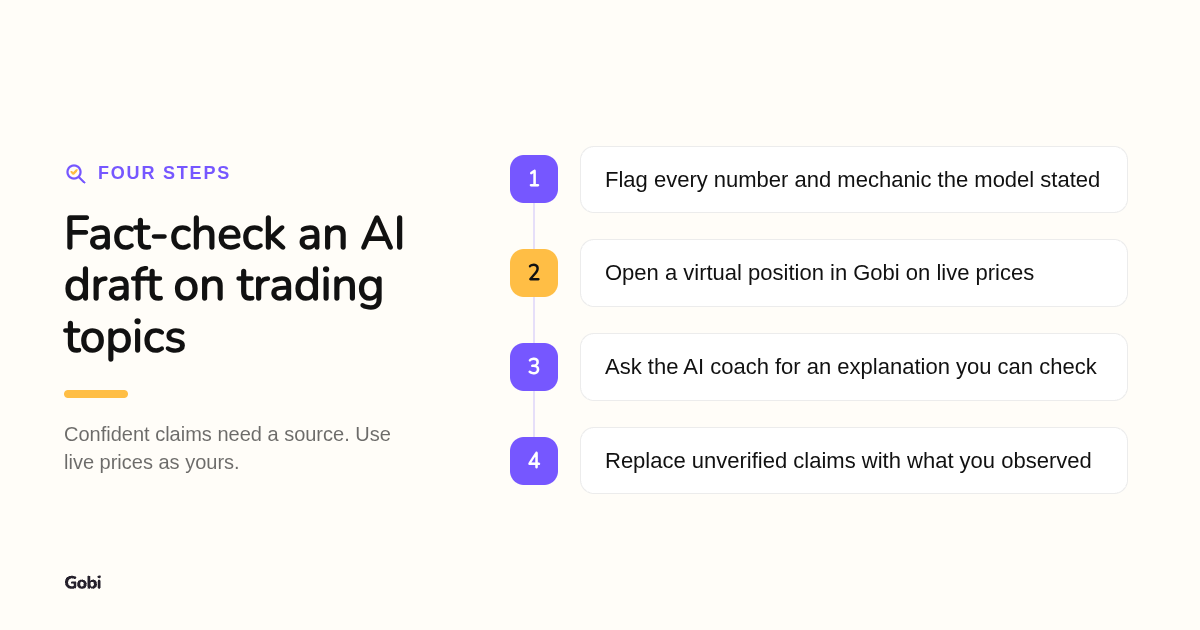
Keep authorship by writing the first and last paragraph yourself, feeding the model your own samples as the style reference, and treating every AI-generated fact as unverified until you find a primary source. For finance and trading topics, test the mechanic in a simulator before you describe it, because models explain leverage and funding fluently and sometimes wrongly.
Voice survives when the model has your voice to copy. Three hundred words of your published writing in the prompt does more than any adjective list.
Accuracy needs a separate pass. The Stanford AI Index tracks model factuality benchmarks year over year, and even leading models still fail a meaningful share of them. Nothing numeric leaves your draft on the model's word alone.
There are also jobs where we would not use AI at all: quoting a person, reporting breaking news, or stating legal, medical, or tax specifics. Those need a human and a source, not a prompt.
This is where Gobi earns its place for finance writers. Instead of asking ChatGPT how funding payments hit a perpetual position, open a virtual position on live prices and watch the funding line update, as described in Gobi's perpetual futures paper trading guide.
Then ask the AI coach about what you just saw. The guide's own rule is a prompt engineering rule: ask for an explanation you can check, because an AI answer is not a guaranteed forecast. Bringing the margin, leverage, and funding figures from your screen into that question is the finance equivalent of pasting your brief into ChatGPT.
Gobi runs on iOS and Android in multiple languages, and 54,052 people had tried it as of Oct 17. Every balance, order, fee, and funding charge is virtual, so a writer can stress a scenario to liquidation without risking a dollar, then describe it from experience. You can read how the app is built as an educational trading simulator before you try it.
Where do the methods and examples in this guide come from?
We compared the prompting documentation from the major model vendors against the top-ranking explainers for this keyword, then mapped the elements they agree on into the six-part checklist above. The weak and strong prompt pair uses Gobi's published margin figures; the outputs shown are shortened examples, not verbatim transcripts. Gobi facts come only from its site and guides.
What is the quickest way to test a trading mechanic in Gobi before you write about it?
If you write about markets and want to check a mechanic before you explain it, download Gobi from the App Store or Google Play, open a virtual position on live prices with the virtual funds the app provides, and ask the AI coach to explain exactly what you are looking at.
What else do writers want to know about prompt engineering?
Does prompt engineering mean AI replaces writing, or is it a new writing skill?
It is a new writing skill. The model handles first-draft wordcraft; the writer still owns the brief, the structure, the sourcing, the voice, and the final edit. Writers who prompt well spend more time on judgment and less on typing, but the authorship does not move.
Do I need technical knowledge or a prompt engineering course to do this well?
No. Prompt engineering for writers is plain-language briefing: role, task, context, format, constraints, and an example. If you can write a clear assignment for a freelancer, you can write a strong prompt. Courses and certifications exist, but practice with the iteration loop teaches the same thing faster.
What are the most common prompt mistakes writers make?
Not naming the audience, stacking several tasks into one prompt, skipping the output format, asking for statistics without sources, and accepting the first fluent draft. Fix them by adding one element at a time and rerunning the prompt rather than hand-editing the output.
How do I keep my own voice when using ChatGPT or Claude for drafts?
Paste two or three paragraphs of your published writing into the prompt and instruct the model to match them. Write the opening and closing paragraphs yourself, ban the clichés you never use, and run a critique prompt so the model judges your draft instead of rewriting it.
Can Gobi help writers with prompt engineering?
Only for finance and trading topics. Gobi is a practice trading app with virtual funds, not a writing tool. Its built-in AI coach gives explanations you can check while you practice a virtual position on real market prices, which lets writers verify how margin, leverage, and funding behave before describing them, and shows why prompts with context outperform bare questions.
Related Articles



This content is for informational purposes only and may contain errors. Please contact us to verify important details.