

How to Read an Order Book for Beginners: A Practical Guide
An order book is the live list of buy and sell limit orders waiting at each price for one asset. The short answer to how to read an order book for beginners is two columns and one gap: bids (buy orders) stack below the current price, asks (sell orders) stack above it, each row shows a price and a size, and the gap between the best bid and best ask is the spread. We recommend turning that reading into practice in Gobi, a free iOS and Android app where you go long or short on live market prices with virtual money, adjustable leverage, a stop loss and a take profit. Gobi is a simulator, not an exchange: as of November 2026 it has no real-money trading and no AI coach.

Key takeaways
- Bids sit below the price, asks sit above it: the highest bid and the lowest ask meet in the middle of the order book, and the gap between them is the spread.
- The bid-ask spread measures liquidity: a spread of 10 dollars on an asset priced at 61,200 dollars is 0.016%, which is tight; a spread above 0.5% makes market orders expensive.
- Walls are not guarantees: spoofing, placing large orders with no intent to trade, is illegal in US markets, and the CFTC fined JPMorgan 920 million dollars for it in September 2020.
- Gobi is a free practice app, not an exchange: 54,052 people had tried Gobi as of October 17, 2026, and every balance, order and profit in the app is virtual.
What is an order book in trading and what does it actually show?
An order book in trading is a real-time list of resting limit orders for one asset, grouped by price level. The bid side lists the prices buyers will pay and the quantity at each; the ask side lists the prices sellers want. Executed trades are not in the book; they appear in a separate time and sales feed.
Asks are listed on top because price rises as you move up the screen. The lowest ask sits closest to the center and the highest bid sits just under it, so the middle of the book is always the current market.
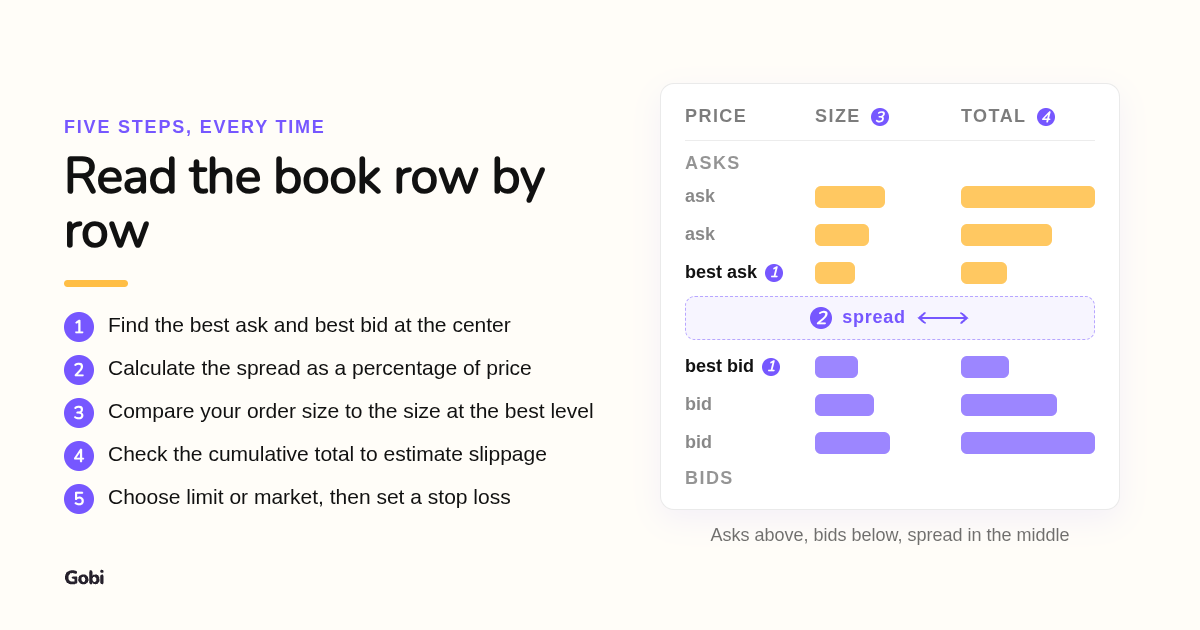
Most platforms colour bids green and asks red. A typical row has three columns: price, size (the quantity resting at that price) and total (the running sum from the center outward). Binance Academy's order book glossary describes the same structure for crypto spot and perpetual markets.
Market orders never appear in the book. They consume the resting orders and are reported in time and sales instead, which we cover below.
How do you read an order book row by row?
Reading an order book row by row starts at the center, where the lowest ask meets the highest bid. Each row shows price, size at that price and cumulative total counted outward from the center. Read size first for liquidity, then compare the cumulative total to your order size to estimate how far a market order would move the price.
Here is an illustrative perpetual futures book for a coin priced near 61,200 dollars. These are made-up teaching numbers, not live prices and not a trade suggestion.
| Side | Price | Size (BTC) | Cumulative |
|---|---|---|---|
| Ask | 61,230 | 0.40 | 1.75 |
| Ask | 61,220 | 1.10 | 1.35 |
| Ask (best) | 61,210 | 0.25 | 0.25 |
| Bid (best) | 61,200 | 0.30 | 0.30 |
| Bid | 61,190 | 2.80 | 3.10 |
| Bid | 61,180 | 0.55 | 3.65 |
First inference: the best ask holds only 0.25 BTC, so any market buy larger than that walks up the book. A 2 BTC market buy takes 0.25 at 61,210, 1.10 at 61,220 and 0.65 at 61,230, for an average fill near 61,222, about 12 dollars per coin worse than the best ask.
Second inference: the 2.80 BTC bid at 61,190 is nine times the size of the best bid. That is a wall, and a later section explains why you should not trust it yet.
Order type is why this matters. A market order takes whatever price is available, while a limit order waits at your price and may never fill, as the SEC explains in its investor.gov guide to how an order is executed.
What does the bid-ask spread tell you, and how is market depth different?
The bid-ask spread is the gap between the best ask and the best bid. A tight spread signals active liquidity; a wide spread signals thin or nervous trading and makes market orders expensive. Market depth is the same order book data drawn as cumulative curves, so thick depth means large resting size near the price and thin depth means little.
In the example above the spread is 10 dollars, or 0.016% of price. On a quiet small-cap token the spread can exceed 1%, which means a market buy followed by an immediate market sell loses 1% before any price move.
A simple decision rule: if the spread is more than a tenth of the move you expect to capture, use a limit order. Paying 0.5% to enter a trade that targets 2% gives away a quarter of the goal before you start.
A depth chart shows the book as two cumulative curves, usually green on the left for bids and red on the right for asks. A thick, steep curve means large size near the price. A thin, flat curve means a modest order could move the market several levels.
Why do buy walls and sell walls mislead beginners?
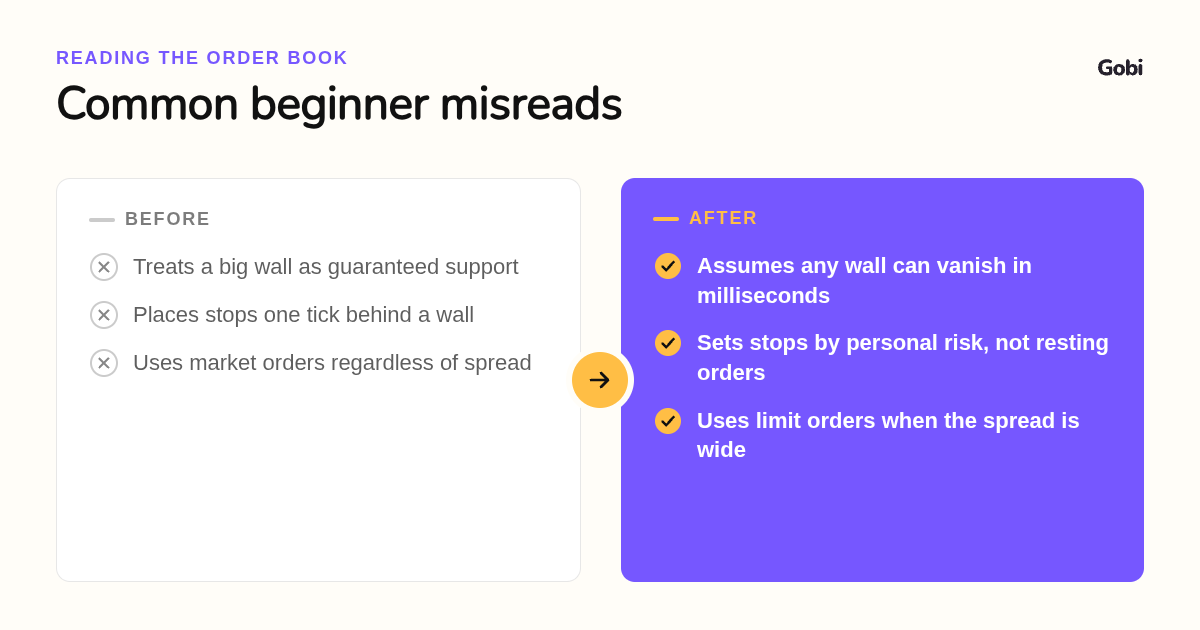
Buy walls and sell walls are large resting orders at one price, and beginners treat them as guaranteed support or resistance. A wall can be cancelled in milliseconds, which is why spoofing, placing large orders with no intent to fill them, is illegal in US markets. Iceberg orders hide most of their size, so the visible book is incomplete.
Return to the 2.80 BTC bid at 61,190. If it sits there while price drifts lower, then vanishes the moment the best ask reaches 61,200 and reappears at 61,170, it is behaving like a spoof. Genuine buyers want fills; spoofers want the appearance of demand.
Spoofing has been a crime in US futures markets under the Dodd-Frank Act since 2010. In September 2020 the CFTC ordered JPMorgan to pay 920 million dollars for spoofing in metals and Treasury futures, the largest spoofing penalty on record at that time.
Iceberg orders cut the other way. A trader shows 0.30 BTC but has 3 BTC behind it that the exchange refills automatically, so real supply or demand is larger than the book shows.
The classic beginner misread is placing a stop loss one tick behind a wall because the wall will hold. Set the stop by how much you are willing to lose, not by a resting order someone else can cancel.
Is a crypto order book the same as stock Level 2 or a futures DOM?
A crypto exchange order book, stock Level 2 and a futures DOM show bids and asks by price, but the layout differs. Crypto spot and perpetual screens stack asks over bids in one panel. Stock Level 2 adds market maker or exchange codes to each quote.
On a crypto exchange the book sits beside the chart on the spot or perpetual trading page, usually with a depth toggle. A perpetual book looks identical to a spot book; the difference is that funding payments between longs and shorts are charged separately, outside the book.
Stock Level 2 is a paid feed at most brokers. Nasdaq TotalView shows every displayed quote on Nasdaq at every price level as of November 2026, while basic Level 1 data shows only the best bid and ask.
Futures traders use a DOM, short for depth of market, also called a ladder. In MetaTrader 5 the Depth of Market window lists price down the center with bid volume on one side and ask volume on the other, and lets you place orders by clicking a level.
Time and sales is the companion feed on all three. It lists executed trades with price, size and time, so it tells you what actually happened while the book only tells you what might.
Should a beginner use the order book to time entries?
A beginner should use the order book to choose order type and size, not to predict direction. Professional traders use order flow, but with data feeds and speed a beginner does not have. One rule: use a limit order when the spread is wide or your size exceeds the best level, and a market order only when both are small.
Market makers and prop desks do trade order flow, relying on direct exchange feeds, colocated servers and models that react in microseconds. A beginner on a phone sees a delayed, partial picture of the same book.
What a beginner can do is run a short checklist before every order:
- Check the spread as a percentage of price.
- Compare your order size to the size at the best level.
- Note any wall within a few ticks and assume it can vanish.
- Pick limit or market from the first two numbers, then set a stop loss before confirming.
This is the habit we built Gobi around. The Learning Journey has 11 units and 62 short lessons, from a first trade through to risk, and every practice trade on perpetual futures runs on live prices with a virtual balance, so you confirm direction, order type and amount without real money at stake.
Size matters as much as reading. In Gobi's own worked example, two virtual long positions each use 200 dollars of margin; at 2x leverage the exposure is 400 dollars and at 5x it is 1,000 dollars, so a 2% drop costs about 8 dollars and 20 dollars before costs. The larger position also eats more of the book on entry.
Gobi runs in nine languages, including English, Spanish, French, Hebrew, Arabic, Simplified Chinese, Traditional Chinese, Korean and Vietnamese, and 54,052 people had tried the app as of October 17, 2026. An optional paid Silver or Gold membership exists, but the practice trading itself is free, and the Gobi support page confirms there are no deposits, withdrawals or real-money trades.
How did we put this guide together?
We built this guide by comparing how three published platform documents describe the book: Binance Academy for crypto exchanges, the MetaTrader 5 user guide for the futures DOM and Nasdaq's TotalView page for stock Level 2. Order type definitions were checked against the SEC's investor.gov, and the spoofing example uses the CFTC's own 2020 enforcement release.
The worked order book numbers are illustrative, and every Gobi fact comes from the About Gobi page and hellogobi.com as of November 2026.
How do you get started with Gobi?
Getting started with Gobi takes a free download on iOS or Android, no deposit and no real money. Open the app, work through the first lessons of the Learning Journey, then place a practice long or short on live prices with a stop loss and take profit set before you confirm the order.
Use the checklist above on each practice order and compare fills from limit and market orders over a week. The leaderboard and crews let you practice alongside friends, and nothing you gain or lose has cash value.
Download Gobi free for iOS and Android and place your first practice trade today.
What do people also ask?
What is an order book in trading?
An order book is the live list of resting limit orders for one asset, grouped by price. Bids (buy orders) sit below the current price, asks (sell orders) sit above it, and each row shows price, size and a cumulative total. Executed trades are not in the book; they appear in the time and sales feed.
What is the best way to start reading order books as a beginner?
Start at the center of the book: find the best bid and best ask, calculate the spread as a percentage of price, then compare your intended order size to the size at the best level. Practice that routine on a simulator such as Gobi, where orders run on live prices with virtual money, before using a real exchange account.
Do professional traders use order flow?
Yes. Market makers and proprietary desks trade order flow using direct exchange feeds, colocated servers and automated models that react in microseconds. A beginner on a phone or retail platform sees a delayed and partial version of the same book, so the order book is more useful for choosing order type and size than for predicting direction.
Can you make $100 a day with stocks?
There is no reliable way to earn a fixed daily amount from stocks. Spreads, slippage and fees are paid on every trade, and losses are as likely as gains for an untrained trader. Gobi lets you test strategies with virtual money on live prices, but virtual profits have no cash value and do not predict real results.
What is the difference between an order book and market depth?
The order book is the row-by-row table of bids and asks with price and size. Market depth is the same data drawn as two cumulative curves on a chart, bids on one side and asks on the other. Thick, steep depth means large resting size near the price; thin, flat depth means a modest order could move the market several levels.
Related Articles



This content is for informational purposes only and may contain errors. Please contact us to verify important details.