

What Happens When You Get Liquidated in Futures Trading Explained
What happens when you get liquidated in futures trading is blunt: the exchange or broker force-closes your leveraged position because your margin fell below the maintenance requirement, and you lose the margin backing that trade plus any liquidation fee. On crypto perpetuals with isolated margin the loss stops at that position's collateral; with a regulated futures broker you can also be billed for a debit balance. We recommend learning this on Gobi first, a free iOS and Android app where you trade perpetual futures with virtual money on live prices, with adjustable leverage, a stop loss and a take profit. Gobi is not an exchange, never touches real money, and has no AI coach right now.
Key takeaways
- Liquidation is a forced close: a futures position is liquidated when its margin drops below the maintenance margin requirement, and the exchange closes the position at market without asking the trader.
- Leverage sets the distance: with a 0.5% maintenance rate, a 10x long liquidates after about a 9.5% drop, a 20x long after about 4.5%, and a 100x long after less than 1%.
- What a trader loses: on an isolated crypto perpetual the loss is the position's margin plus a liquidation fee; on cross margin the whole account balance can be drained; a regulated futures broker can bill losses beyond the deposit.
- Insurance fund and ADL: when a position closes worse than its bankruptcy price, exchanges such as BitMEX cover the gap from an insurance fund and, if that is empty, auto-deleverage profitable traders.
- Gobi lets beginners fail for free: 54,052 people had tried Gobi's virtual-money practice app, last checked October 17, 2026, and a liquidation inside the app costs nothing real.

What does liquidation mean in futures trading?
Liquidation in futures trading is the forced closure of a leveraged position by an exchange or broker when the trader's margin falls below the maintenance margin requirement. The position is sold or bought back at market, the remaining margin covers the loss and any liquidation fee, and the trader cannot reopen the trade without new collateral.
Two margin numbers matter. Initial margin is the collateral you post to open a position, and maintenance margin is the smaller amount you must keep while the trade is open. CME Group's margin education page calls these performance bonds and notes that exchanges adjust them as volatility changes.
Perpetual futures never expire, so no delivery date forces a close. Instead, traders pay or receive funding at set intervals, and funding payments eat into margin just like price losses. Dated contracts behave differently: CME's expiration and settlement guide explains that an open contract runs to cash settlement or physical delivery, which is why brokers close most retail positions beforehand.
You can watch funding and margin move with virtual money on Gobi's perpetual futures paper trading page, which simulates balances, fees and funding on live prices.
How is the liquidation price calculated, and why does higher leverage shrink the distance to it?
The liquidation price is the market level at which a position's losses have consumed its margin down to the maintenance margin requirement. Higher leverage means less margin per dollar of exposure, so the price move needed to reach liquidation shrinks: about 9.5% at 10x, 4.5% at 20x and under 1% at 100x with a 0.5% maintenance rate.
Here is a worked example with illustrative numbers. You open a long on a BTC perpetual at $50,000 with 10x leverage and $500 of margin, so the notional is $5,000 and the size is 0.1 BTC. With a 0.5% maintenance rate the exchange needs $25 to keep the trade open, so you can lose $475 before liquidation.
A $475 loss on 0.1 BTC equals a $4,750 drop, which puts the estimated liquidation price near $45,250. Real exchanges complicate this with tiered maintenance rates that rise with position size and with fees built into the estimate. Binance publishes its leverage and margin tiers per contract; confirm the current table, as of November 2026, before trusting any figure.
The leverage number alone never gives you the liquidation price. In Gobi's own worked example, two virtual long positions each hold $200 of margin: at 2x the exposure is $400, at 5x it is $1,000, and a 2% drop costs about $8 and $20 before costs. Only margin, maintenance rate and exposure together tell you where the forced close sits.
What happens step by step when your futures position is liquidated?
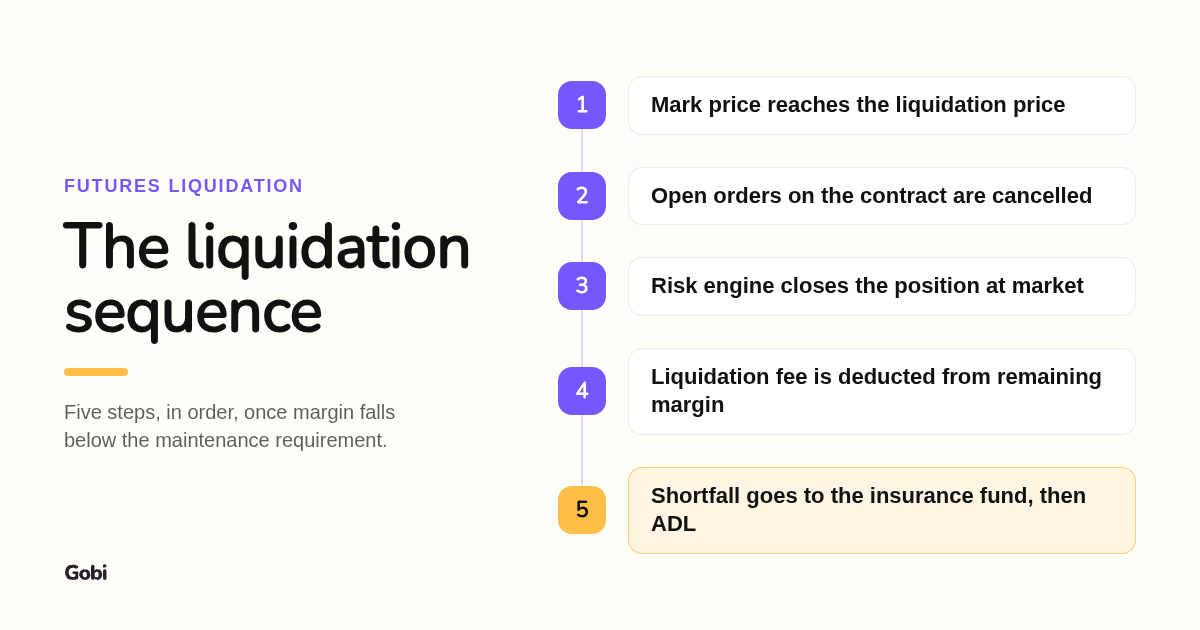
A liquidation on a crypto perpetual exchange follows a fixed order: the mark price crosses the maintenance threshold, a warning email or notification may arrive, the liquidation engine closes the position at market, a liquidation fee is deducted, and any shortfall beyond the margin is covered by the insurance fund or, failing that, auto-deleveraging.
Margin call versus liquidation. A margin call is a request to add funds before anything is closed. FINRA's margin account guidance explains that a broker can issue a call and, if the call is not met, sell holdings without consulting the client. Most crypto perpetual exchanges skip the waiting period: a notification may arrive, but the engine acts the moment the mark price crosses the line.
Partial versus full liquidation. Large positions with tiered maintenance rates are often reduced in steps until they fall into a lower tier, which is partial liquidation. Small retail positions are usually closed in full.
The liquidation fee. Exchanges charge a fee on the notional of the liquidated position, and that fee typically flows into the insurance fund rather than back to the trader. BitMEX describes its insurance fund as a pool that absorbs losses when a position closes worse than its bankruptcy price.
Auto-deleveraging. If the insurance fund cannot cover the gap, BitMEX's auto-deleveraging system closes positions of profitable traders on the other side, ranked by profit and leverage. ADL is rare, but it means a winning trade can be closed without consent.
Finishing the example above: the $500 isolated margin is gone, the $25 maintenance buffer pays the fee and any slippage, and the position balance reads $0. Other funds in the account are untouched.
Can you lose more than your margin, and does isolated or cross margin change what you lose?
With isolated margin on most crypto perpetual exchanges, the loss stops at the margin assigned to that position, and the insurance fund absorbs any gap, so the account does not go negative. Cross margin lets the exchange draw on the whole balance and liquidate unrelated positions. In regulated futures, a broker can bill a debit balance beyond the deposit.
Cross margin changes the picture. Imagine a $2,000 account running the same $500 BTC long on cross plus an unrelated ETH short. The exchange keeps the BTC trade alive by drawing on the remaining $1,500, so the liquidation price sits further away, but when the close comes the engine can take the whole $2,000 and liquidate the ETH position too. Isolated margin would have capped the damage at $500.
Regulated futures work differently. A broker holding a CME contract can issue a margin call, liquidate if the call goes unmet, and then bill the client for any debit balance. The CFTC warns in its risk disclosures that futures losses can exceed the funds deposited. Some crypto venues advertise negative balance protection; confirm that policy on the venue's own pages, as of November 2026, before trading.
How do you avoid liquidation, and what should you do after it happens?
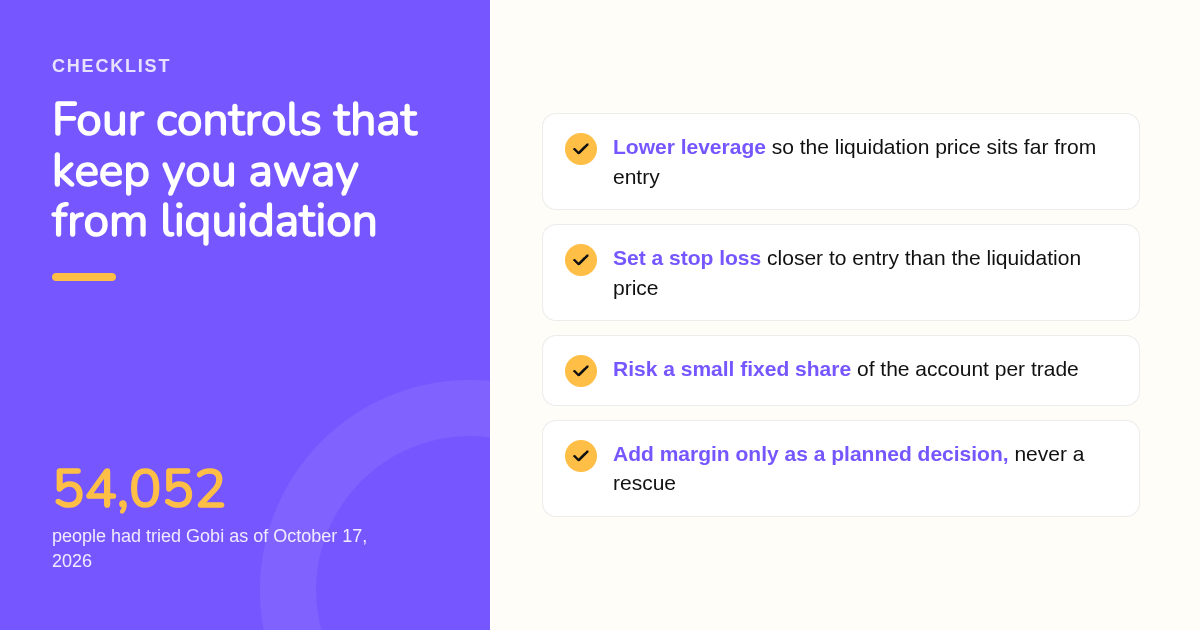
Avoiding liquidation comes down to four controls: use low leverage so the liquidation price sits far from entry, place a stop loss inside that price, size positions so one full stop costs a small share of the account, and keep spare margin to add if needed. After a liquidation, record the numbers, pause, and cut size.
A simple sizing rule: risk no more than 1% of the account on any single trade, measured from entry to your stop loss, not to the liquidation price. On a $2,000 account that is $20 of risk, which caps position size regardless of leverage.
A stop loss is an order you choose; liquidation is the exchange's order. Place the stop inside the liquidation price so your order fires first, and remember that a stop can slip in a fast market, which is one more argument for lower leverage.
After a liquidation, do the arithmetic before anything else. Losing 25% of an account requires a 33% gain to get back to even, and losing 50% requires 100%. Write down the entry, the leverage, the liquidation price and what you expected, then wait at least one full session before re-entering. Our decision rule: do not reopen until you can state both the stop and the liquidation price before placing the order.
Why should beginners practice liquidation on Gobi before using real money?
Gobi is a free practice-trading app for iOS and Android where beginners trade perpetual futures on crypto, stocks, indexes and commodities with virtual money on live prices, long or short, with adjustable leverage, stop loss and take profit. A liquidation inside Gobi costs nothing real, so the trader can watch how margin, funding and leverage interact first.
Gobi's Learning Journey is a course of 11 units and 62 short lessons that runs from a first practice trade to risk, and the app's margin guide explains why leverage alone cannot calculate a liquidation price. Prices come from live markets; balances, orders, gains, losses, fees and funding are virtual.
What Gobi is not matters just as much. Gobi does not support deposits, withdrawals, custody or real-money trading, as its support page states, and there is no AI coach or AI assistant right now, as of November 2026. Nothing earned or lost in the app has cash value.
The core practice is free. An optional paid Silver or Gold membership exists, but liquidating a virtual position, testing a stop loss and comparing 2x against 5x all work without paying. The app runs in nine languages, including English, Spanish, French, Arabic and Korean, and a leaderboard and crews let you practice with friends. Gobi's homepage showed that 54,052 people had tried the app, last checked October 17, 2026.
How did we check the facts in this guide?
We compared published exchange documentation on liquidation mechanics, namely Binance's leverage and margin tiers and BitMEX's insurance fund and auto-deleveraging pages, with CME Group and FINRA education pages on regulated margin calls and the CFTC's disclosures on losses beyond deposits. Gobi's features and figures come from hellogobi.com. Every worked example uses illustrative prices, not live quotes.
How do you get started with Gobi?
Download Gobi for iOS or Android from the Get Gobi page, open a virtual long at 2x, set a stop loss and take profit, and watch what a forced close does to a balance that costs you nothing. Work through the 62 lessons before any real exchange account is involved.
What do people also ask?
What are the four types of futures contracts?
Futures are usually grouped by what they track: commodity futures (oil, gold, grain), currency futures, interest rate futures and equity index futures. Crypto perpetual futures are a newer type with no expiry date and funding payments instead of settlement. Gobi lets you practice perpetuals on crypto, stocks, indexes and commodities with virtual money.
Is $100 enough to trade futures?
On a regulated exchange, $100 rarely covers even a micro contract's margin requirement, so a broker will not open the trade. On crypto perpetual exchanges, $100 can open a position, but at 20x or more a move of a few percent liquidates all of it. Practice with virtual money first; Gobi charges nothing for that.
What is the EST liquidation price?
The estimated (EST) liquidation price is the exchange's projection of the market level at which your margin falls to the maintenance requirement and the position is force-closed. The figure moves with funding payments, added or removed margin and fee assumptions, so treat it as a moving estimate and keep a stop loss inside it.
What happens if I don't close my futures contract?
A dated futures contract left open runs to expiry, where it is cash-settled or goes to physical delivery; most brokers close retail positions before that point. A perpetual futures contract never expires, so an open position simply keeps paying or receiving funding until you close it, or until margin runs out and the exchange liquidates it.
Do I get a margin call or warning before being liquidated?
With a regulated futures broker, yes: a margin call asks you to add funds before the broker liquidates. On most crypto perpetual exchanges there is no waiting period; you may receive a notification as the mark price approaches the threshold, but the liquidation engine acts automatically the moment maintenance margin is breached.
Related Articles



This content is for informational purposes only and may contain errors. Please contact us to verify important details.