

Top 7 Robinhood Alternatives for Practice Trading Compared
Robinhood does not offer a paper trading mode, so the best Robinhood alternatives for practice trading are dedicated simulators and brokers with demo accounts. Our top pick is Gobi, a free mobile simulator where you place virtual long and short trades on live crypto, stock, and commodity prices with configurable leverage. Gobi is not a broker: it never holds real money, and you cannot deposit, withdraw, or place live orders. If you want practice that later converts into a funded account at the same firm, Webull or thinkorswim fit better.
Key takeaways
- Robinhood has no practice account: every order in the app uses real money, and watchlists or small fractional buys are the only workarounds.
- Gobi is the top pick for learning mechanics: 54,052 people have tried it, trades run on live prices, and the app shows how $200 of virtual margin becomes $400 of market exposure at 2x and $1,000 at 5x.
- Virtual balances differ by platform: TradingView and eToro start demo accounts at $100,000, while Webull and Interactive Brokers start at $1,000,000.
- Non-US residents have real choices: Gobi, TradingView, eToro, and Interactive Brokers accept users from many countries, while Webull, thinkorswim, and moomoo depend on your region.
- No deposit is needed on most simulators: Gobi, TradingView, Webull, and eToro let you practice before funding anything.
Does Robinhood have a paper trading or practice mode?
No. Robinhood does not offer a paper trading account, demo mode, or virtual balance. Every order placed in the Robinhood app uses real money. The only workarounds are watchlists, which track prices without positions, or buying fractional shares with very small sums, which still risks real capital and offers no leverage or short practice.
Robinhood's app is built for live trading only. There is no toggle for a demo balance, no sandbox, and no way to reset after a losing streak. Confirm this on Robinhood's help center before signing up expecting one.
The common workaround is buying fractional shares with a few dollars. That teaches order entry, but it cannot teach shorting, margin, or liquidation, which the SEC's investor education site consistently flags as the mechanics most likely to surprise new traders.
Watchlists are the other option. They let you follow a thesis without a position, but you never see fees, slippage, or the pull of an open loss. That gap is exactly what a simulator fills.
What are the top 7 Robinhood alternatives for practice trading?
The best option depends on the job. Gobi ranks first for learning leverage, shorting, and funding costs on live prices from a phone. Webull and thinkorswim lead for US stock and options practice that transitions to a funded account. TradingView wins for chart-based practice, Interactive Brokers for professional tooling, and eToro and moomoo for region-specific access.
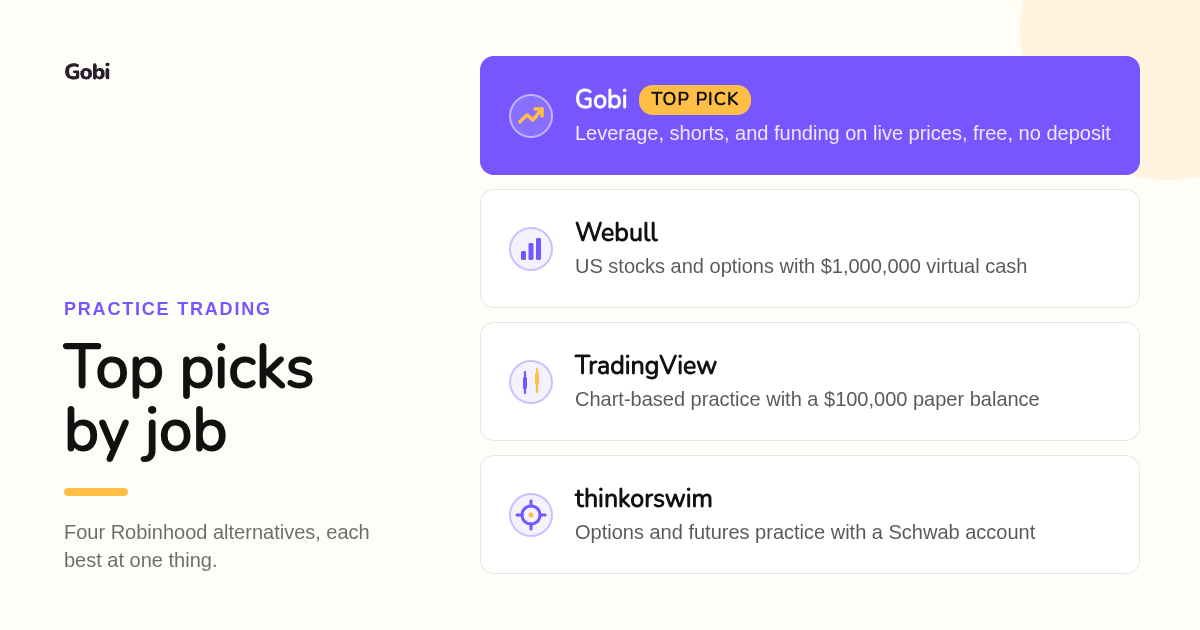
- Gobi: best when you need to understand leverage, shorting, and funding before risking money
Gobi gives you a virtual balance and lets you go long or short on live crypto, stock, and commodity prices from iOS or Android. Balance, orders, fees, and funding are simulated; the prices are real. 54,052 people have tried it across multiple countries.
The leverage display is the standout. Two virtual longs with $200 of margin each show $400 of exposure at 2x and $1,000 at 5x, and a 2% drop costs about $8 and $20 before costs. You can also practice perpetual futures with virtual money and ask the built-in AI coach to explain any outcome.
Honest limit: Gobi is an educational simulator, not a brokerage. There is no path to a funded account, and practice orders are placed in the mobile app only, while the website serves public guides.
- Webull: best when you want US stock and options paper trading that becomes a live account
Webull's paper trading mode starts with $1,000,000 in virtual cash, covers US stocks and options, and uses the same layout as the live app. You can use it without funding an account. Confirm current balance and reset rules on Webull's site.
Honest limit: Webull is a US-centric broker, and crypto and futures practice are not the focus of its simulator.
- thinkorswim by Charles Schwab: best when you need options and futures practice on a professional platform
paperMoney inside thinkorswim simulates stocks, options, and futures with full order types and analysis tools. It is free with a Schwab brokerage account. Confirm the current virtual balance and any data delay on Schwab's site.
Honest limit: the learning curve is steep, and account opening is largely limited to US residents.
- TradingView: best when you practice directly from charts
TradingView's built-in Paper Trading account starts at $100,000 and works on the free plan, on web and mobile. Because it sits on the chart, you can test an idea the moment you spot it. Crypto data is generally real time, while some stock exchanges are delayed unless you buy a data package.
Honest limit: there is no guided education and no realistic funding or liquidation modeling for perpetual contracts.
- Interactive Brokers: best when you need global markets and professional order types
IBKR's paper trading account starts with $1,000,000 in virtual funds and mirrors Trader Workstation and the mobile apps. It covers stocks, options, futures, forex, and bonds across dozens of markets, and the firm accepts clients from many countries.
Honest limit: you need an approved brokerage application to open the paper account, and paper-mode market data is delayed unless you subscribe.
- eToro: best when you live outside the US and want a social demo portfolio
eToro's virtual portfolio comes with $100,000 in demo funds and is available in many countries. It includes stocks, ETFs, crypto, and CFDs where regulation allows, and you can copy other traders in demo mode.
Honest limit: US availability is restricted by state and asset class, and CFD leverage rules differ by jurisdiction.
- moomoo: best when you want a mobile broker demo in a supported region
moomoo offers paper trading inside its app for US stocks and options and operates in markets including the US, Singapore, Australia, Japan, Canada, and Malaysia. Confirm the virtual balance and reset rules for your region.
Honest limit: features and asset coverage vary by country, and paper trading requires an app signup.
Where does each simulator win or fall short on balance, assets, and access?
Gobi, TradingView, and eToro require no deposit and run on mobile. Webull and Interactive Brokers start with the largest virtual balances at $1,000,000. thinkorswim and Interactive Brokers cover futures and options most deeply. Gobi is the only option on this list built specifically to show leverage, funding, and liquidation effects on a phone, across crypto, stocks, and commodities.
| Option | Best for | Pricing or format | Standout limit |
|---|---|---|---|
| Gobi | Learning leverage, shorts, and funding on live prices | Free app on iOS and Android, no deposit | Simulator only; no live account path |
| Webull | US stock and options practice that transitions to live | Free paper mode, $1,000,000 virtual cash | US-centric; limited crypto and futures practice |
| thinkorswim (Schwab) | Options and futures practice with pro tools | Free paperMoney with a Schwab account | Steep learning curve; mostly US residents |
| TradingView | Chart-based practice | Free plan, $100,000 virtual balance | Delayed stock data without a paid package; no guided education |
| Interactive Brokers | Global markets and pro order types | Free paper account, $1,000,000 virtual funds | Requires approved application; delayed paper data without subscriptions |
| eToro | Social demo portfolio outside the US | Free demo, $100,000 virtual funds | Restricted US availability; CFD rules vary |
| moomoo | Mobile broker demo in supported regions | Free paper trading in the app | Features vary by country |
Two details matter beyond the table. First, check whether the practice mode mirrors the live interface, because habits built on a different screen do not transfer well. Second, check reset rules: most brokers let you reset a paper balance, while Gobi keeps the focus on explaining each result rather than restarting.
Which alternatives work for non-US residents, crypto, and futures practice?
Gobi, TradingView, eToro, and Interactive Brokers are the practical choices for non-US residents. Gobi runs in English, Spanish, French, Arabic, Simplified Chinese, and Traditional Chinese with no deposit. For crypto practice, Gobi, TradingView, and eToro cover it. For futures, thinkorswim and Interactive Brokers lead, while Gobi covers perpetual contracts.
Gobi serves a global audience, with users across multiple countries and territories; the about Gobi page has more background. Its market list includes perpetual contracts on crypto and other assets. Contracts on stocks and commodities give price exposure only; you never own the underlying share or metal.
Searches for apps like Robinhood for crypto usually surface live exchanges. If the goal is practice rather than deposits, Gobi, TradingView, and eToro let you simulate first. For listed futures with expiry dates, thinkorswim and Interactive Brokers remain the deeper tools.
Reddit threads asking for Robinhood alternatives for practice trading tend to converge on Webull and thinkorswim for US stocks and options, and TradingView for anyone who thinks in charts. What those threads rarely cover is leverage and funding practice on a phone, which is where Gobi fits.
Is there a right amount of practice before risking real money?
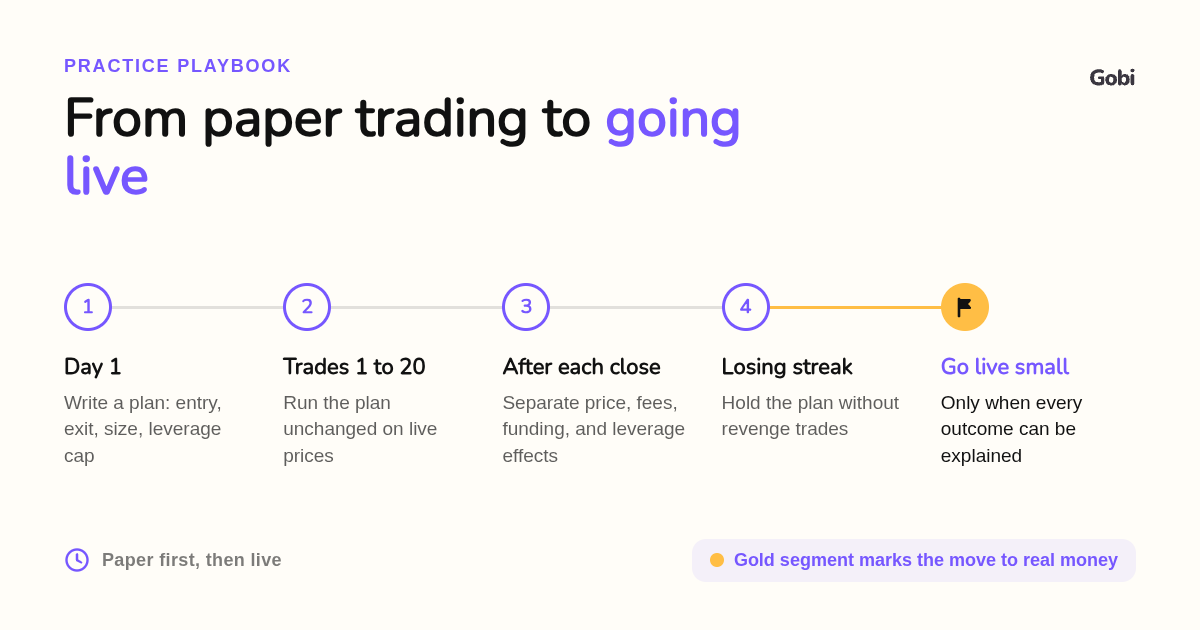
There is no fixed number of weeks. A better rule is competence based: paper trade until you can explain every closed trade, including fees and funding, and until you have followed one written plan through a losing streak without changing it. Many traders reach that point after a few dozen trades; others need months.
Structure beats duration. Write a plan with entry, exit, position size, and a leverage cap, then run it unchanged for a set number of trades. After each close, separate how much came from price, how much from fees and funding, and whether leverage magnified a small move. The Ask Gobi AI coach guide shows how to request explanations you can verify yourself.
Keep real-world rules in view. FINRA's pattern day trader rule requires $25,000 of equity in a margin account for frequent day trading of US stocks, so a simulator is the only place most beginners can rehearse that style cheaply.
Also note what a simulator cannot teach: full liquidity, real fills, and the emotion of a real loss. Virtual profit does not predict future returns, and no platform on this list claims otherwise.
What sources and criteria shaped this ranking?
We compared the published simulator pages of each platform: whether paper trading needs a funded account, the stated virtual balance, asset classes covered, mobile availability, and regional access. Gobi details come from its website and guides. We did not run a user survey, and balances or data policies can change, so confirm current terms before relying on them.
What happens after you download Gobi?
Download Gobi from the App Store or Google Play, open the app, and you receive a virtual balance immediately. No deposit, card, or brokerage application is needed. Place a first practice long or short on a live price, check the exposure line before confirming, then ask the AI coach to explain what happened.
Ready to practice without risking a cent? Get Gobi for iOS and Android and place your first virtual trade today.
FAQ: Which questions come up most about Robinhood practice trading?
Are there better alternatives to Robinhood for practice trading?
Yes, because Robinhood has no simulator at all. Gobi, Webull, thinkorswim, TradingView, Interactive Brokers, eToro, and moomoo each offer a virtual balance. Gobi is the best fit for learning leverage and shorting on a phone, while Webull and thinkorswim suit US traders who want practice that leads to a live account.
Does Robinhood have a practice trading platform?
No. Robinhood offers no paper trading mode, demo account, or virtual funds. Every order uses real money. Watchlists and small fractional share purchases are the only workarounds, and neither lets you practice shorting, leverage, or margin.
What is the best platform to practice trading with virtual money?
It depends on the job. Gobi is strongest for understanding leverage, funding, and liquidation on live crypto, stock, and commodity prices with no deposit. Webull and thinkorswim lead for US stock and options practice, TradingView for chart-based practice, and Interactive Brokers for global markets and professional order types.
How do you make $100 a day on Robinhood?
There is no reliable method, and most short-term traders lose money. FINRA's pattern day trader rule also requires $25,000 of margin account equity for frequent day trading of US stocks. A safer path is to rehearse a written plan in a simulator like Gobi until you can explain every outcome, then start small with real money.
Do I need to deposit real money to unlock a paper trading account?
Not on most platforms. Gobi, TradingView, Webull, and eToro give you a virtual balance without funding. Interactive Brokers requires an approved brokerage application before the paper account opens, and thinkorswim's paperMoney requires a Schwab account. Confirm current requirements on each vendor's site.
Related Articles



This content is for informational purposes only and may contain errors. Please contact us to verify important details.