

A Simple Guide to Trading With Leverage for Beginners
Leverage lets you control a market position larger than the cash you put up, so both profits and losses move faster than the price itself. The safest way to work through any guide to trading with leverage for beginners is on a simulator, and we recommend Gobi: a free practice app that runs long and short trades with configurable leverage on real market prices using virtual funds only. Gobi is not a broker or exchange, it accepts no deposits, and nothing earned inside it can be withdrawn. Read the math below, then test it in Gobi before real capital is involved.
Key takeaways
- Leverage multiplies exposure, not capital: $500 of virtual margin at 10x controls $5,000 of market exposure, so a 1% price move changes your margin balance by 10%.
- Liquidation depends on maintenance margin, not leverage alone: a $100 long at 10x with a 0.5% maintenance rate is liquidated near $90.50, before the price has fallen the full 10%.
- Regulators cap retail leverage very differently: ESMA limits major forex pairs to 30:1 and crypto CFDs to 2:1, while some offshore brokers advertise 500:1.
- Costs are charged on full exposure: spreads, overnight swaps and perpetual funding rates scale with the position size, not with your margin.
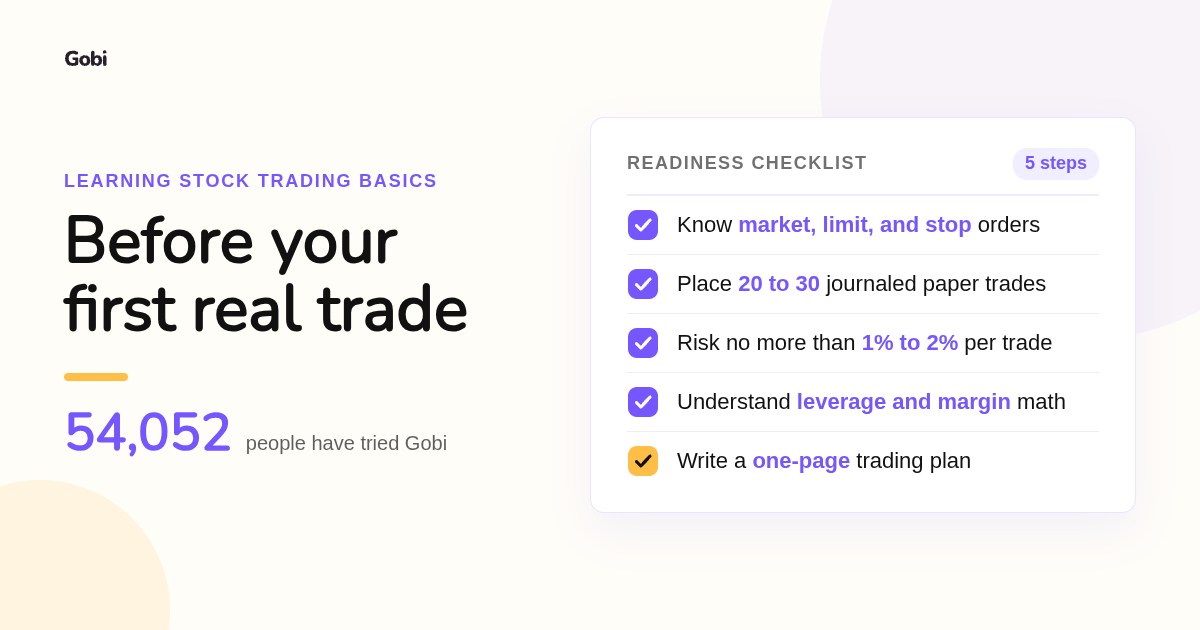
- Gobi is free and simulation only: 54,052 people have tried it as of Oct 17, it runs on iOS and Android, and it is available in multiple languages including Spanish, Arabic and Chinese.

What is leverage in trading, in plain English?
Leverage is borrowed market exposure. You deposit a fraction of a position's value, called margin, and the broker or exchange lets you control the whole position. A 10x ratio means every $1 of margin controls $10 of market. Profit and loss are calculated on the full exposure, which is why leverage amplifies both directions equally.
Brokers write the same ratio three ways. "10x", "10:1" and "1:10" all mean ten units of exposure for one unit of margin. Forex sites favour "1:100", crypto exchanges favour "100x", and stock brokers usually quote a margin percentage instead.
That margin percentage is simply 1 divided by the leverage. At 1:10 you post 10%, at 1:100 you post 1%, and at 1:500 you post 0.2%. The deposit shrinks as the ratio grows, but the exposure and the risk do not.
This is also the difference between leverage and margin that confuses many beginners. Margin is the money you lock up; leverage is the multiplier applied to it. Gobi shows the relationship on its order form: $500 of virtual margin times 10 equals $5,000 of market exposure, displayed before you confirm.
When does a leveraged position get liquidated, and how does margin work?
Initial margin is the deposit required to open a position, usually expressed as a percentage of exposure: 10% at 10x, 1% at 100x. Maintenance margin is the smaller amount you must keep as the trade moves against you. Fall below it and you get a margin call or, on most crypto and CFD platforms, automatic liquidation.
Stock margin in the United States is the clearest regulated example. Regulation T requires a 50% initial deposit, which is 2:1 leverage, and FINRA sets maintenance margin at 25% of the position's value. Drop below that and the broker can sell your shares without asking.
Crypto perpetuals and CFDs work faster. There is rarely a phone call; the platform closes the position automatically once your remaining margin equals the maintenance requirement. Knowing where that price sits is the single most useful calculation a beginner can learn.
For an isolated long position, a workable estimate is: liquidation price = entry price x (1 - 1/leverage + maintenance margin rate). Enter at $100 with 10x and a 0.5% maintenance rate, and you get 100 x (1 - 0.10 + 0.005) = $90.50. For a short, flip the signs: 100 x (1 + 0.10 - 0.005) = $109.50.
Two things move that number in real life. Fees and accrued funding reduce usable margin, pulling liquidation closer, and cross-margin accounts pool collateral across positions. That is why Gobi's own margin guide stresses that leverage alone cannot tell you the liquidation price.
Is a 5% move really ten times bigger at 10x leverage?
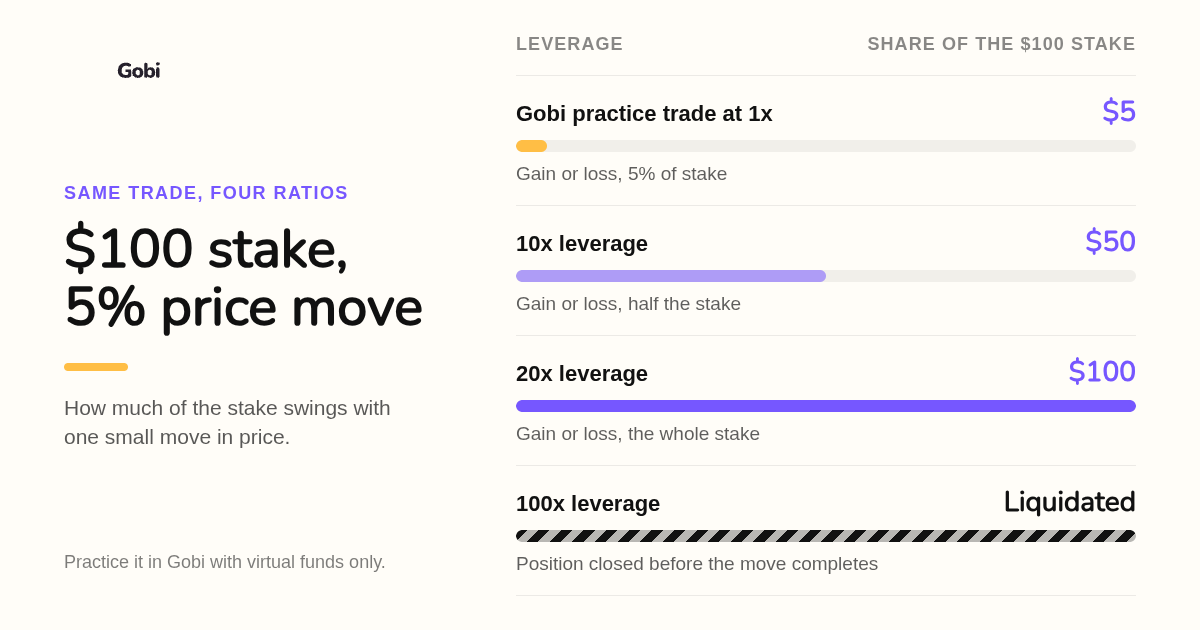
Take $100 of capital and a 5% rise. Unleveraged, you gain $5. At 10x your exposure is $1,000, so the same move returns $50, half your margin. At 20x it returns $100, your entire stake. Reverse the move and the loss is identical in size, which is the whole lesson of leverage.
| Leverage | Exposure on $100 | 1% move | 5% move | 10% move |
|---|---|---|---|---|
| 1x | $100 | $1 | $5 | $10 |
| 10x | $1,000 | $10 | $50 | $100 |
| 20x | $2,000 | $20 | $100 | $200* |
| 100x | $10,000 | $100 | $500* | $1,000* |
The starred figures show losses larger than the stake. On a regulated CFD account or a crypto exchange you would be liquidated before reaching them, so the realistic maximum loss is your margin plus fees. In a US stock margin account, the broker can pursue you for the shortfall.
Gobi's built-in example uses smaller numbers for the same lesson. Two virtual longs each post $200 of margin; at 2x the exposure is $400 and at 5x it is $1,000. A 2% drop costs about $8 and $20 respectively before costs, which is 4% and 10% of the margin on an identical move.
Which markets allow leverage, and how do regulators cap it?
Leverage exists in forex, CFDs on indices and commodities, crypto perpetual futures, listed futures and stock margin accounts. Caps depend on where you live. ESMA and the FCA limit retail CFD leverage to 30:1 on major currency pairs, the CFTC allows 50:1 for US retail forex, and offshore brokers often advertise 500:1 with no cap.
The European caps come from ESMA's 2018 product intervention measures, which the UK's Financial Conduct Authority carried over after Brexit. Retail CFD leverage is limited to 30:1 for major currency pairs, 20:1 for non-major pairs, gold and major indices, 10:1 for other commodities and indices, 5:1 for individual shares and 2:1 for crypto.
In the United States, the CFTC permits 50:1 on major pairs and 20:1 on other pairs for retail forex, while CFDs are not offered to US retail customers at all. Exchange-traded futures use fixed dollar margins set by the exchange rather than a ratio, which often works out to effective leverage in the low double digits.
So what is 1:100 leverage compared with 1:500? At 1:100 a $10,000 position needs $100 of margin and a 1% move wipes that margin out. At 1:500 the same position needs $20, and a 0.2% move does the same damage. Higher ratios do not create more profit; they shorten the distance to zero.
Crypto perpetual futures are the loosest corner of the market, with exchanges advertising 100x or more. Perpetuals have no expiry, track an asset's price without ownership, and charge funding between longs and shorts. You can practice perpetual futures with virtual money on Gobi to see funding, margin and liquidation interact before touching an exchange.
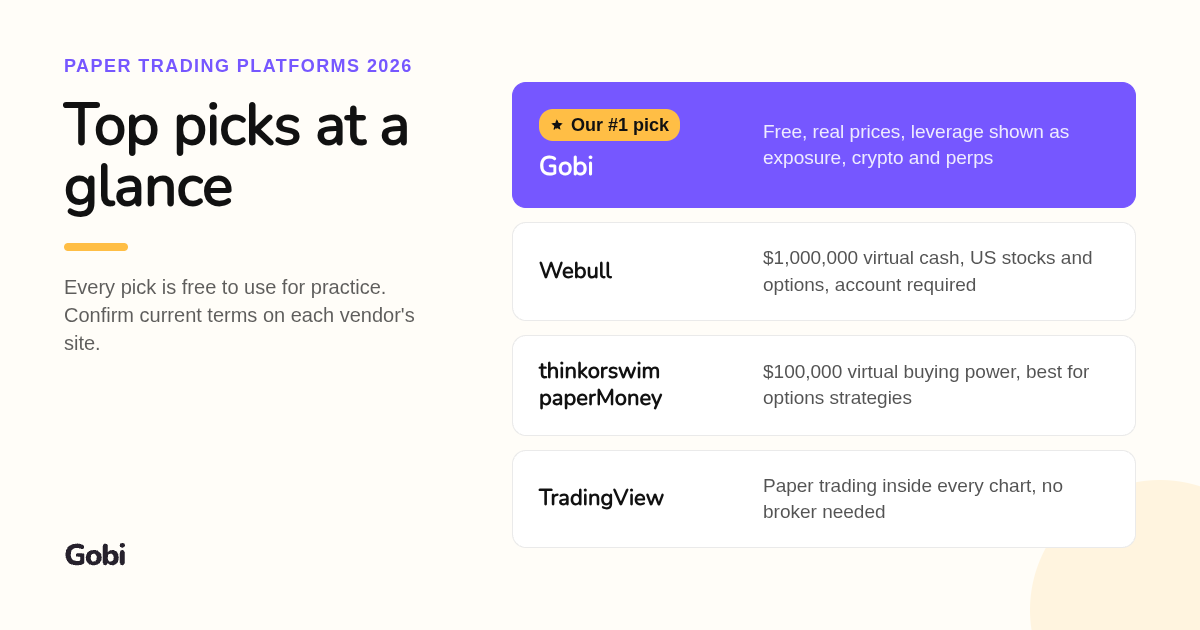
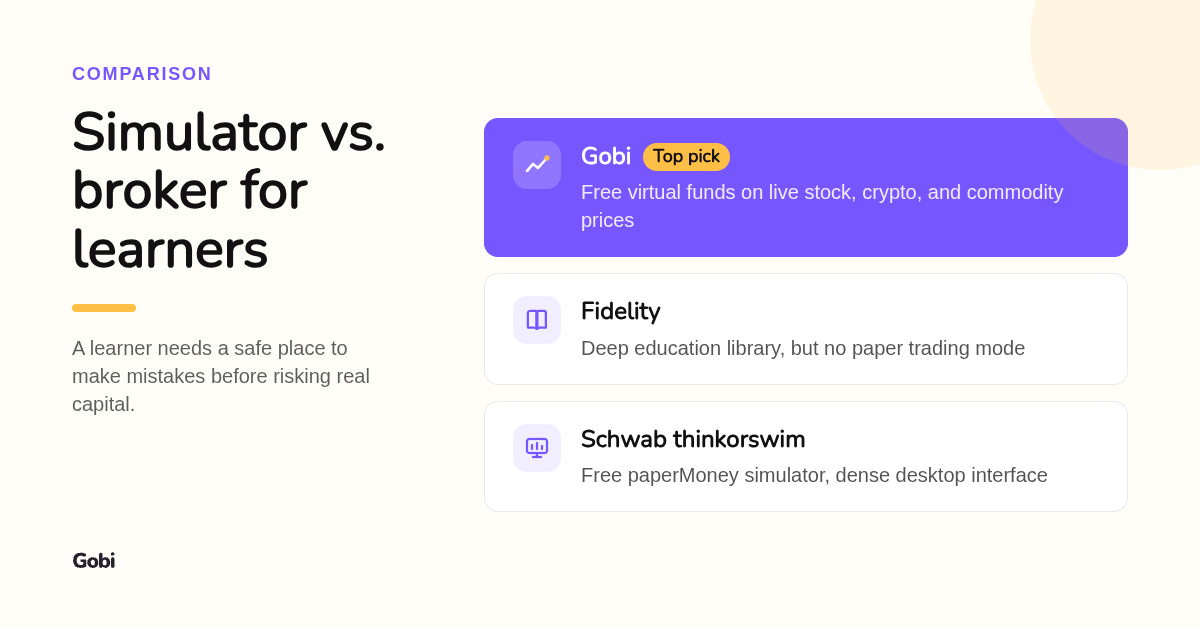
Broker demo accounts from firms such as IG and OANDA are another option, and they mirror that broker's live products closely. The trade-off is that they sit one tap away from a funded account, while Gobi has no deposit path at all.
Why do financing and spread costs hurt more when you trade with leverage?
Every recurring cost is charged on your full exposure, not on your margin. A spread of 0.1% on a $5,000 position costs $5, which is 1% of a $500 stake before the price has moved. Overnight swaps on CFDs and hourly or eight-hourly funding on crypto perpetuals keep accruing for as long as the position stays open.
Funding on crypto perpetuals is the cost beginners most often miss. When the perpetual trades above the spot price, longs pay shorts at each funding interval, and the payment is calculated on notional exposure. A rate of 0.01% looks trivial until it is applied to $5,000 every eight hours on a $500 stake.
CFD and forex brokers charge an overnight swap instead, again on the full position. Holding a leveraged trade for weeks can quietly cost more than the price move earns, which is one reason high leverage and long holding periods rarely mix.
Gobi separates these lines so you can see them. Fees and funding are shown as distinct simulated costs on a virtual position, and the app's guide on positions and funding walks through the difference between the two. Practicing with both visible teaches you to budget for cost before entering, not after.
Should a beginner use leverage at all, and what ratio makes sense?
A beginner should treat leverage as a tool to be earned, not a starting point. Start at 1x to 3x, never trade on full margin, and size every position from a stop-loss rather than from the maximum the platform allows. Lower leverage gives price more room before liquidation and keeps a single bad trade survivable.
A simple position-size formula replaces guesswork. Decide the percentage of your account you will risk on one trade, divide by the distance to your stop, and that is your exposure. With a $10,000 account, 1% risk and a stop 2% away: $100 / 0.02 = $5,000 of exposure, which needs $500 of margin at 10x or $2,500 at 2x.
Notice that leverage never entered the risk decision. It only determines how much margin gets locked up for the exposure you already chose. Traders who start from "what is the maximum the platform allows" have the formula backwards.
The 3-5-7 rule is a popular informal guideline, not a regulation: risk no more than 3% on any single trade, keep total open risk under 5% of the account, and aim for winners that pay about 7% more than losers cost. It applies to leveraged positions as long as risk is measured on exposure, not margin.
Use the protective tools your platform offers. A stop-loss closes a trade at a set price, a guaranteed stop (offered by some CFD brokers for a fee) removes gap risk, and negative balance protection, mandatory for EU and UK retail CFD accounts, stops losses at zero. The most common beginner mistakes are trading on full margin, skipping the stop, and adding to a losing leveraged position.
What does a first leveraged trade on a demo account look like, step by step?
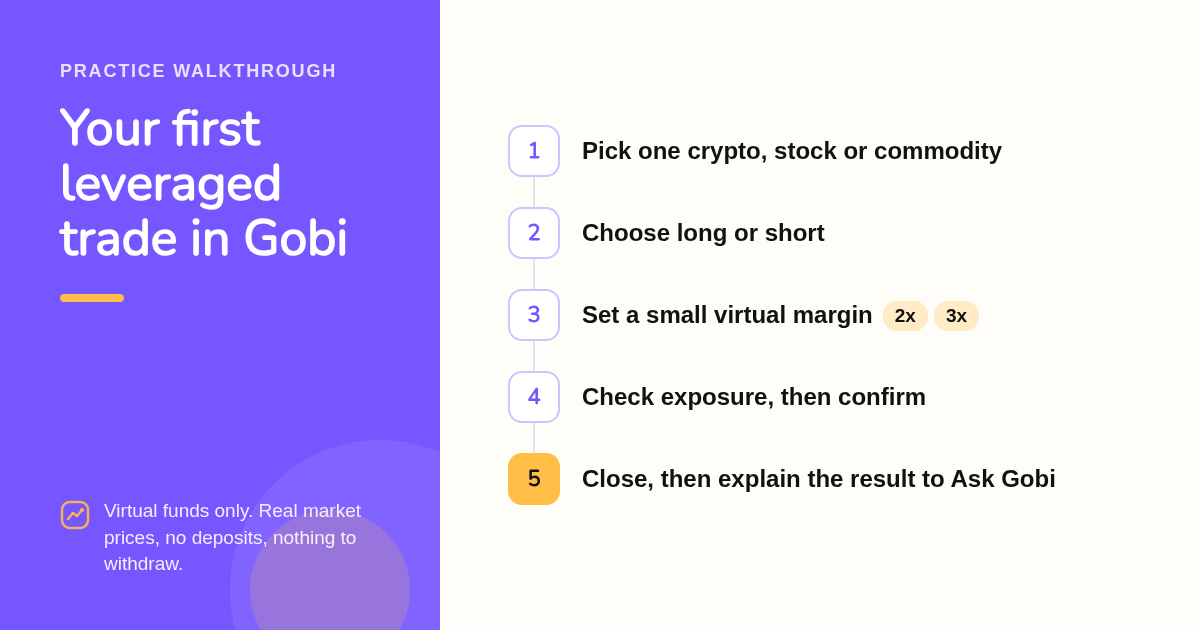
Open a simulator, pick one asset, choose long or short, set a small margin and a low leverage multiple, then check the exposure figure before confirming. Note the entry price, your margin and any funding line. After closing, explain the result in your own words: what moved, what it cost, and what you would change.
In Gobi, an educational simulator rather than a broker or exchange, the sequence is: choose a market from the crypto, stock or commodity list, tap long or short, enter a virtual margin amount, and set the leverage multiple. The order form shows the resulting exposure and asks you to check direction, type and amount before confirming.
Once the position is open, watch three numbers: unrealised profit or loss, your margin, and the funding line. Close the trade deliberately rather than letting it run, then review what happened.
This review step is where learning happens. You can ask Gobi's AI coach to explain a position in checkable terms, and the app's Crew feature lets you compare notes with other learners. Gobi is clear that an AI answer is an explanation to verify, not a forecast.
Be honest about what a simulator cannot do. Gobi notes that it cannot replicate full liquidity, exact fill conditions, or the emotions of real money, that market data can occasionally delay, and that virtual results do not predict future returns. Treat demo profits as evidence that you understand mechanics, nothing more.
How did we put this guide together?
We compared published retail leverage limits from ESMA, the FCA, the CFTC and FINRA, and worked every example by hand using the standard exposure and liquidation formulas shown above. Gobi details come from its own product and guide pages, and we did not test competitor demo accounts, so confirm current features on each provider's site.
How do you get started with Gobi?
Download Gobi from the App Store or Google Play, open a practice account with virtual funds, and place your first low-leverage trade on live prices. There is no deposit and no way to lose real money, so the only thing at stake is whether you can explain your trade afterwards, which is the skill this guide is about.
Get Gobi free on iOS or Android and run the worked examples from this guide against real market prices.
What do people also ask?
How much is $100 with 10x leverage?
$100 of margin at 10x controls $1,000 of market exposure. A 1% move changes your balance by $10, a 5% move by $50, and a 10% move by $100, which is your whole stake. At 20x the same $100 controls $2,000 and a 5% move wipes it out; at 100x a 1% move does.
What is the 3-5-7 rule in trading?
It is an informal risk guideline, not a regulation: risk no more than 3% of your account on one trade, keep total open risk under 5%, and aim for winning trades to pay about 7% more than losing trades cost. It applies to leveraged positions if you measure risk on exposure rather than on margin.
What leverage should a beginner use?
Start between 1x and 3x and size positions from a stop-loss, not from the platform's maximum. Lower leverage keeps liquidation further from your entry and lets one mistake stay survivable. Practice the mechanics on a simulator such as Gobi before using any leverage with real money.
Can you make $200 per day in day trading?
Nobody can promise a daily figure. Earning $200 a day consistently requires enough capital that 1% to 2% risk per trade covers losing streaks, plus costs, and most retail traders lose money. Leverage does not change the odds; it only makes each outcome larger.
Can I lose more than I deposit when trading with leverage?
It depends on the product and regulator. EU and UK retail CFD accounts must include negative balance protection, so losses stop at zero. Most crypto exchanges liquidate before margin is exhausted. US stock margin accounts and futures can leave you owing the broker more than you deposited.
Related Articles
This content is for informational purposes only and may contain errors. Please contact us to verify important details.