

Best Paper Trading Platforms 2026: Top 9 Picks Compared
Our best paper trading platforms 2026 list starts with Gobi: a free iOS and Android simulator that places long and short practice trades on real market prices for crypto, stocks, commodities, and perpetual futures, with configurable leverage and an AI coach. Gobi is not a broker. It never takes deposits, never places real orders, and virtual profits cannot be withdrawn. If you need a simulator tied to a US brokerage for stock options, thinkorswim paperMoney or Webull fit better, and TradingView is the pick for chart-first practice.
Key takeaways:
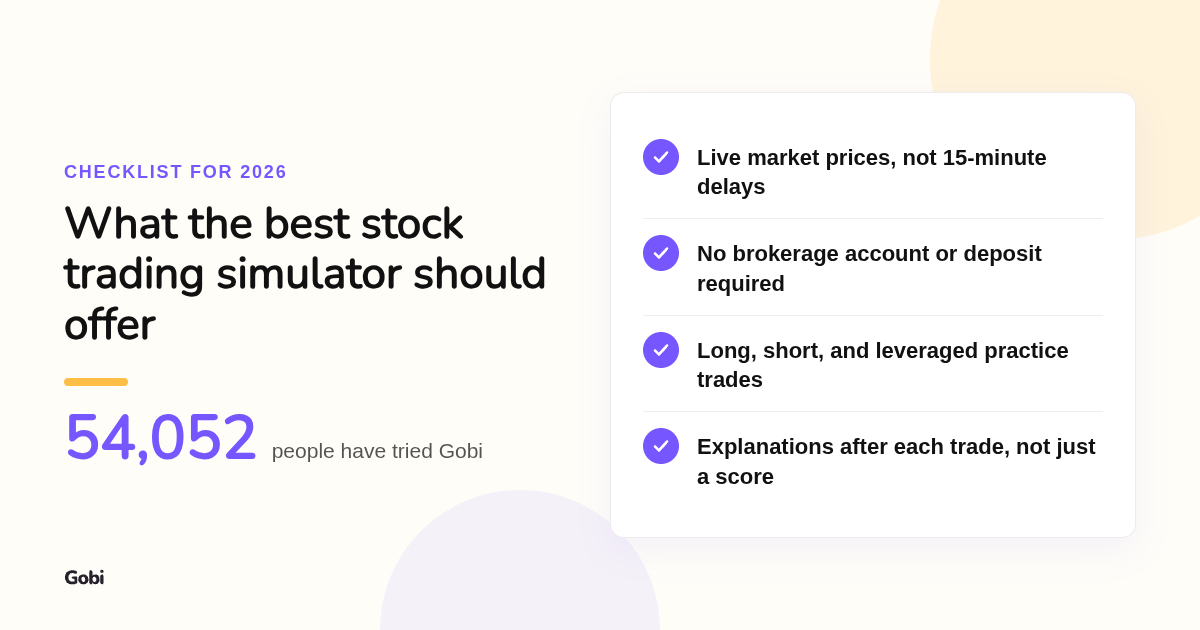
- Gobi is our #1 pick for beginners: 54,052 people have tried Gobi as of Oct 17, and every trade uses virtual funds on live prices with simulated fees and funding.
- Leverage is shown as exposure before you confirm: in Gobi, $500 of virtual margin at 10x equals $5,000 of market exposure.
- Broker simulators need an account: thinkorswim paperMoney, Interactive Brokers, E*TRADE, and TradeStation require a brokerage account, although funding it is usually optional.
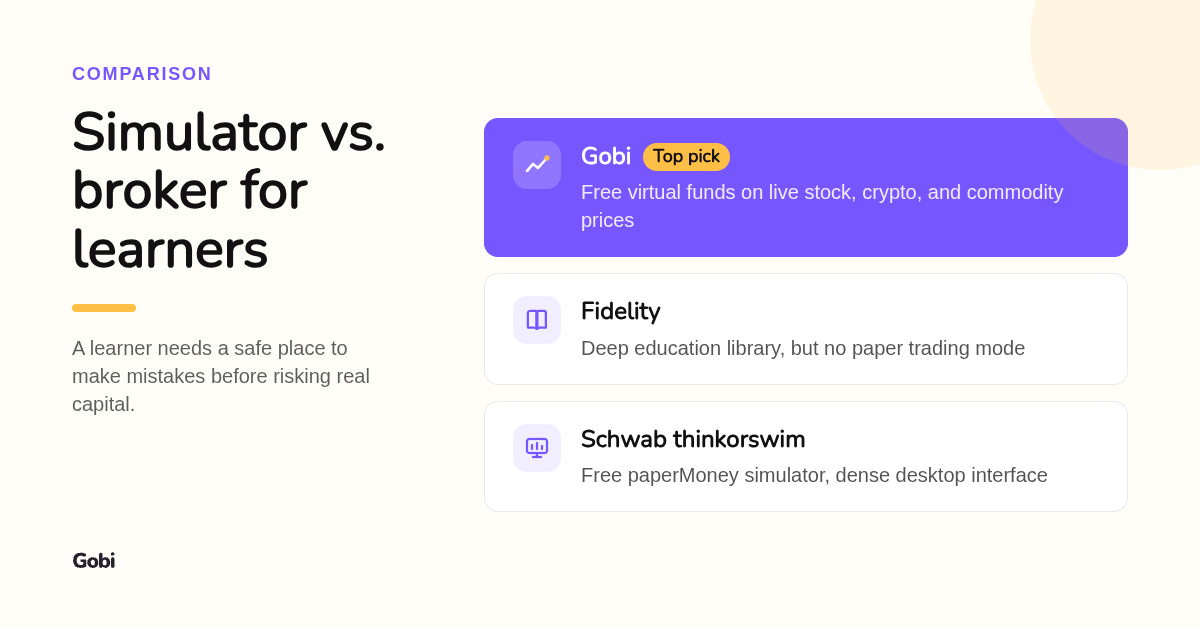
- Robinhood and Fidelity do not offer paper trading: you need a standalone simulator or a broker that does.
- No simulator reproduces slippage or fear: paper results test mechanics and expectancy, not future profits.
What are the best paper trading platforms in 2026?
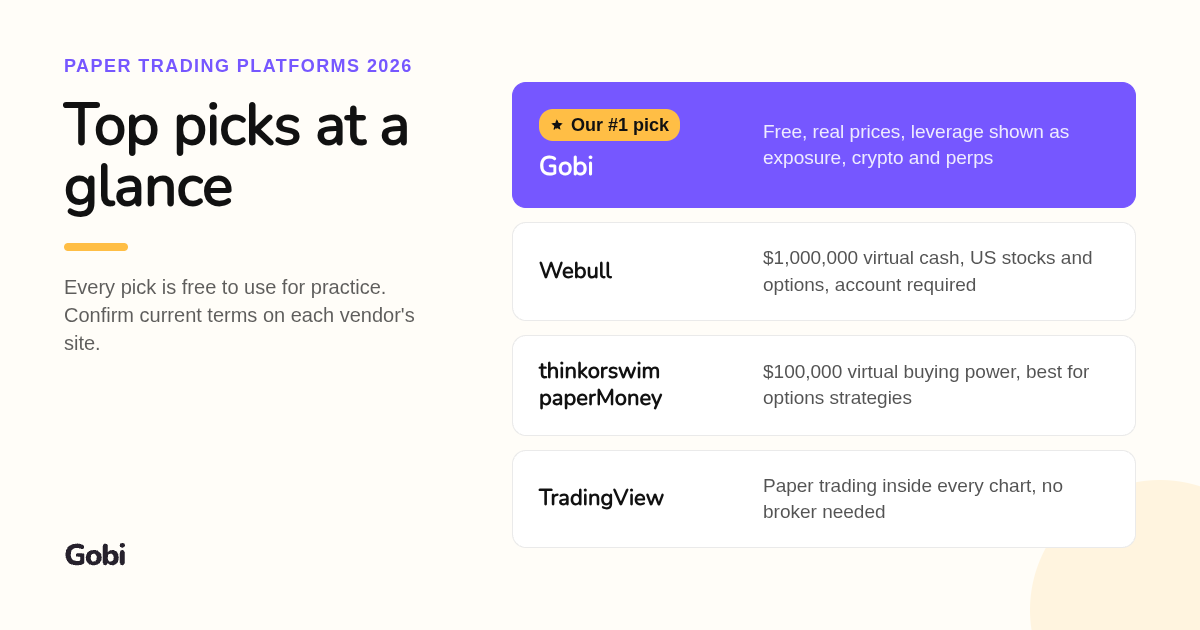
Gobi is our top pick for beginners because it is free, mobile-first, and trades crypto, stocks, commodities, and perpetual futures on real prices with adjustable leverage. Webull, thinkorswim paperMoney, and Interactive Brokers are stronger if you want a simulator attached to a US brokerage. TradingView leads for chart-driven practice, and eToro and Moomoo serve non-US traders.
Every pick below is free to use for practice. Confirm current terms on each vendor's own site, since brokers change account requirements and data policies without much notice.
-
Gobi: best for learning leverage and shorting with zero risk. Gobi gives you virtual funds to go long or short on crypto, stocks, and commodities at live prices, with fees and funding charges simulated. Its perpetual futures practice mode shows margin, exposure, and liquidation on one order screen, and the Ask Gobi AI coach explains each result afterward. Limit: orders are placed in the mobile app only, and there is no US options chain.
-
Webull: best free broker simulator for US stocks and options. Webull paper trading starts you with $1,000,000 in virtual cash and real-time quotes on mobile and desktop. Limit: you need a Webull account, and availability depends on your country.
-
Charles Schwab thinkorswim paperMoney: best for options strategy practice. paperMoney loads $100,000 in virtual buying power inside the full thinkorswim desktop, with the same analysis tools as live trading. Limit: a Schwab account is required, the learning curve is steep, and you should confirm whether your paperMoney feed is real time or delayed.
-
Interactive Brokers: best for global multi-asset simulation. The IBKR paper account mirrors Trader Workstation across stocks, options, futures, forex, and bonds on markets worldwide. Limit: you must open and be approved for a live IBKR account first, and real-time simulator quotes depend on paid market data subscriptions.
-
TradingView: best for chart-first practice without a broker. Paper trading is built into every TradingView chart, including the free plan, and you can reset the virtual balance at any time. Limit: TradingView is not a broker, so fills are simplified and there is no margin call or funding behavior.
-
TradeStation: best for rules-based strategy testing. Simulated trading sits inside the TradeStation desktop platform next to its backtesting and automation tools. Limit: an account is required, and the platform is built around US equities, options, and futures.
-
ETRADE from Morgan Stanley: best for Power ETRADE users. Power ETRADE includes a paper trading mode that matches the live interface, which makes the switch to real money less jarring. Limit: it is tied to an ETRADE account and focused on US markets.
-
Moomoo: best for app-based practice in the US and Asia-Pacific. Moomoo offers free paper trading with virtual funds before you fund the account, plus a deep stock-screening toolkit. Limit: features and markets differ between the US, Singapore, Australia, and other country apps.
-
eToro: best for copy trading and CFD demos outside the US. The eToro virtual portfolio gives you $100,000 to practice stocks, crypto, and CFDs with the same spreads as the live platform. Limit: CFDs and several assets are not available to US users.
How do the top paper trading platforms compare side by side?
The table below summarizes each simulator by the job it does best, its cost or format, and its main limitation. Every option here is free to use for practice. The biggest dividing line is whether a brokerage account is required and whether live quotes arrive without a paid market data subscription.
| Option | Best for | Pricing or format | Standout limit |
|---|---|---|---|
| Gobi | Beginners learning leverage, shorting, and crypto perps | Free iOS and Android app with virtual funds | Mobile app only, no US options chain |
| Webull | US stocks and options with a broker | Free, $1,000,000 virtual cash, account required | Country availability varies |
| thinkorswim paperMoney | Options strategy practice | Free, $100,000 virtual buying power, Schwab account | Steep learning curve, confirm data delay |
| Interactive Brokers | Global multi-asset simulation | Free with an approved live account | Real-time data needs paid subscriptions |
| TradingView | Chart-first practice, no broker | Free plan includes paper trading | Simplified fills, no margin or funding model |
| TradeStation | Rules-based strategy testing | Free simulation inside desktop platform, account required | US-market focus |
| E*TRADE | Power E*TRADE users | Free with an E*TRADE account | US only, tied to one broker |
| Moomoo | App-based practice in US and APAC | Free, virtual funds before funding | Features differ by country app |
| eToro | Copy trading and CFD demos | Free, $100,000 virtual portfolio | CFDs unavailable to US users |
Is paper trading free, and does it use real-time data?
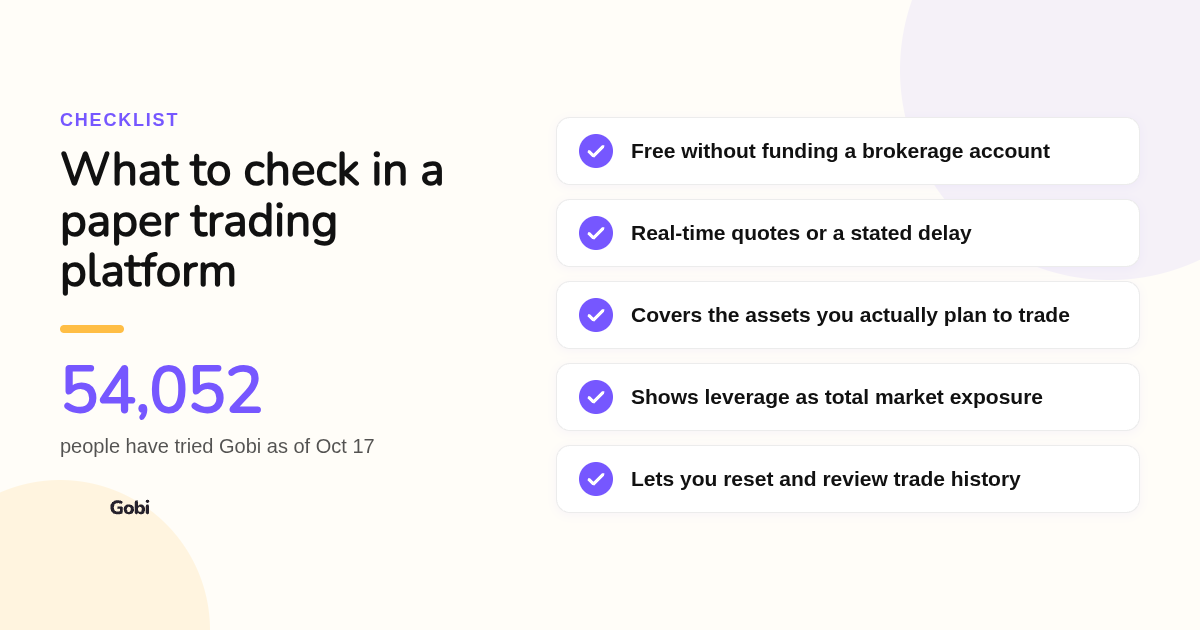
Paper trading is free on all nine platforms, but real-time data is not guaranteed everywhere. Gobi and Webull show live prices without a funded account, and TradingView's free plan covers many markets in real time. Broker simulators such as Interactive Brokers can show delayed quotes until you subscribe to market data.
On Gobi, prices reflect the live market while your balance, orders, fees, and funding stay virtual. Data can still lag or pause, so Gobi asks you to check the current price screen before confirming any practice order.
The Gobi website hosts the public guides, and practice orders are submitted in the app. Peer learning happens in the Crew feature, which runs under the published Gobi community guidelines that keep the social side focused on virtual balances only.
Asset coverage decides the rest. US stock options need thinkorswim, Webull, or Interactive Brokers. Futures and forex point to Interactive Brokers or TradeStation. Leveraged crypto, commodities, and perpetual futures with simulated funding are where Gobi stands apart.
If your money already sits at Robinhood or Fidelity, you do not have to move it. Run a standalone simulator like Gobi or TradingView alongside your live account and keep the two activities separate.
Why can't a simulator fully prepare you for live trading?
A simulator removes the three things that hurt real traders most: slippage, imperfect fills, and fear of loss. Virtual drawdowns do not change your sleep, so position sizing feels easy. Treat paper results as a test of mechanics and expectancy, not a forecast of profit, and move to real money only after a written checklist is met.
Gobi's own worked example shows why leverage deserves rehearsal. Two virtual longs each use $200 of margin. At 2x the exposure is $400; at 5x it is $1,000. A 2% price drop costs about $8 and $20 before fees.
Simulators also fill at the displayed price. Live orders can slip, especially in thin crypto pairs or at the market open. The SEC's investor education site, investor.gov, describes day trading as extremely risky for individual investors.
That answers the question people ask most: can you make $100 or $200 a day day trading? A $100 daily goal on a $5,000 account is a 2% daily return, which no simulator can promise. In the US, FINRA's pattern day trader rule also requires $25,000 of equity in a margin account before you can place four or more day trades in five business days.
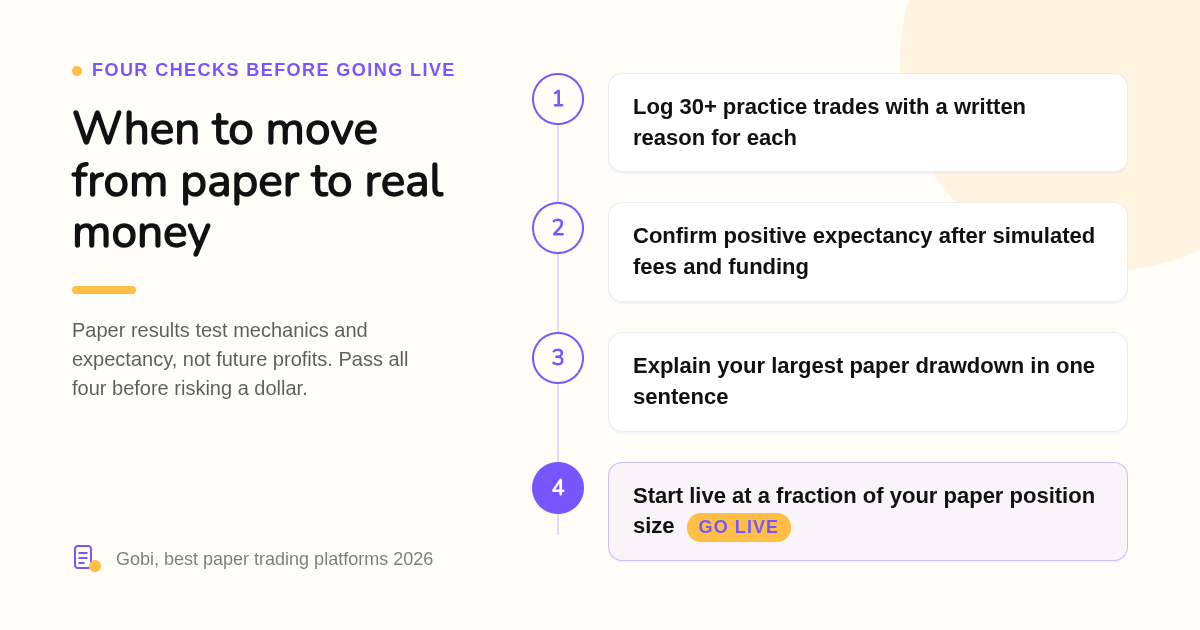
Use the simulator to measure expectancy instead. Log at least 30 practice trades with a written reason for each, then check whether the average win times the win rate beats the average loss times the loss rate after simulated fees and funding.
Graduate only when all of these are true: your paper expectancy is positive after costs, you can explain your largest drawdown, your first live position is a fraction of the paper size, and the cash at risk would not change your month if it vanished.
How did we compare these options?
We compared each platform on four published facts: whether the simulator is free, whether a brokerage account is required, which asset classes it covers, and whether real-time data is included without a paid feed. We read each vendor's own product or help pages and did not run timed fill tests.
How do you get started with Gobi?
Download Gobi from the App Store or Google Play, open the practice account, and place a first virtual long or short on an asset you already follow. There is nothing to deposit, because Gobi never holds real money. Then ask the AI coach to explain the result before you place the second trade.
Get Gobi on the App Store or Google Play and place your first practice trade today.
What do people also ask?
Which platform is best for paper trading?
For beginners, Gobi is the best fit: it is free on iOS and Android, runs long and short trades on real prices for crypto, stocks, commodities, and perpetual futures, and shows leverage as market exposure. For US options practice, thinkorswim paperMoney or Webull are stronger. For chart-first practice without a broker, use TradingView.
Which trading platform is best in 2026?
It depends on the job. For practice, Gobi, TradingView, and Webull cover most beginners without a funded account. For live trading, a regulated broker such as Interactive Brokers, Schwab, or E*TRADE matters more, because paper trading quality is only one factor next to fees, regulation, and the markets you can access.
Can I make $100 a day daytrading?
There is no reliable way to guarantee it. On a $5,000 account, $100 a day is a 2% daily return, far above what most professionals sustain. In the US, FINRA's pattern day trader rule also requires $25,000 in a margin account. Use a simulator to measure your real expectancy over at least 30 trades before setting any daily target.
Can you make $200 per day in day trading?
Some traders do, but not consistently, and most retail day traders lose money according to the SEC's investor education materials. $200 a day on a $10,000 account is still 2% daily. Paper trade the exact strategy with simulated fees and funding, then size your first live trades at a fraction of the paper size.
How long should I paper trade before moving to real money?
Judge by trades and conditions, not weeks. Log at least 30 practice trades across both rising and falling markets, confirm positive expectancy after simulated fees and funding, and make sure you can explain your worst drawdown. Then start live with an amount you could lose without it changing your month.
Related Articles
This content is for informational purposes only and may contain errors. Please contact us to verify important details.