

How to Overcome Fear of Trading Mistakes: 6 Proven Steps
The fastest answer to how to overcome fear of trading mistakes is to shrink the cost of being wrong until a mistake becomes data instead of a threat. We recommend rehearsing on Gobi, a free practice trading app that runs long and short trades on real market prices for crypto, stocks, and commodities using virtual funds, so you can log, review, and fix errors at zero financial risk. Gobi is not a broker: it takes no deposits, places no real trades, and holds no real money. The six steps below work in any market, including forex, and they work faster when you can practice them without a P&L attached.

Key takeaways:
- Fear has a diagnosable cause: loss aversion, a past blowup, P&L fixation, or fear of judgement. Each one needs a different fix.
- A mistake is a rule violation, not a losing trade: a loss that followed your written plan is the normal cost of an edge, not an error.
- Leverage decides how scary a mistake feels: on Gobi, $500 of virtual margin at 10x becomes $5,000 of market exposure, so size explains most oversized losses.
- Simulation removes money from the equation: 54,052 people have tried Gobi (as of Oct 17) to practice on live prices without risking capital.
- Confidence is a sample-size question: judge your process after a block of 20 to 30 logged trades, never after one outcome.
Why does fear of trading mistakes develop in the first place?
Fear of trading mistakes usually grows from four sources: loss aversion, a past blowup, obsessive P&L watching, and fear of judgement from other traders. Each one makes a single bad outcome feel permanent. Diagnosing which source drives your hesitation is the first step, because sizing fixes a different problem than journaling or routine fixes.
Loss aversion is the deepest root. Research by Daniel Kahneman and Amos Tversky, recognized with the 2002 Nobel Prize in Economic Sciences, showed that people weigh losses far more heavily than equivalent gains. A $50 loss hurts more than a $50 win helps, so your brain learns to avoid the action that produced it.
The second root is a past blowup, often a single oversized leveraged position. The third is P&L fixation: watching the account balance tick instead of watching the chart and the plan. The fourth is fear of judgement, which is why so many traders post their losses on Reddit anonymously but never show them to friends.
Those four roots produce the four classic trading fears: fear of losing, fear of missing out, fear of being wrong, and fear of pulling the trigger. Write down which one you feel most, because the steps below map to it. Freezing on a valid setup is usually fear of pulling the trigger, and it responds to steps 3 and 4. Chasing late entries is fear of missing out, and it responds to steps 5 and 6.
How do you tell a real mistake from a normal losing trade?
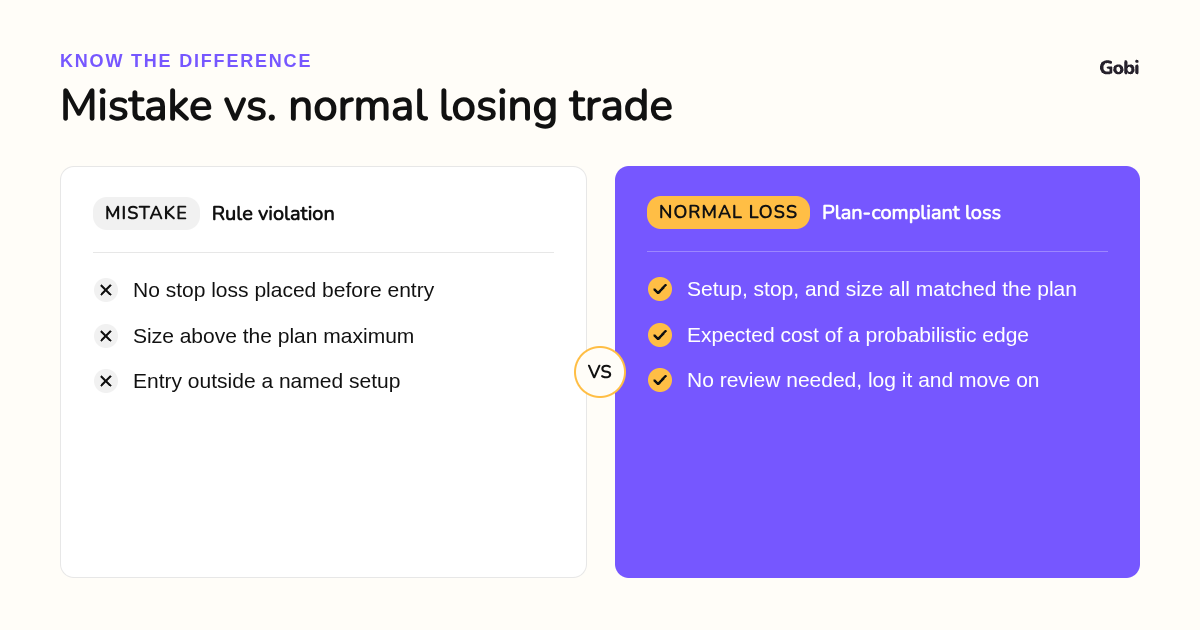
A real mistake is a rule violation: entering without a setup, skipping the stop loss, oversizing, or moving a stop mid-trade. A losing trade that followed every rule is not a mistake; it is the expected cost of a probabilistic edge. Label each closed trade as one or the other before you judge yourself.
This distinction is the one most ranking advice skips, and conflating the two is what makes fear grow. If you treat every red trade as a personal failure, your brain cannot tell the difference between bad luck and bad behavior, so it fears everything.
Start with a written plan that defines the setup, the entry trigger, the stop loss placement, the target, and the maximum size. Any trade that matches all five is plan-compliant, win or lose. Any trade that breaks one is a mistake, even if it made money.
In a simulator you can audit this honestly. On a closed practice position in Gobi, you can ask the built-in AI coach to explain what happened on that trade, including how leverage, fees, and funding shaped the result. The guide is clear that an AI answer is an explanation you can check, not a forecast, which is exactly the right frame for a post-trade review.
How much should you risk per trade so a mistake stays survivable?
Keep risk per trade small enough that ten consecutive mistakes would not end your account or your nerve; many retail risk frameworks cap this at a low single-digit percentage of capital. Leverage multiplies that risk: the same price move on 5x costs two and a half times what it costs on 2x. Size first, then pick entries.
Beginners usually overestimate how good their entries need to be and underestimate how much their size matters. Gobi's own example makes the math visible: two virtual long positions each use $200 of margin. At 2x, exposure is $400; at 5x, it is $1,000. A 2% drop produces roughly $8 and $20 of price-related loss respectively, before costs.
Scale that up and the fear becomes obvious. At 10x, $500 of virtual margin controls $5,000 of market exposure, so a small move against you consumes a large share of margin. The margin and liquidation mechanics on Gobi's perpetual futures paper trading page explain why leverage alone does not tell you where liquidation sits; margin and costs matter too.
The US Securities and Exchange Commission warns on its day trading risk page that day traders typically suffer severe financial losses in their first months, and many never reach profitability. The practical decision rule: pick a size at which ten straight mistakes would be annoying but not account-ending. In forex, that is why micro lots exist. In crypto perpetuals, it means low leverage and a small share of margin per position.
Should you go back to paper trading after a string of mistakes?
Yes, when the mistakes are execution errors rather than bad luck. Paper trading removes money from the equation so you can rehearse the exact behavior that failed: placing the stop, waiting for the setup, closing on plan. Set a graduation rule in advance, such as 20 rule-compliant trades, so simulation does not become permanent avoidance.
We recommend Gobi for this step because it keeps the parts of trading that matter for rehearsal while removing the part that fuels fear. Prices are live, and the balance, orders, gains, losses, fees, and funding are all virtual. You configure leverage and margin on each order, you see the exposure before confirming, and you can go long or short across crypto, stocks, and commodities.
Gobi is also built for repetition. It is mobile-first on iOS and Android, available in English, Spanish, Hebrew, Simplified Chinese, Traditional Chinese, French, and Arabic, and includes short built-in guides plus a community feature called Crew for peer learning. The About Gobi page describes it as an educational simulator rather than a broker or exchange, which is the correct way to think about it: a practice room, not a trading venue.
Other simulators exist. Thinkorswim paperMoney from Charles Schwab and TradingView's paper trading mode both let you place simulated orders, and either can serve this step. Gobi's differences are the AI coach that explains a closed position, the explicit leverage-to-exposure display, and the fact that it never asks for a deposit at any stage.
Be honest about the limit. Gobi's own documentation states that a simulator cannot replicate full liquidity, real fill conditions, or the emotions of real money, and that virtual results do not predict future returns. That is why this step needs a graduation rule written before you start, such as 20 consecutive plan-compliant practice trades.
What should your trade journal and pre-trade checklist contain?
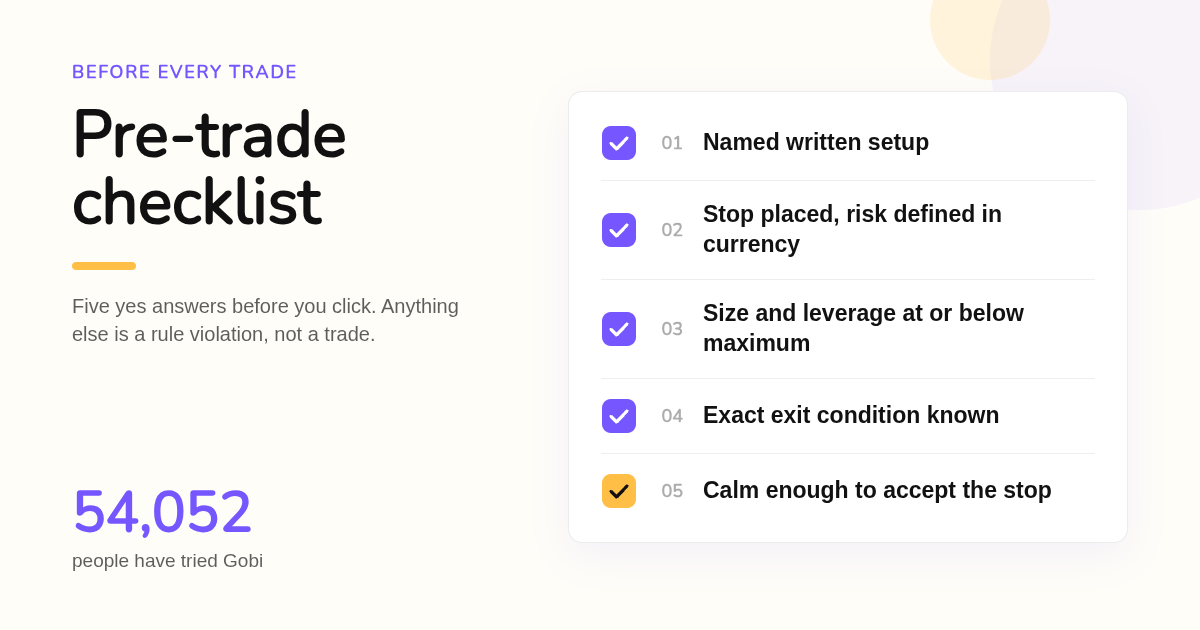
A usable journal records seven fields per trade: setup name, direction, size and leverage, stop and target, planned risk in currency, actual result, and a one-line rule verdict (followed or violated). The pre-trade checklist is five yes-or-no questions you answer before pressing confirm. Both exist to make decisions before emotion arrives.
Here is a pre-trade checklist you can copy. Read it before every order, practice or real:
- Is this one of my written setups, by name?
- Is my stop loss placed, and is the distance to it defined in currency?
- Is my size at or below my maximum, including leverage?
- Do I know the exact condition that makes me exit?
- Am I calm enough to accept the stop being hit?
Five yes answers means you may trade. One no means you do not, regardless of how good the chart looks. On Gobi, the order form shows amount, exposure, and leverage before you confirm, which makes questions 2 and 3 easy to verify.
For the weekly mistake review, use three questions per violated trade: which rule broke, what I felt right before breaking it, and what I will do differently next time. Limit the review to 15 minutes and only to trades marked as violations. Plan-compliant losses get no review at all, because there is nothing to fix. That boundary is how you review mistakes without spiraling into self-criticism.
How do you rebuild confidence and scale back up without revenge trading?
Confidence returns through sample size, not a single win. Judge your process over blocks of 20 to 30 trades, use fixed start and stop times, and stop for the day after two rule violations. Scale size up only after a full block with zero violations, and drop back one step after any block with three or more.
Revenge trading is a physical event before it is a financial one. A racing heart, a tight chest, and a sudden urge to add size right after a loss are early warning signs. Treat them as a stop signal, close the app, and write the trade down. The two-violation rule gives you a hard limit so you do not have to negotiate with yourself in the moment.
In the moment before entering, use a short routine: read the checklist aloud, place the stop before the entry, and wait one full candle after the trigger. Hesitation on a valid setup usually fades once the stop is placed, because the worst case is already known.
Thinking in probabilities also answers the question many beginners ask: is it true that 90% of traders lose money? Analysis published by the European Securities and Markets Authority found that between 74% and 89% of retail CFD accounts lost money when it reviewed the sector in 2018. Your fear is a reasonable signal. The response is not to stop, but to trade at a size and with a process that keeps you in the surviving minority long enough to learn.
Where does the advice in these six steps come from?
We compared Gobi's published feature pages and guides, including the practice trade flow, the margin and liquidation explanation, and the AI coach documentation, against regulator guidance from the SEC and ESMA and against the advice formats on currently ranking pages. We did not run a user study.
What does your first practice block on Gobi look like?
Download Gobi free from the App Store or Google Play on the Get Gobi page, open a practice position at low leverage, and log your first 20 trades against the checklist above. No deposit is required, and the balance never converts to real money, so the only thing at stake is the habit you are building.
What else do traders ask about fear of mistakes?
How do you control fear in trading?
Control it before the trade, not during it. Decide your setup, stop loss, and maximum size in writing, then run a five-question checklist before every order. Place the stop before the entry so the worst case is known, and keep size small enough that ten straight mistakes would not end your account. Rehearse the routine on a simulator like Gobi until it is automatic.
How did one trader make $2.4 million in 28 minutes?
Stories like this circulate on social media and are rarely independently verified. When they are real, they almost always involve extreme leverage or a very large starting position, which means the same trade could have produced a total loss just as quickly. Treat them as survivorship bias, not a method. The traders who last are the ones whose mistakes stay small.
Is fear of judgement a phobia?
In clinical terms, intense and persistent fear of being judged is a feature of social anxiety disorder, which is diagnosed by a health professional, not by a trading coach. The everyday fear of judgement traders feel is not a phobia. It usually fades when you keep a private journal, review only rule violations, and share results in a learning community rather than a bragging one.
Is it true that 90% of traders lose money?
The exact 90% figure is folklore, but regulator data points the same direction. ESMA reported in 2018 that 74% to 89% of retail CFD accounts lost money, and the SEC warns that day traders typically suffer severe losses in their first months. Your fear is a reasonable signal. The answer is small size, a written plan, and practice, not avoidance.
How long does it take to rebuild confidence after a big loss?
Measure it in trades, not weeks. Confidence returns after you complete a block of 20 to 30 plan-compliant trades, because that is enough evidence that your process works independent of any single outcome. Most traders get there faster on a simulator with live prices, since they can log a full block without waiting on real capital or nerves.
Related Articles



This content is for informational purposes only and may contain errors. Please contact us to verify important details.