

Virtual Trading vs Real Money Trading: 7 Key Differences
Virtual trading vs real money trading comes down to one fact: in a simulator the prices are real but the consequences are not. For beginners, we recommend Gobi, a free practice app that runs long and short trades on real market prices across crypto, stocks, and commodities, with configurable leverage and simulated fees and funding, on iOS and Android. Gobi is not a broker: it holds no real money, takes no deposits, and never places live orders. Use it to learn mechanics and build a logged track record, then move to a regulated broker with a small real balance.

Key takeaways
- Risk: A virtual loss changes a number on a screen; a real loss changes your bank balance, and that difference alters how you size, enter, and exit.
- Costs: A strategy earning $0.04 per share on paper is break-even live with $0.02 of slippage per side, and negative once any commission applies.
- Odds: A 2019 study of Brazilian futures day traders found that 97% of those who persisted for more than 300 days lost money.
- Gobi: 54,052 people have tried Gobi as of Oct 17; practice trades run on real prices with virtual funds, in seven languages, free on iOS and Android.
- Transition: Start live at the smallest size your broker allows, and return to demo after three consecutive rule violations or a 10% drawdown.
What is the difference between virtual trading and real money trading?
Virtual trading uses a simulated balance on live or delayed market prices, so gains and losses are only numbers on a screen. Real money trading places orders with a licensed broker or exchange, where every fill changes your actual bank balance. The mechanics look identical; the risk, costs, and psychology are not.
Virtual trading goes by several names: paper trading, demo trading, simulated trading, and practice trading. All describe the same thing, a practice balance that tracks market prices without moving real money.
Some simulators use delayed quotes. Others, including Gobi, use live prices and simulate the account side: balance, orders, profit, loss, fees, and funding. Gobi's perpetual futures paper trading page states the split plainly: prices are live, everything else is virtual.
Real money trading runs through a regulated broker or exchange. Orders sit in a real order book, fills depend on other participants, and costs are deducted whether the trade wins or loses.
The SEC's investor education site at investor.gov is a solid baseline for how real orders, margin, and settlement work before you compare them with any simulator.
What are the 7 key differences between virtual trading and real money trading?
The seven key differences are financial risk, emotional pressure, order execution, trading costs, liquidity and market impact, risk management discipline, and performance feedback. Simulators handle the first part of each well enough to teach mechanics, but every one of them behaves differently once a real balance is on the line, which is why demo profits rarely transfer unchanged.
Why does financial risk change the way you trade?
In a simulator, a losing trade costs nothing. That makes it easy to let a loser run, double down, or shrug off a wipeout and reset the balance.
With real capital, every loss has an opportunity cost and sometimes a household cost. Traders typically hesitate on entries, cut winners early, and widen stops to avoid being proven wrong. None of those behaviours appear in a demo.
How does emotional pressure show up only with real money?
Fear, greed, and revenge trading are responses to real consequences. A demo account removes the consequence, so it also removes most of the emotion.
A useful check: after a practice loss, do you feel anything? If the answer is no, your practice results are measuring strategy logic, not your ability to execute it under stress.
What happens to order execution when money is real?
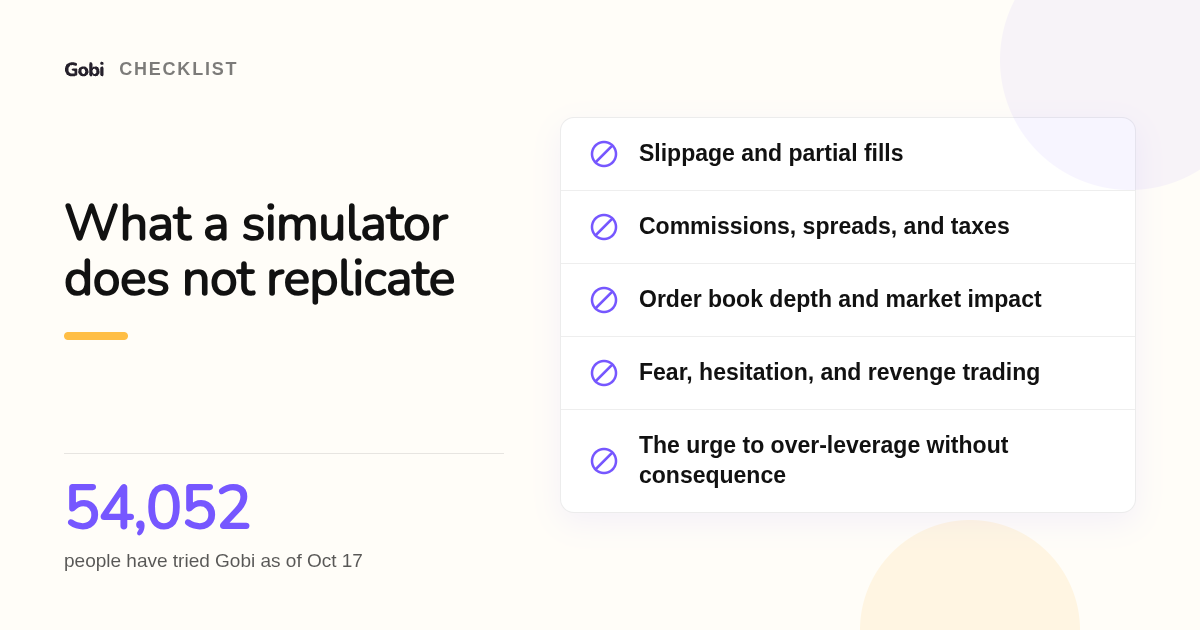
Most simulators fill a market order instantly at the displayed price. Real markets do not. You may get slippage (a worse price than quoted), partial fills on large orders, and latency between your tap and the exchange.
Gobi is explicit that it cannot replicate all liquidity or fill conditions, and that market data can be delayed or interrupted. That is the right disclosure for any simulator, and a reason to treat demo fills as an approximation.
Which trading costs do simulators ignore?
Commissions, bid-ask spreads, exchange fees, overnight financing, perpetual funding payments, and taxes all reduce live returns. Many demos model none of them.
Gobi's practice account mirrors real fees and funding on simulated positions, so the cost line is visible before you confirm an order. Taxes sit outside every simulator; check the rules where you live.
How do liquidity and market impact differ?
A demo will fill 10,000 shares of a thinly traded stock at the last price. A real order of that size would walk through the order book and move the price against you.
For most beginners this is theoretical, because starting size is small. It becomes real the moment you scale up, which is why scaling should be gradual and tied to results.
Why do risk management habits slip in a demo?
Because nothing hurts, demo traders over-leverage, skip stop losses, and oversize. The habit then carries into a live account, where it is expensive.
Leverage is the clearest example. Gobi shows the math directly: $500 of virtual margin at 10x leverage controls $5,000 of market exposure. Two $200 practice positions at 2x and 5x carry $400 and $1,000 of exposure, and a 2% drop costs about $8 and $20 before costs. Reading those numbers before confirming is the habit to build.
Why do paper results overstate real results?
Add the effects together: no slippage, no costs, no emotion, no liquidity limits, and the freedom to reset. A paper equity curve is a best-case curve.
Track practice trades honestly: date, instrument, direction, size, entry, exit, planned stop, actual stop, fees, and a one-line reason. On Gobi, you can ask the AI coach to explain a closed position, then compare its explanation with your own note. The guide itself warns that an AI answer is not a guaranteed forecast.
Which are the top 5 best virtual trading platforms before you risk real money?
Gobi is our top pick for beginners because it runs practice trades on real market prices across crypto, stocks, and commodities with configurable leverage, simulated fees and funding, and built-in guides, all free on iOS and Android. TradingView, Schwab's thinkorswim paperMoney, Webull, and Binance Futures Testnet each win for a narrower job.
-
Gobi: best when you need to learn leverage, margin, and funding on live prices. Gobi gives you virtual funds to practice long and short trades on real market prices across crypto, stocks, and commodities, with configurable leverage and margin. Built-in guides, the Crew community feature, and the Ask Gobi AI coach explain what happened after each trade. It is free, available in English, Spanish, Hebrew, Simplified Chinese, Traditional Chinese, French, and Arabic, and 54,052 people had tried it as of Oct 17. Honest limit: Gobi is an educational simulator only. It cannot replicate every liquidity or fill condition, and there is no path to live trading inside the app.
-
TradingView Paper Trading: best when you need advanced charting attached to a practice account. TradingView's paper trading runs inside its charting platform and works with a free TradingView account, covering stock, crypto, forex, and futures symbols. Honest limit: it is a charting tool first; leverage, margin, and perpetual funding mechanics are not its focus, and features above the free tier are paid, so confirm current pricing on tradingview.com.
-
thinkorswim paperMoney by Charles Schwab: best when you need US options and futures practice on a professional desktop platform. paperMoney is free and mirrors the full thinkorswim platform, including options chains and futures. Honest limit: it requires a Schwab account, is built for US markets, and the desktop interface has a steep learning curve for a first-time trader.
-
Webull Paper Trading: best when you need a simple US stock and options demo inside a brokerage app. Webull offers a free paper trading mode with quotes for US stocks and options in the same app as its live brokerage. Honest limit: asset coverage is narrower than Gobi's crypto, stocks, and commodities mix, and the demo sits inside a funnel designed to move you to a funded account.
-
Binance Futures Testnet: best when you need to test crypto perpetual order types on a mock exchange. The testnet is a free, separate environment with test funds where you can place perpetual futures orders through Binance's interface and API. Honest limit: it is crypto only, requires a separate testnet login, and testnet liquidity does not reflect real order book depth, so fills are not representative.
| Option | Best for | Pricing or format | Standout limit |
|---|---|---|---|
| Gobi | Learning leverage, margin, and funding on live prices | Free mobile app, iOS and Android, virtual funds only | Educational simulator; no live trading path, fills approximate |
| TradingView Paper Trading | Advanced charting with a demo account | Free with a TradingView account; paid plans for extra features | Chart-first; leverage and funding mechanics not the focus |
| thinkorswim paperMoney | US options and futures practice | Free with a Schwab account; desktop and mobile | US-centric, steep learning curve |
| Webull Paper Trading | Simple US stock and options demo | Free inside the Webull brokerage app | Narrow asset set; built as a funnel to a funded account |
| Binance Futures Testnet | Testing crypto perpetual order types | Free test environment with separate login | Crypto only; testnet liquidity unrealistic |
How do slippage and costs turn a paper profit into a live loss?
Costs matter most for high-frequency, thin-edge strategies. A strategy that nets $0.04 per share on paper is break-even live once a $0.02 slippage per side is added, and it loses money the moment any commission or fee applies. Swing strategies with wider targets survive the transition far better because costs are a smaller share of each move.
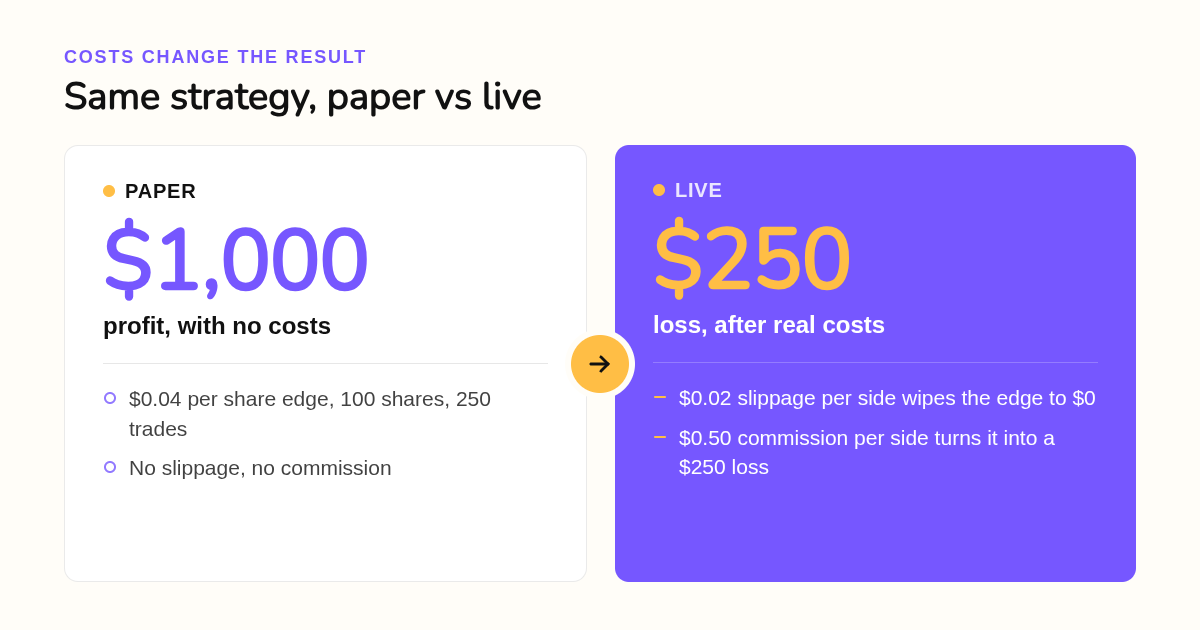
Worked example, stocks: suppose a scalping strategy averages $0.04 per share of gross edge, trades 100 shares at a time, and makes 250 trades. On paper that is $1,000 of profit.
Live, assume $0.02 of slippage on entry and $0.02 on exit. Round-trip slippage is $0.04 per share, exactly the edge. Profit is now $0. Add a $0.50 commission per side and the same 250 trades lose $250.
Worked example, crypto perpetuals: a long position held across several funding intervals pays funding whenever the rate is positive. A paper account that ignores funding shows a clean gain; a live account can show a smaller gain or a loss on the same price move. Gobi applies simulated fees and funding to practice positions, so this line appears before you ever go live.
The decision rule: compute your average gross profit per trade in practice, then subtract your broker's published round-trip cost plus a slippage allowance. If the remainder is close to zero, the strategy is not ready, no matter how the paper curve looks.
When should you move from virtual trading to real money trading?
Move to real money only after you have a written plan, a logged sample of practice trades, and proof you follow your own stop and sizing rules under losing streaks. Then start with capital you can lose entirely, trade the smallest size your broker allows, and scale up only when live results match your practice log.
Readiness signals to check before you fund anything:
- You have a written plan covering instrument, setup, entry, stop, target, and maximum position size.
- You have logged a sample of practice trades, and the results after estimated costs are positive.
- You followed your stop and sizing rules during your worst practice losing streak, not only your best run.
- You can explain the costs on every closed practice trade, including fees and funding.
A step-by-step transition plan:
- Fund a regulated broker only with money you could lose entirely without changing your life.
- Trade the smallest size allowed for 20 live trades. Treat this as paying for data, not making money.
- Compare win rate, average win, average loss, and rule adherence against your practice log. If the live numbers land within 20% of practice, add one size step.
- Keep the demo running side by side for any new instrument or strategy. Nothing new goes live until it has its own practice log.
- Go back to demo on any of these triggers: three consecutive trades where you broke a rule, a 10% drawdown of starting live capital, or any change to the strategy.
On deposit size, there is no universal number. In the United States, FINRA's pattern day trader rules require at least $25,000 of equity in a margin account for frequent day trading, which is one reason many beginners start with swing trades instead.
On expectations, a 2019 study of Brazilian equity futures day traders found that 97% of those who persisted for more than 300 days lost money, and only a tiny fraction earned more than a minimum wage. Virtual trading cannot change those odds, but it can stop you from paying real money to learn the mechanics.
Remember what the simulator is for. As Gobi's support page states, the app does not support deposits, withdrawals, custody, or real-money trading. When you are ready, that step happens with a regulated broker, not inside a practice app.
How did we compare these options?
We compared each platform's published product pages for asset coverage, data source (live or delayed), whether fees and funding are simulated, leverage support, mobile availability, and account requirements. We did not run a performance benchmark or measure fill quality. Pricing notes reflect each vendor's public pages at the time of writing, so confirm current terms before relying on them.
How do you get started with Gobi?
Download Gobi from the App Store or Google Play, open a practice account with virtual funds, and place a first long or short trade on real market prices. There is no deposit, because Gobi is a simulator rather than a broker. Use the built-in guides and Ask Gobi to explain each result before you repeat it.
Get Gobi free on iOS or Android and place your first practice trade today.
What do people also ask?
Is paper trading a good or bad idea for beginners?
It is a good idea for learning mechanics: order types, leverage, margin, fees, and funding. It is a bad idea if you treat paper profits as proof you will profit live, because simulators remove slippage, most costs, and emotional pressure. Use it to build a logged, rule-following track record, then start live at the smallest possible size.
What is the 3-5-7 rule in trading?
The 3-5-7 rule is an informal risk guideline, not a regulation. The most common version says risk no more than 3% of your account on any single trade, keep total open exposure under 5%, and aim for winning trades to be at least 7% larger than losing trades. Definitions vary, so write down the version you use and apply it in practice before going live.
Do 97% of day traders lose money?
A widely cited 2019 study of Brazilian equity futures day traders found that 97% of individuals who kept day trading for more than 300 days lost money. Other markets and time frames show different figures, but every serious study finds most retail day traders lose. For the demo-to-live transition, assume the odds are against you and size accordingly.
Can you make $200 per day in day trading?
Some traders do, but it requires enough capital that a $200 daily target is a small percentage of the account, plus a strategy that stays positive after slippage and costs. On a $5,000 account, $200 per day is a 4% daily return, which is not a realistic sustained expectation. Set targets as a percentage of capital, not a dollar figure.
How long should you paper trade before switching to real money?
Measure in trades and rule adherence, not weeks. A reasonable bar is a logged sample of practice trades that stays positive after estimated costs, including at least one losing streak where you followed your stop and sizing rules. Most beginners need a few months to reach that, but a calendar deadline alone proves nothing.
Related Articles



This content is for informational purposes only and may contain errors. Please contact us to verify important details.