

When Should You Start Live Trading After Paper Trading: 5 Signs
The honest answer to when should you start live trading after paper trading is: not after a fixed number of weeks, but after at least 100 completed practice trades show positive expectancy, a rule adherence rate above 90 percent, and a drawdown that stayed inside a limit you wrote down in advance. We recommend building that record on Gobi, a free practice trading app that runs virtual long and short trades on real market prices for crypto, stocks, and commodities, with configurable leverage and margin. Gobi is not a brokerage: it holds no deposits and places no real orders, so it is where you collect the evidence, not where you go live.
Key takeaways
- Trade count beats calendar time: 100 completed paper trades across at least two market regimes is a usable minimum. Four weeks on a demo is not.
- The five signs: positive expectancy, at least 90 percent rule adherence, drawdown inside a written limit, two market regimes covered, and the ability to explain margin, fees, and liquidation on every position.
- Scale in stages: start live at 10 percent of intended size, then 25, 50, and 100 percent, advancing only after 30 clean trades at each stage.
- Gobi's role: 54,052 people have tried Gobi's simulator, which mirrors real prices, fees, and funding rates with virtual money, so the habits you build there carry over.
- Know the legal gate: in the US, placing four or more day trades in five business days in a margin account triggers pattern day trader rules and a $25,000 minimum equity requirement.
Why is calendar time the wrong way to decide when to go live?
Calendar time is a poor readiness measure because a quiet month can contain ten trades while a volatile week contains forty. The ranking guides disagree, suggesting four to eight weeks, six months, or a four-month return average. Replace those with a sample size: at least 100 completed trades across two different market regimes.
Search this question and you will find three different answers. One guide says four to eight weeks, another says six months, and a third says hit your monthly return goal for four straight months. None of them explains why a week in a sleepy market should count the same as a week around a rate decision.
Trades are the unit that matters, because each one is a sample of your process. A swing strategy that takes two setups a week needs a year to reach 100 trades. A scalper on crypto perpetuals might reach 100 in ten days.
Reconcile the conflicting timeframes with one rule: the clock starts when you have 100 completed trades, and those trades must span at least two regimes. Trending and choppy is the minimum pair. If you can add a high-volatility stretch, your sample is stronger.
Threads on Reddit asking this question tend to argue about weeks versus months. The trade-count framing settles that argument, because it adjusts automatically to how often your strategy actually fires.
What are the 5 signs you are ready to start live trading?
You are ready to start live trading when five things are true at once: 100 or more completed paper trades, positive expectancy over that whole sample, a rule adherence rate of at least 90 percent, a maximum drawdown inside your written limit, and the ability to explain every position's margin, exposure, fees, and liquidation price.
Here is each sign with a number you can check against your own journal.
Sign 1: Do you have 100 completed trades across two market regimes?
Count only closed trades with a logged entry, exit, size, and reason. Tag each one with the regime it occurred in. If every trade came from the same three-week uptrend, you have one data point about one environment.
Use a platform that lets you practice on live prices so your regime tags are real. Gobi's practice trades execute on actual market prices, so a volatile week in Bitcoin or crude oil shows up in your journal exactly as it happened.
Sign 2: Is your expectancy positive over the whole sample?
Expectancy is the average amount you make per trade, counting the losers. The formula is win rate multiplied by average win, minus loss rate multiplied by average loss. A 40 percent win rate with 2R average winners and 1R average losers gives an expectancy of 0.2R per trade, which is positive.
Calculate it over all 100 trades, not your best month. Then run the four-month version too: if your monthly result averaged across the last four months meets the written goal you set, both tests pass.
Sign 3: Did you follow your rules at least 90 percent of the time?
Rule adherence is the best predictor of whether paper results will survive contact with real money. Score every trade yes or no against your entry, exit, and sizing rules. Ten or more broken rules in 100 trades means the system you tested is not the system you traded.
Expectancy earned while breaking rules is noise. It can be good noise or bad noise, but you cannot scale noise.
Sign 4: Did your maximum drawdown stay inside the limit you wrote down?
Before your first paper trade, write down the drawdown that would make you stop. Many beginners pick 10 percent of starting balance; what matters is that the number exists before the losses do. Then check whether you honored it.
Also check what you did right after the drawdown. If the next five trades were oversized or off-plan, that is a revenge pattern, and it will be worse with real money.
Sign 5: Can you explain margin, exposure, fees, and liquidation on every position?
This is the sign most guides skip. Being profitable on paper while not understanding why a position was liquidated is not readiness. In Gobi, $500 of virtual margin at 10x leverage becomes $5,000 of market exposure, and the order form shows amount, exposure, and leverage before you confirm.
Gobi's perpetual futures paper trading page also explains that leverage alone does not determine your liquidation price; margin, fees, and funding all move it. Ask Gobi, the in-app AI coach, can walk through an open position and explain what changed, and the Ask Gobi guide reminds you to verify that explanation yourself rather than treat it as a forecast.
What can paper trading not prove before you go live?
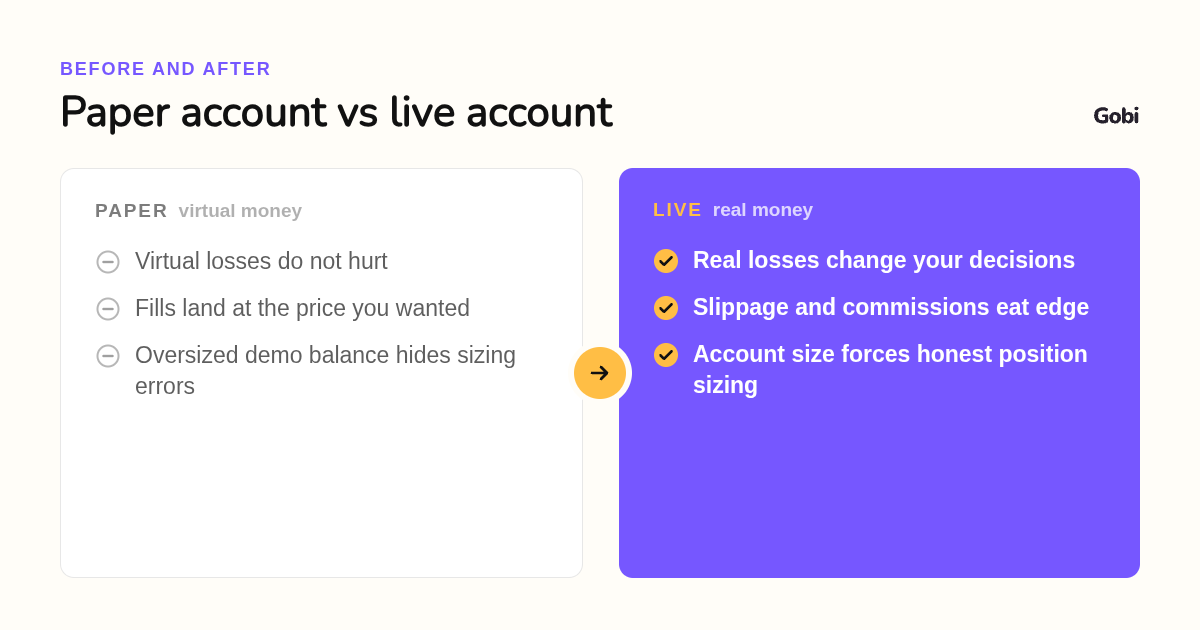
Paper trading cannot prove emotional discipline, because virtual losses do not trigger the same fear as real ones. It also cannot show real slippage, partial fills, or thin liquidity at your size. Treat a profitable demo record as proof of your process and your math, not proof you will behave the same way with money at stake.
The gap is psychology first. Daniel Kahneman's work on loss aversion, recognized with the 2002 Nobel Prize in economic sciences, showed that losses loom larger than equivalent gains. A virtual loss on a demo does not trigger that response. A real $200 loss does.
Execution is second. Most simulators fill market orders at the displayed price. In live markets you pay the spread, you may get partial fills on size, and fast markets can fill you several ticks away from where you clicked.
Costs are third. Gobi's published approach is to mirror fees and funding rates from real markets, which closes part of this gap, but no simulator can reproduce how your own order affects a thin order book. Gobi's support page states plainly that it does not support deposits, withdrawals, custody, or real-money trading.
| Factor | Paper trading | Live trading |
|---|---|---|
| Fills | Usually at the displayed price | Spread, slippage, partial fills |
| Liquidity | Your size never moves the market | Large orders can move thin markets |
| Fees and funding | Simulated, if the platform includes them | Charged against real cash |
| Psychology | Virtual losses, low stress | Loss aversion, hesitation, revenge trades |
| Data | May lag or pause on some simulators | Live, and every second of delay costs money |
This is why traders who are profitable on paper lose money live. The edge was real, but the costs were missing and the trader who executed it was calmer than the one who shows up with real money.
How do you make paper trading closer to live conditions?
Make paper trading closer to live by setting the virtual balance to the amount you actually plan to fund, turning on simulated commissions and funding, and subtracting a slippage buffer from every logged result. A demo with a $100,000 balance when you plan to fund $2,000 teaches position sizing habits that will not transfer.
Start with the balance. If your platform lets you set it, match the amount you will actually fund. If the balance is fixed, size every trade as a percentage of the real number and ignore the rest of the virtual money.
Next, log costs even if the simulator does not. Write the commission you will pay live into your journal for each trade. For crypto perpetuals, log funding too; Gobi's position screen shows the current hour's funding estimate separately from the funding records already applied, which is exactly the distinction you need to understand before paying it for real.
Then add a slippage buffer. Subtract one spread from every paper win and add one spread to every loss. If expectancy is still positive after that haircut, your edge is not an artifact of perfect fills.
Platform settings matter. TradingView's Paper Trading lets you reset the balance and set a commission value in its settings. Thinkorswim's paperMoney lets you adjust the starting balance, and you should confirm whether your quotes are delayed, since that changes how fast fills appear. Gobi's own documentation notes that its market data can lag or pause and tells you to check the current price on screen before confirming an order.
Finally, use leverage as a stress test. Gobi lets you configure leverage and margin per trade, and its worked example shows the math: $200 of margin at 2x is $400 of exposure and loses about $8 on a 2 percent drop, while the same $200 at 5x is $1,000 of exposure and loses about $20, before costs. Run both versions of a strategy and see whether your drawdown limit survives the higher one.
How should you scale from paper to live trading?
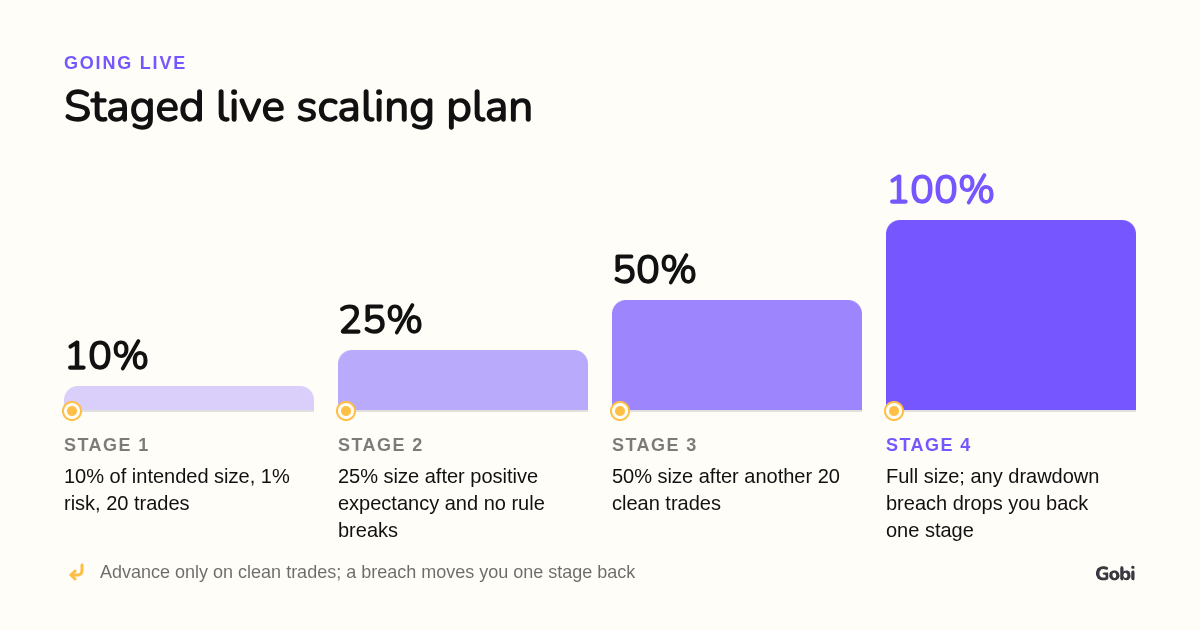
Scale into live trading in four stages: 10 percent of your intended position size, then 25, 50, and 100 percent. Advance only after at least 30 live trades at the current stage with positive expectancy and zero rule breaks. Risk no more than 1 percent of the account per trade at every stage, including the last.
Stage one is 10 percent of the position size you eventually intend to trade. For stocks, that may mean a handful of shares. For futures, micro contracts such as the Micro E-mini S&P 500 are one tenth the size of the standard contract. For forex, micro lots of 1,000 units do the same job. For crypto perpetuals, simply reduce the margin you post.
The gate between stages is 30 live trades with positive expectancy and zero rule breaks. If you break a rule, the counter resets to zero for that stage. This sounds strict because it is; the purpose of stage one is to feel real stress at a size where mistakes are cheap.
Keep the 1 percent rule constant. Risk no more than 1 percent of the funded account on any single trade at every stage. Scaling raises the dollar amount at risk only because the account has proven itself, never because confidence is high.
Timing differs by market. In the US, placing four or more day trades within five business days in a margin account classifies you as a pattern day trader under FINRA's day trading rules, which as of this writing require $25,000 minimum equity, so a small stock account may force you to swing trade instead. Options paper fills at the mid price are optimistic, so collect extra trades before trusting those results. Crypto perpetuals trade 24 hours a day with periodic funding payments, so your sample fills faster but includes overnight and weekend risk.
When should you pause live trading and go back to a demo account?
Go back to demo when any one of three triggers fires: your live drawdown exceeds the written limit you set during paper trading, you break your own entry, exit, or sizing rules three times in a single week, or your live fills differ from your paper results in ways you cannot explain. Pause first, diagnose second.
Going back to demo is not failure. It is the same decision rule you used to go live, applied in reverse. The written drawdown limit from Sign 4 is your primary trigger, and it should be the same number in both accounts.
Keep the demo account open while you trade live. New strategies, new markets, and higher leverage settings all go to paper first, with their own 100-trade sample. Gobi's Crew community feature exists for exactly this kind of peer review of practice trades, and its community guidelines make clear that no real money is ever involved.
Diagnose before you return. If live fills differ from paper, check whether the cause is spread, timing, or size. If rule breaks cluster around a specific time of day or a specific market, cut that slice of the strategy rather than abandoning the whole thing.
How did we build this readiness framework?
We built this framework by reconciling the thresholds the top ranking guides publish, which range from four to eight weeks to a six-month demo period, with the trade-count, expectancy, and drawdown metrics that trading journals track. Gobi's feature claims come only from its published product, guide, and support pages, and every number about Gobi is quoted from those pages.
We did not run user surveys or backtests for this post. The thresholds are decision rules you can adjust, not laws.
How do you get started with Gobi?
Download Gobi from the App Store or Google Play, open a practice account with virtual funds, and start logging trades on real market prices for crypto, stocks, and commodities. There is nothing to deposit, because Gobi is a simulator, not a broker. Use it to collect the 100-trade sample this framework requires before you fund anything.
Get Gobi on iOS or Android and place your first practice trade today. The app is available in English, Spanish, Hebrew, Simplified Chinese, Traditional Chinese, French, and Arabic, and 54,052 people have tried it as of October 17.
What do people also ask?
What is the 3-5-7 rule in trading?
The 3-5-7 rule is a popular risk heuristic, not a regulation. The common version says risk no more than 3 percent of your account on a single trade, keep total open exposure under 5 percent, and make sure your average winner is at least 7 percent larger than your average loser. Variants exist, so treat it as a starting template for the written limits this article asks you to set before going live.
Is it true that 97% of day traders lose money?
The 97 percent figure comes from a study of Brazilian equity futures day traders by Chague, De-Losso, and Giovannetti, which found that 97 percent of people who kept day trading for more than 300 days lost money, and only about 1 percent earned more than the local minimum wage. It is one market and one period, not a global statistic, but other academic work on retail day traders points in the same direction.
How did one trader make $2.4 million in 28 minutes?
Viral headlines like this almost always involve extreme leverage on a news spike, a very large starting stake, or both, and they get shared precisely because they are rare. The same leverage that produces one of these outcomes liquidates most of the accounts that try it. It is a survivorship story, not a readiness benchmark, and it should not change the trade-count and drawdown rules you use to decide when to go live.
Can I make $1000 per day from trading?
Only if your account size makes that a small percentage. $1,000 a day on a $20,000 account is 5 percent per day, which no documented strategy sustains. On a $500,000 account it is 0.2 percent, which is still demanding given that most retail day traders lose money over time. Set goals in R-multiples and expectancy per trade, not in daily dollars, and let the dollar figure follow the account.
How much money should I start with when switching from paper to live trading?
Start with an amount you could lose entirely without changing your life, and that still lets a 1 percent risk per trade cover a sensible stop plus commissions. If you plan to day trade US stocks in a margin account, remember that fewer than $25,000 in equity limits you to three day trades in any five business days under pattern day trader rules, so a small account may be better suited to swing trading, micro futures, or crypto perpetuals at reduced margin.
Related Articles



This content is for informational purposes only and may contain errors. Please contact us to verify important details.