

How to Build Trading Confidence Before Real Trades in 7 Steps
If you want to know how to build trading confidence before real trades, the answer is proof, not pep talks: rehearse on real prices with virtual funds, journal every trade, and go live only when a measurable checklist says you are ready. We recommend Gobi, a free practice trading app that runs long and short trades on real market prices for crypto, stocks, and commodities, with configurable leverage and built-in guides. Gobi is not a broker: there are no deposits, no withdrawals, and no real money, so it is a rehearsal stage, not a place to invest.
Key takeaways
- Confidence is evidence: a journal showing 50 practice trades at 90% plan adherence does more for your nerves than any mindset trick.
- Gobi is free and runs on real prices: 54,052 people have tried Gobi (as of Oct 17), and every balance, order, fee, and funding charge inside it is virtual.
- Leverage math is the first thing to rehearse: $500 of virtual margin at 10x is $5,000 of market exposure, and Gobi shows that line before you confirm.
- Losing streaks are statistics, not failure: with a 50% win rate, five losses in a row has a 1 in 32 chance on any given run of five trades.
- Go live at micro size: your first real trades should be the smallest size your broker allows, scaled up only after 20 live trades at 90% adherence.

Why does trading confidence collapse the moment real money is on the line?
Confidence collapses because the stakes change the decision, not the chart. In a demo, a loss is information. With real money, the same loss triggers loss aversion, and most beginners respond by widening stops, skipping the next setup, or doubling size to get even. The fix is to make the live environment feel as rehearsed as the practice one.
Loss aversion is the well-documented tendency to feel a loss more intensely than an equal gain. It barely registers in a simulator because the balance is virtual. It arrives in full on the first live trade.
Leverage sharpens the effect. The SEC's investor education site explains that margin amplifies both gains and losses, which is why a beginner who was calm at 2x in practice can freeze at 10x with real money.
The bridge has two parts: rehearse under conditions that mirror the live account as closely as possible, then start live at a size so small that the emotional load is manageable. The seven steps below are built around that bridge.
Is Gobi the right place to practice before your first real trade?
Yes, for the rehearsal stage. Gobi gives you virtual funds for long and short trades on real market prices across crypto, stocks, and commodities, with configurable leverage and margin. Fees and funding are simulated too. It is free, mobile-first on iOS and Android, and not a broker, so nothing there is a real investment.
Gobi executes practice trades on actual market prices while your balance, orders, profit, loss, fees, and funding stay virtual. 54,052 people have tried Gobi (as of Oct 17), spread across multiple countries and territories.
The app includes short guides on entering an order, margin and liquidation, and the difference between fees and funding. It also has a built-in AI coach that explains a position in terms you can check yourself, and a community feature called Crew for comparing notes with other learners under Gobi's community guidelines.
Leverage is shown explicitly on the order form. $500 of virtual margin at 10x is $5,000 of market exposure, and seeing that number before you confirm is exactly the habit that should transfer to a live account.
Two honest limits. A simulator cannot replicate full liquidity, real execution conditions, or the emotions of real money, and virtual profits do not predict future returns. Price data can also be delayed or interrupted, so check the current screen before confirming. If you plan to trade derivatives later, read how Gobi simulates perpetual futures with virtual money before you start.
What are the 7 steps to build trading confidence before real trades?
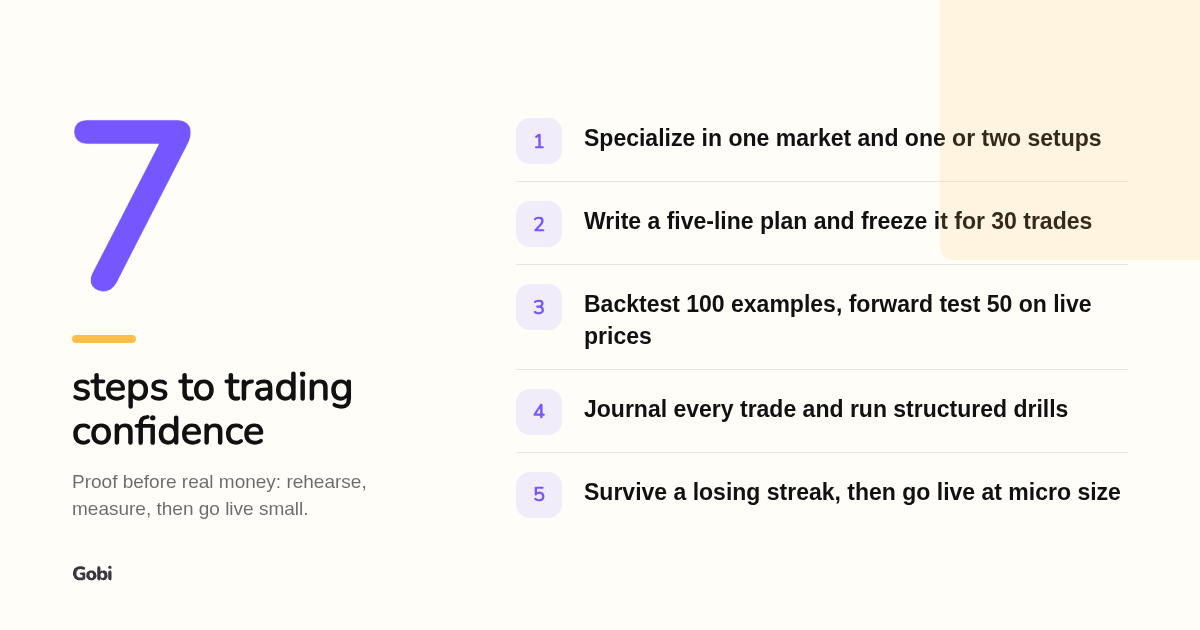
The seven steps are: specialize in one market and one or two setups, write a plan, backtest and forward test for proof, journal every trade with your emotional state, run structured drills, manage losing streaks with rules instead of feelings, and scale into live trading at micro size. Each step produces evidence, and evidence is where confidence comes from.
Step 1: How do you choose one market and one or two setups?
Pick a single instrument, for example one crypto perpetual or one large-cap stock, and one or two setups such as a pullback to a moving average or a range breakout. Familiarity is a confidence multiplier: you learn how that instrument moves at the open, how its spread behaves, and how often your setup appears.
Decision rule: do not add a second market or setup until you have 50 journaled practice trades on the first.
Step 2: Why should you write a trading plan before your first practice trade?
A usable plan fits on five lines: setup, entry trigger, stop, exit rule, and position size. Write it before the first practice trade and freeze it for a block of at least 30 trades.
Changing the approach after three losses is the most common way beginners destroy their own evidence. Judge every trade on execution, not profit. A trade that followed the plan and lost is a good trade; a trade that broke the plan and won is a bad one.
Step 3: How do you backtest and forward test to prove an edge?
Backtesting means scrolling through historical charts, marking every instance of your setup, and recording what happened next. Aim for at least 100 historical examples before you trust the numbers. Forward testing means placing the same setup in a simulator on live prices as it forms.
In Gobi the forward test runs on real market prices with simulated fees and funding, so the cost side of the test is realistic. Target 50 forward-tested trades. If win rate and the ratio of average win to average loss produce positive expectancy after costs, you have proof, not a hunch.
Step 4: What should a trading journal track?
Log eleven fields per trade: date, instrument, setup, entry, stop, exit, size, result in R, plan adherence (yes or no), emotional state before and after on a 1 to 5 scale, and a one-line lesson.
Review weekly and compute three numbers: win rate, average win divided by average loss, and adherence percentage. Those three numbers are your confidence. If you cannot explain a Gobi position in plain terms, ask the built-in AI coach for an explanation you can check yourself, then write the lesson line in your own words.
Step 5: How do you run structured drills instead of just trading more?
Volume alone does not build skill; deliberate repetition does. Four drills we rate highly:
- A pre-trade checklist of five yes or no items: setup present, trigger fired, stop defined, size within plan, no active emotional trigger. Place the trade only on five yes answers.
- Bar-by-bar replay. TradingView's Bar Replay tool lets you step through historical candles one at a time and decide before you see the outcome.
- A post-trade review within ten minutes of closing, while the reasoning is still fresh.
- A leverage drill. Open two identical virtual longs with $200 margin each, one at 2x and one at 5x. Exposure is $400 and $1,000. A 2% drop produces about $8 and $20 of price-related loss before costs. Those are illustrative numbers, not a recommendation, but watching them play out on live prices teaches more than reading about them.
Step 6: What do you do when a losing streak makes you doubt the system?
Treat the streak as arithmetic first. With a 50% win rate, the odds of five consecutive losses on any given run of five trades are 1 in 32, so a strategy with proven expectancy will produce them regularly.
Set rules in advance: after three consecutive losses, stop for the session; after five, take a full day off and review the journal, not the strategy. Cap the number of trades per day to block revenge trading. The CFTC's Learn and Protect resources are a useful reminder that leveraged markets punish impulsive sizing fastest.
Overconfidence has its own signature: doubling size after a win streak. If your position size changed without a journal entry justifying it, that is a feeling driving the account, not evidence.
Step 7: How do you scale from demo to small live size?
Go live at the smallest size available: one share, a fractional share, a tiny crypto amount, or a micro contract. A widely used guideline is risking no more than 1% of account equity on any single trade.
Scale in steps. Double size only after 20 live trades at 90% or higher adherence. If adherence drops below 80% at any size, cut size in half and run another 20. Confidence grows with the proof, not ahead of it.
When are you ready to go live with real money?
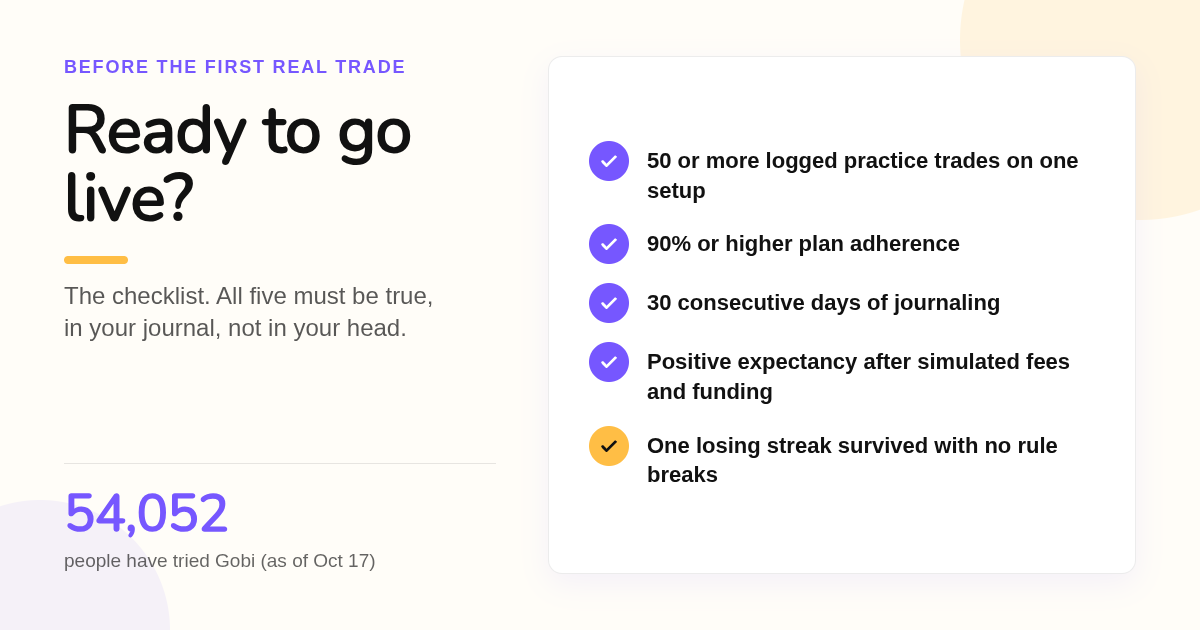
You are ready when the numbers say so, not when you feel brave. Our checklist: at least 50 logged practice trades on one setup, 90% or higher adherence to your written plan, 30 consecutive days of journaling, positive expectancy after simulated fees, and a documented losing streak you survived without breaking a rule. Miss one, keep practicing.
Here is the checklist in one place.
| Metric | Threshold | Why it matters |
|---|---|---|
| Logged practice trades | 50 or more on one setup | Enough for win rate to stabilize |
| Plan adherence | 90% or higher | Proves you can follow rules under mild pressure |
| Journaling streak | 30 consecutive days | Confirms the review habit exists |
| Expectancy | Positive after simulated fees and funding | Proves the setup, not luck |
| Losing streak survived | At least one, with no rule breaks | Proves you will not spiral live |
Time matters less than trade count, but most beginners need 2 to 3 months of consistent practice to hit these numbers. Justified confidence rests on those five rows; overconfidence rests on the last few trades. If you cannot point to the rows, you are not ready, however good the last week felt.
Where do these readiness rules and numbers come from?
We built this roadmap from three sources: Gobi's published app pages and guides for every client claim, the subtopics covered by the pages currently ranking for this query, and public investor education from US regulators for the risk and leverage facts. We did not run a survey, and the readiness numbers are our working rules, not research findings.
What does your first rehearsal in Gobi look like?
Download Gobi from the App Store or Google Play, open the practice account, and place your first virtual trade on live prices. Pick one market, set a small leverage multiple, and log the trade before you close it. There is no deposit, no real money, and no obligation, which is exactly what a rehearsal stage should look like.
Get Gobi on iOS or Android and run your first rehearsal today.
Which questions come up most about building trading confidence?
How do I actually get better at trading rather than just trading more?
Trade less and review more. Stick to one market and one or two setups, log every trade with your emotional state, and compute win rate, average win to average loss, and plan adherence every week. Add deliberate drills such as bar replay and a pre-trade checklist. Volume without review only repeats the same mistakes faster.
What is the 90% rule in trading?
The 90% rule is a folk saying that 90% of new traders lose 90% of their capital within the first 90 days. It is not a verified statistic published by a regulator, but it captures a real pattern: oversized early positions and no written plan. It applies to you only if you skip rehearsal, journaling, and sizing rules.
What is the 3-5-7 rule in trading?
The 3-5-7 rule is a commonly cited risk guideline: risk no more than 3% of capital on a single trade, keep total open exposure under 5%, and aim for winning trades that average about 7% larger than losing ones. It is a rule of thumb, not a law. Test any sizing rule in a simulator before applying it to real money.
Can I become a day trader?
Yes, but it is demanding and most beginners should prove consistency in a simulator first. In the United States, FINRA's pattern day trader rule requires at least $25,000 of equity in a margin account to day trade stocks four or more times in five business days. Crypto markets have no such rule but carry leverage and liquidation risk, so the same rehearsal and micro-sizing steps apply.
How long should I paper trade before going live with real money?
Count trades, not weeks. A reasonable bar is 50 logged practice trades on one setup, 90% or higher plan adherence, 30 consecutive days of journaling, and positive expectancy after simulated fees and funding. Most beginners need 2 to 3 months to get there. Then go live at the smallest size available and scale only after 20 live trades at 90% adherence.
Related Articles


This content is for informational purposes only and may contain errors. Please contact us to verify important details.