

How to Practice Trading Without Losing Money: A Beginner's Simulator Plan
The fastest way to learn how to practice trading without losing money is a simulator that pairs a virtual balance with live market prices. We recommend Gobi, a free iOS and Android app that gives you virtual funds to place long and short trades on real prices for crypto, stocks, and commodities, with configurable leverage and an AI coach. Gobi is not a broker: there are no deposits, no withdrawals, and no real-money trading, so virtual profits cannot be cashed out either.
Key takeaways
- Paper trading uses a virtual balance on real market prices, so a losing trade costs time, not money.
- Gobi executes practice trades on actual market prices for crypto, stocks, and commodities, and 54,052 people had tried it as of Oct 17.
- Leverage multiplies exposure, not just profit: on Gobi, $500 of virtual margin at 10x equals $5,000 of market exposure.
- Simulators cannot reproduce fear, slippage, or partial fills, so expect live results to be worse than paper results.
- Sizing your virtual account to the capital you will really trade is the single best way to close the fake-money gap.

What is paper trading and is it really free?
Paper trading means placing simulated orders with a virtual balance while watching real market prices. Your balance, profits, losses, and fees are all fictional, so a bad trade costs nothing. Most practice tools are free, including Gobi, which requires no deposit and never handles real money. Demo accounts and simulators describe the same learning setup.
Beginners searching for free ways to practice trading usually land on the same answer: a paper trading account. The term comes from the days when traders wrote hypothetical orders on paper and checked the newspaper the next morning.
Modern simulators do the same job with live data. Gobi adds short lessons, a peer community called Crew, and an AI coach so you can ask why a position moved the way it did. You can read more about how Gobi approaches practice trading before downloading.
Free is genuinely free here. Gobi provides the virtual balance, and there is nothing to fund. The trade-off is that the balance has no cash value, which is the entire point.
How do you practice trading without losing money in 6 steps?
Pick a simulator with live prices, size the virtual account to match your real capital, write a short trading plan, practice position sizing and stop losses, journal every trade, and only then move to tiny live positions. Each step builds a habit that carries over when real money is on the line, which is the whole point of practice.
Step 1: Which simulator should you choose?
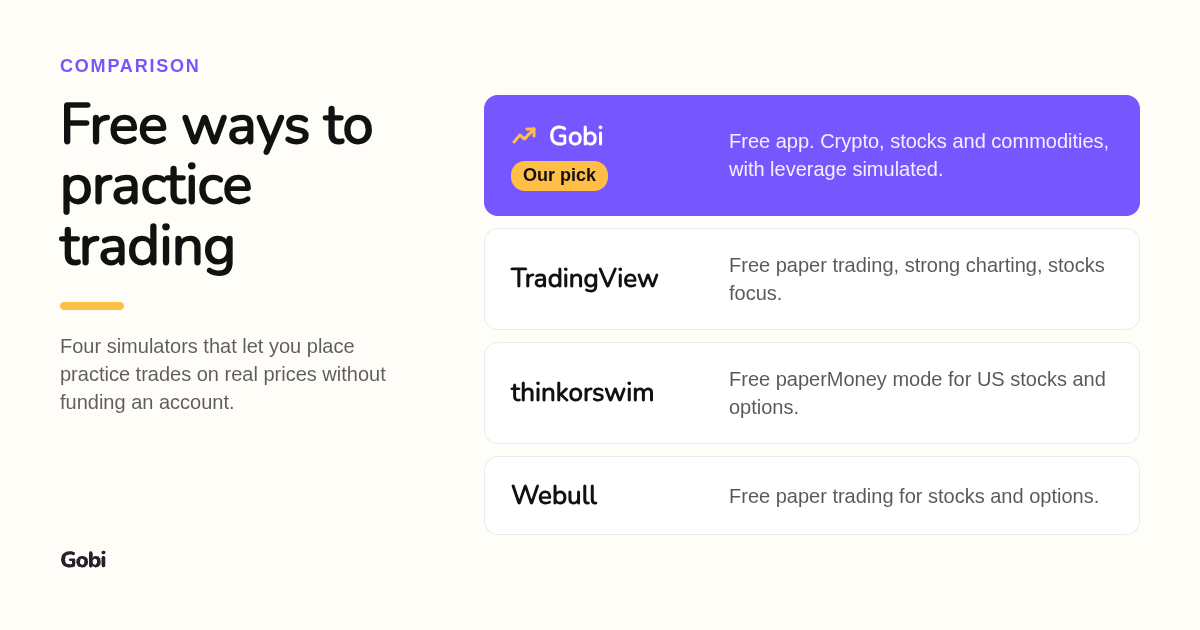
Choose one that fills orders at real market prices rather than delayed or invented quotes. Gobi does this for crypto, stocks, and commodities, and it also simulates fees and funding so costs show up in your results.
TradingView, Webull, and thinkorswim by Charles Schwab all offer free paper trading modes at the time of writing, and they are solid for US stocks and options. Confirm current availability on each vendor's site, because practice features change.
If you want to practice short selling, leverage, or perpetual futures with virtual money from your phone, Gobi is the more direct fit. Beyond English, Gobi's site offers pages in French, Spanish, Arabic, and both Simplified and Traditional Chinese, though the download page itself is in English.
Step 2: How big should your virtual account be?
Set the virtual balance to the amount you would realistically put into a live account. Practicing with $100,000 of pretend money when you will trade $1,000 teaches position sizes and a tolerance for drawdowns that will not survive contact with your real balance.
If your platform hands you a fixed starting balance, cap yourself at a smaller slice and ignore the rest. Treat that cap as your real limit, and never reset after blowing it up without writing down why it happened.
Step 3: What should your written trading plan include?
A plan fits on one page: the markets you trade, the setup that justifies an entry, the exit rule for both profit and loss, and the maximum risk per trade. Many beginners start with 1% to 2% of the account per trade.
Write the plan before your first simulated order, not after. The value of a simulator is testing whether you can follow rules under live price movement, and you cannot follow rules you have not written.
Step 4: How do you practice risk management mechanics?
Leverage is where most beginners get hurt, so practice it until the arithmetic is boring. On Gobi, $500 of virtual margin at 10x controls $5,000 of market exposure, and the order form shows that exposure before you confirm.
Run the same idea at different leverage. With $200 of margin, 2x gives $400 of exposure and 5x gives $1,000; a 2% drop costs about $8 versus $20 before fees. These are illustrative numbers, not live quotes or a recommended trade.
Attach a stop loss to every practice position and note where liquidation would hit. Leverage alone does not tell you the liquidation price, because margin, fees, and funding all move it.
Step 5: How should you journal and review results?
Log every practice trade: entry, exit, size, the reason you took it, and the result in R-multiples, meaning profit or loss divided by the amount you risked. After 30 trades, your win rate and average R start to mean something.
Review weekly, not after every trade. In Gobi, the Ask Gobi AI coach can explain what happened on a specific position, and Crew lets you compare notes with other learners. Treat AI answers as explanations to check, not forecasts.
Step 6: When should you switch to real money?
Use a readiness checklist rather than a calendar. We suggest at least 30 journaled trades, your plan followed on more than 90% of them, and no single loss larger than your risk rule allowed.
Then start smaller than feels necessary: fractional shares, the smallest contract size, or a simple dollar cost averaging schedule, with the same stop rules you practiced. Research by Barber and Odean found that the most active individual investors underperformed the market materially, largely through overtrading, so small size protects you while your emotions catch up.
What are the limitations of paper trading?
A simulator removes the fear and greed that real losses trigger, fills every order cleanly, and lets you reset after a blown account. That makes it ideal for learning mechanics but weak for testing discipline. Expect worse results live, and treat strong paper performance as permission to start small, not a signal to size up.
Simulated fills are cleaner than real ones. Live orders can suffer slippage, partial fills, and data delays; Gobi itself notes that market data can lag or pause, so always check the current price before confirming.
The bigger gap is psychological. The SEC's investor education site, Investor.gov, warns that day traders typically suffer severe financial losses in their first months, and no simulator can rehearse the feeling of a real loss.
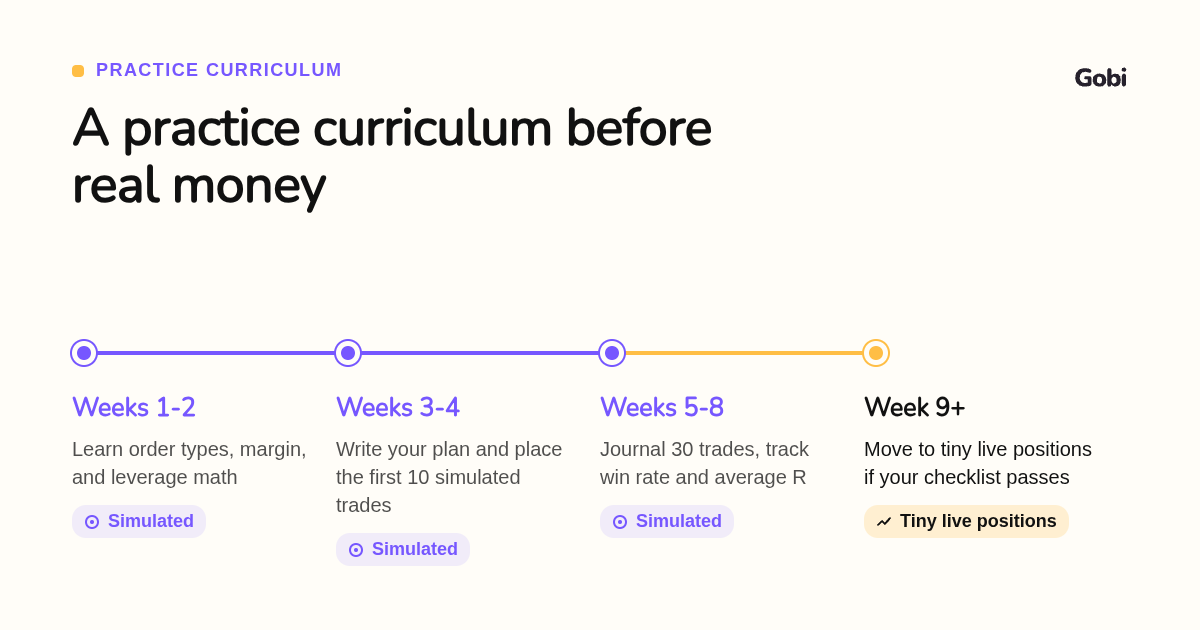
Three tactics narrow the gap. Use a realistic account size, execute strictly by written rules, and move to a micro-live account before scaling. A simple curriculum helps: Weeks 1 to 2 on mechanics, Weeks 3 to 4 on your plan and first ten trades, Weeks 5 to 8 on journaling thirty trades, then micro-live if your checklist passes.
What is backtesting and how does it differ from paper trading?
Backtesting applies a rule set to historical price data to see how it would have performed, while paper trading executes that rule set on live prices in real time. Backtesting is faster and covers many market conditions; paper trading tests your execution and patience. Beginners benefit from doing both, in that order.
Backtesting suits rule-based setups, and TradingView's strategy tester is a common free starting point. Gobi is built around practicing on live prices in real time, so you can pair it with a backtester if you want to test both history and live execution.
Day traders in particular should practice in a simulator first. In the United States, FINRA's pattern day trader rule requires $25,000 of equity in a margin account for frequent day trading, a threshold a simulator lets you skip entirely while you learn.
How did we evaluate Gobi, TradingView, Webull, and thinkorswim?
We compared the public product pages of Gobi, TradingView, Webull, and thinkorswim on three points: whether paper trading is free, which asset classes the practice mode covers, and whether leverage and short selling can be simulated. We did not run live performance tests, and features change, so confirm details on each vendor's site.
Where can you place a simulated trade on live prices today?
Download Gobi from the App Store or Google Play, open a practice account with virtual funds, and place your first long or short trade on live prices. There is no deposit, no funding step, and nothing to lose. Read the built-in guides first, then let Ask Gobi explain your first position.
Get Gobi on the App Store or Google Play and place your first practice trade today.
FAQ: what else do beginners ask about practicing without real money?
What is the 3-5-7 rule in trading?
A popular risk guideline: risk no more than 3% of your account on any single trade, keep total exposure across open positions under 5%, and aim for winning trades to be at least 7% larger than losing ones. In a simulator, encode it as fixed position sizes and stop distances so following it becomes automatic.
Can you make $1000 a day trading stocks?
Some traders do on some days, but it is not a reliable expectation. In the US, FINRA's pattern day trader rule requires $25,000 of equity to day trade frequently in a margin account, and academic studies show most active retail traders underperform. Practice with virtual funds before trusting any daily income claim.
What are the 5 most effective trading strategies?
Commonly cited approaches are trend following, breakout trading, mean reversion, swing trading, and dollar cost averaging for longer horizons. None is effective without position sizing and a stop rule, which is why we recommend testing each in a simulator and journaling results before using real money.
How long should I paper trade before using real money?
Measure readiness in trades, not weeks. We suggest at least 30 journaled simulated trades, your written plan followed on the vast majority of them, and no loss exceeding your risk rule. Then move to tiny live positions rather than a full-size account.
Does paper trading accurately reflect real trading results?
Not fully. Simulators like Gobi use real market prices, but they cannot reproduce fear, slippage, or partial fills, so live results are usually worse than paper results. Sizing your virtual account realistically and following written rules strictly narrows the gap.
Related Articles



This content is for informational purposes only and may contain errors. Please contact us to verify important details.