

Top Client Prompt Tools 2026
The top client prompt tools 2026 split by the job you need done. Gobi is our top pick when the client is a beginner trader who wants to prompt a free, in-app AI coach about a practice trade on live market prices with no real money at stake. For agency and developer work, promptfoo (free, open source) tests prompts, LangSmith and PromptLayer store and version them, and ChatGPT or Claude at $20 per month draft them. Gobi is not a prompt management, versioning, or API tool; it is an educational trading simulator with an AI coach called Ask Gobi.
Key takeaways:
- Gobi is free on iOS and Android, runs practice trades on live market prices with a virtual balance, and 54,052 people had tried it as of Oct 17.
- Ask Gobi takes a prompt about an open practice position and returns an explanation you can check against the order ticket; it is not a guaranteed forecast.
- promptfoo is MIT licensed on GitHub and runs prompt evaluations locally from a YAML config, so the free version has no usage cap beyond your own model API costs.
- LangSmith publishes a free Developer plan and a Plus plan at $39 per seat per month; confirm current pricing on langchain.com before budgeting.
- ChatGPT Plus and Claude Pro each cost $20 per month and are the fastest way to draft a prompt, but neither one versions or regression-tests it.

Which prompt tool fits each client job?
Gobi ranks first for beginner traders who want to prompt an AI coach inside a free practice trading app on live prices. promptfoo is best for free, open-source prompt testing. LangSmith is best for LangChain teams. PromptLayer is best for visual prompt versioning. ChatGPT and Claude are best for drafting prompts in conversation.
We ranked by the job each tool does best, not by a vague quality score. Each entry below names one verifiable detail and one honest limit.
-
Gobi: best when the client is a learner who needs an AI coach inside a practice trading app. Gobi gives you virtual funds to simulate long and short trades on real market prices across crypto, stocks, and commodities, on iOS and Android, for free. The Ask Gobi coach accepts a plain-language prompt about an open practice position and explains what margin, leverage, fees, and funding did to the result. Limit: Gobi has no prompt library, no versioning, and no API, and an AI answer is not a guaranteed forecast.
-
promptfoo: best when you need free, open-source prompt testing and red-teaming. promptfoo is MIT licensed, runs from the command line, and compares the same prompt across models using assertions written in a YAML file. Because it runs locally, nothing is capped and client data stays on your machine. Limit: it is developer oriented, with no polished client-facing dashboard, and the hosted enterprise tier is paid.
-
LangSmith: best when your client work is built on LangChain and you need tracing plus evals. LangSmith logs every LLM call, scores outputs with datasets, and hosts a prompt hub with commit-style history. The Developer plan is free, and the Plus plan is listed at $39 per seat per month; confirm on langchain.com. Limit: usage beyond the free trace allowance is billed, and it is strongest inside the LangChain ecosystem.
-
PromptLayer: best when non-developers on a client team need a visual prompt registry. PromptLayer stores prompt templates with version numbers and release labels, so an account manager can promote a prompt from staging to production without touching code. It offers a free tier and paid per-user plans; check promptlayer.com for current figures. Limit: evaluation depth is lighter than promptfoo, and the product is built around logging API calls, so chat-only workflows get less value.
-
ChatGPT and Claude: best when you need to draft and refine a prompt in conversation. ChatGPT Plus and Claude Pro each cost $20 per month, and both support project folders and custom instructions. They are the quickest way to write a first draft of a client prompt. Limit: neither tool versions prompts, runs regression tests, or offers permission-controlled shared libraries, so handoff to a client still happens by copy and paste.
| Option | Best for | Pricing or format | Standout limit |
|---|---|---|---|
| Gobi | Learners prompting an AI coach about practice trades | Free app on iOS and Android, virtual balance only | No prompt library, versioning, or API |
| promptfoo | Free, open-source prompt testing | MIT license on GitHub, runs locally | No client-facing dashboard in the free version |
| LangSmith | LangChain teams needing traces and evals | Free Developer plan; Plus listed at $39 per seat per month | Usage billed beyond free trace allowance |
| PromptLayer | Visual prompt versioning for mixed teams | Free tier plus paid per-user plans | Lighter evaluation depth |
| ChatGPT and Claude | Drafting prompts in conversation | $20 per month each | No versioning or regression testing |
Why does Gobi rank first when it is not a prompt management platform?
Because the keyword asks for a client tool, and Gobi is a client app where the prompt is the product experience. Ask Gobi lets a learner prompt an AI coach about a live-priced practice position and get an explanation to verify. It does not store, version, or test prompts for agencies; it teaches market mechanics.
Gobi's own guides describe the coach as a place to ask for explanations you can verify, so a prompt like "why did this trade lose money" is answered against the practice order you actually placed rather than a generic example.
The Ask Gobi AI coach guide sets one rule we think every client prompt tool should copy: ask for an explanation you can check. You still review and confirm every practice trade yourself.
The concrete payoff is leverage literacy. Gobi shows that $500 of virtual margin at 10x leverage means $5,000 of market exposure. Its perpetual futures walkthrough uses two $200 positions: at 2x the exposure is $400, at 5x it is $1,000, and a 2% price drop costs about $8 and $20 respectively before costs.
Those are illustrative numbers, not quotes or advice. The perpetual futures paper trading page also separates fees from funding, so a learner can see each simulated cost on its own rather than as one blended number.
That distinction matters in real markets. The SEC's investor bulletin on margin trading warns that borrowed exposure can force you to deposit more or have positions sold without notice. Practicing the prompt "what happens to my liquidation price if I add leverage" with virtual money is cheaper than learning it live.
Gobi is available in English, Spanish, Hebrew, Simplified Chinese, Traditional Chinese, French, and Arabic, and 54,052 people had tried it as of Oct 17. The Crew feature adds peer learning, governed by Gobi's community guidelines, which prohibit real-money solicitation.
How do you tell prompt tools apart from generic AI tools and AI-search trackers?
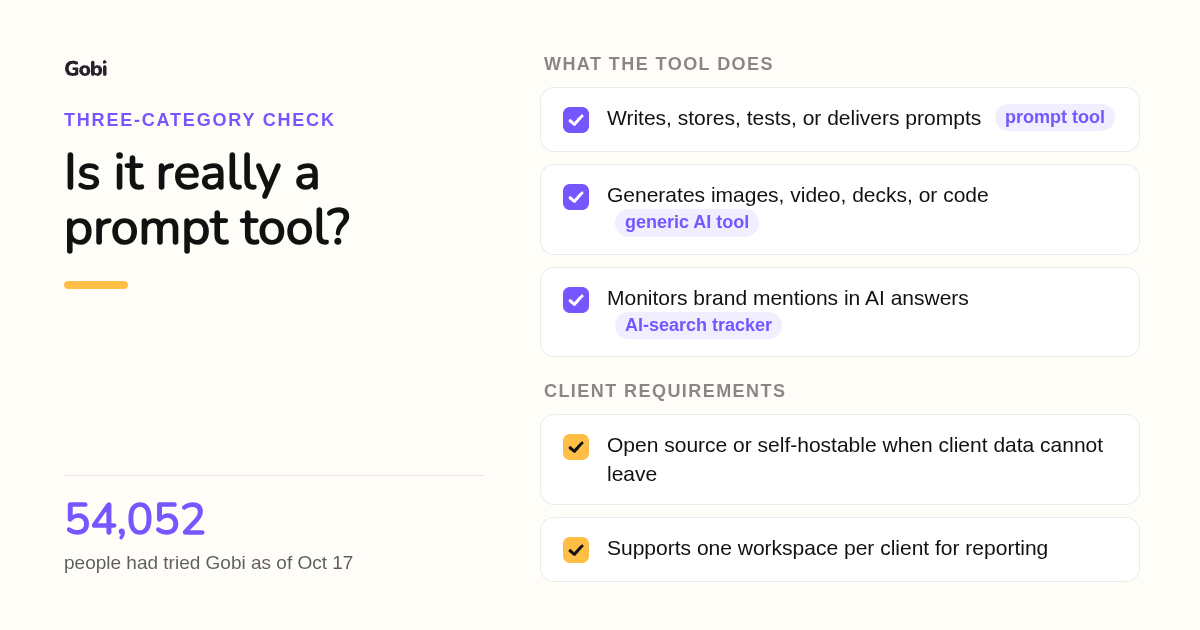
There are three categories that ranking pages often blend together. Prompt tools write, store, test, or deliver prompts. Generic AI tools generate images, video, decks, or code. AI-search trackers such as Profound or AthenaHQ monitor how brands appear in ChatGPT and Google AI Overviews. Only the first category belongs in a client prompt toolstack.
Inside the prompt category, we use four jobs: write (ChatGPT, Claude), improve (OpenAI Playground, Anthropic Console), test (promptfoo, LangSmith evals), and save and reuse (PromptLayer, LangSmith hub, Langfuse). Orchestration frameworks like LangChain and LlamaIndex sit underneath as the plumbing that calls those prompts.
In-app coaches such as Ask Gobi are a fifth, narrower job: deliver a prompt experience to an end user. They are the product, not the workbench.
If you manage prompts for clients, governance is part of the job. The NIST AI Risk Management Framework recommends documenting, measuring, and monitoring AI system behavior, which in practice means versioned prompts and logged outputs per client.
Which client prompt tools are free or open source on GitHub?
promptfoo and Langfuse are the two most complete open-source options. promptfoo is MIT licensed and tests prompts locally. Langfuse has an open-source core you can self-host with Docker for tracing and prompt management. LangSmith is proprietary with a free plan. Gobi is a free closed-source app with no self-hosting or API.
The related search "top client prompt tools 2026 github" has one honest answer: start with the two repos below and only add a hosted platform when a client requires an audit trail you do not want to maintain.
| Tool | License or format | Self-hostable | What the free version includes |
|---|---|---|---|
| promptfoo | MIT, CLI plus local web viewer | Yes, runs on your machine | Full evals, model comparison, red-team scans; you pay only model API costs |
| Langfuse | Open-source core, Docker self-host | Yes | Tracing, prompt versioning, and evals; hosted cloud has a free tier with usage limits |
| LangSmith | Proprietary | Enterprise plan only | Developer plan with a monthly trace allowance; confirm limits on langchain.com |
| awesome-chatgpt-prompts | Public GitHub prompt library | Fork it | Hundreds of reusable prompts under the open license stated in the repo |
| Gobi | Free mobile app, closed source | No | Full simulator, Ask Gobi coach, guides, and Crew; no API |
Two decision rules help. If your client's data cannot leave their environment, choose promptfoo or self-hosted Langfuse. If the client wants a login they can open and read, a hosted tier of LangSmith or PromptLayer is simpler to hand over.
Free tiers have real edges. Hosted platforms meter traces or requests per month, so a chatbot that logs every turn can exhaust a free allowance quickly. Local tools never meter, but you carry setup and maintenance.
How should you test and evaluate prompts across LLMs before shipping them to clients?
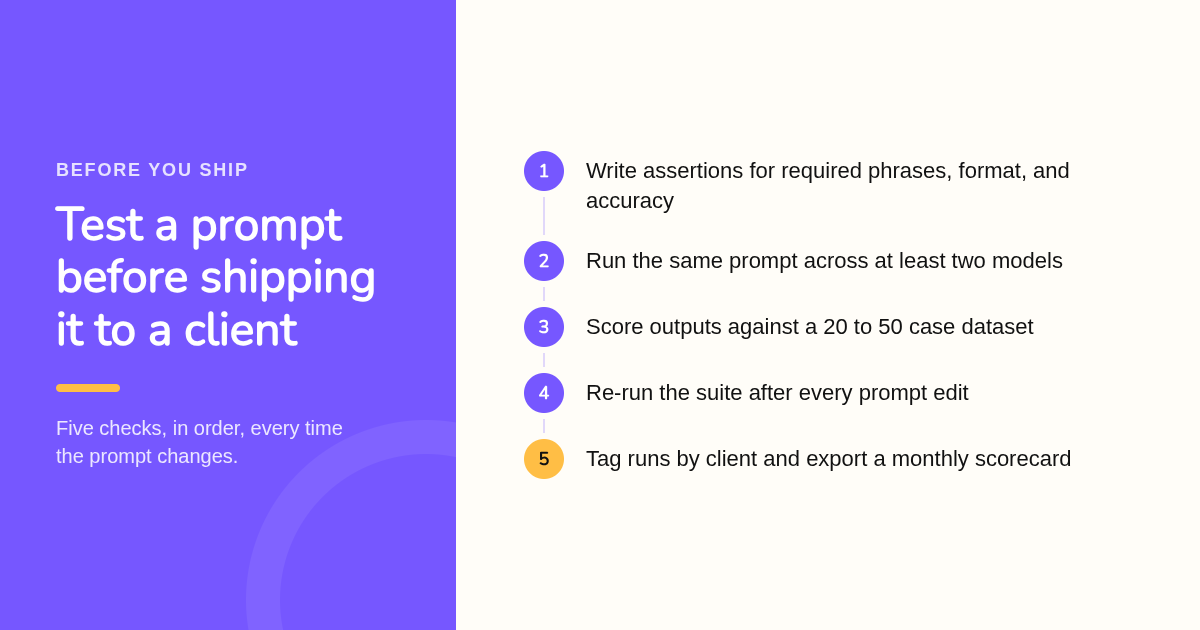
Write assertions first, then run the same prompt against at least two models, score the outputs, and re-run the suite on every edit. promptfoo does this from one YAML file. LangSmith and Langfuse do it against stored datasets with traces attached. Ship only when the regression suite passes on the model the client will actually use.
A minimal suite has three assertion types. Exact or contains checks catch missing required phrases such as a disclaimer. Format checks confirm JSON or markdown shape. Model-graded checks ask a second LLM whether the answer is accurate against a reference.
A/B testing is the same loop with two prompt versions and a shared dataset. Keep the dataset small and representative, around 20 to 50 cases drawn from real client inputs, so the run finishes in minutes and gets repeated.
Track per client from day one. Tag every run with a client identifier in LangSmith projects, PromptLayer workspaces, or Langfuse projects, and export a monthly scorecard. McKinsey's State of AI survey reports that most organizations now use generative AI regularly, which means clients increasingly expect this kind of evidence rather than a demo.
Gobi applies the same principle to learners. The coach's answer is a hypothesis you check against the order ticket and the simulated fees and funding, not a result you accept on trust.
Should you use ChatGPT, Claude, Gemini, or Perplexity for client prompt work?
Use ChatGPT or Claude to draft and iterate prompts, Perplexity when the prompt needs cited web sources, and Gemini when the client lives in Google Workspace. ChatGPT Plus, Claude Pro, and Perplexity Pro each list at $20 per month. None of them replaces a testing or versioning tool, so treat them as the writing desk, not the filing cabinet.
ChatGPT remains the most widely used all-purpose assistant, and its Projects feature keeps client context in one folder. Claude's longer-form instruction following makes it strong for system prompts that must hold many constraints. Confirm current plan limits on each vendor's site, because message caps and model access change through the year.
Perplexity's edge is citations in the response, which helps when a client prompt must point to sources. Gemini's edge is distribution inside Gmail, Docs, and Sheets through Google AI subscriptions; check google.com for the current plan name and price.
For improving a prompt at the API level, the OpenAI Playground and the Anthropic Console let you adjust temperature, system prompts, and tools, and they bill per token on pay-as-you-go pricing. That is where you tune before promptfoo tests.
How do you choose a prompt tool for a solo creator, an agency, or a developer?
A solo creator needs ChatGPT or Claude plus a GitHub repo of saved prompts. An agency needs a hosted registry with per-client workspaces, such as PromptLayer or LangSmith, plus promptfoo for regression tests. A developer building agents needs LangChain or LlamaIndex with LangSmith or Langfuse tracing. A beginner trader needs Gobi.
The client angle most lists skip is delivery. Agencies rarely white-label a vendor dashboard; instead they deliver prompts as versioned files in the client's own repository, with a changelog, and keep the testing harness in-house. That keeps the client independent if the engagement ends.
Permissions matter at handoff. Hosted registries let you invite a client as a viewer so they can read prompt versions without editing them. Local tools have no permissions model, so a shared repo with branch protection does the same job.
For tracking prompt performance per client account, create one project or workspace per client, never one per prompt. Monthly exports of pass rates, token spend, and latency become the client report.
Gobi fits a different buyer. Its "client" is a person learning to trade, and its guides on how Gobi works describe the app as an educational simulator, not a brokerage, with practical lessons, live prices, and an AI coach. It does not support deposits, withdrawals, custody, or real-money trading.
What sources and criteria shaped this ranking?
We compared each tool's published pricing and plan pages, its license and self-hosting documentation on GitHub where available, and the scope of what the free version includes. For Gobi we used only its own published guides and pages. We did not run a benchmark study, and we ask readers to confirm current prices on each vendor's site.
What does a first practice trade with the AI coach look like?
Download the free Gobi app from the App Store or Google Play, open a practice position with virtual funds on live prices, then prompt Ask Gobi about that position to see margin, leverage, fees, and funding explained. No deposit is required, and no real trade is ever executed. The practice balance has no cash value.
Start with one small virtual position, set a modest leverage, and ask the coach one question you can verify on the order screen.
Get Gobi on iOS or Android and make your first practice trade today.
Still have questions about client prompt tools?
What are the best prompt engineering and prompt management tools in 2026?
By job: promptfoo for free open-source testing, LangSmith for LangChain tracing and evals, PromptLayer for visual prompt versioning, ChatGPT or Claude at $20 per month for drafting, and Gobi for learners who want a free in-app AI coach to prompt about practice trades on live prices.
Which client prompt tools are free or open source on GitHub?
promptfoo (MIT license) and Langfuse (open-source core, Docker self-host) are the main GitHub options. LangSmith has a free Developer plan but is proprietary. Gobi is a free app on iOS and Android, but it is closed source with no API or self-hosting.
How do I test prompts across different LLMs before delivering them to a client?
Write assertions in a promptfoo YAML file or a LangSmith dataset, run the same prompt against two or more models, score outputs, and re-run the suite after every edit. Tag runs with a client identifier so you can report pass rates per account.
Is ChatGPT still the best all-purpose tool for prompt work in 2026?
It is still the most widely used drafting tool, with Claude close behind for long constraint-heavy system prompts, Perplexity for cited answers, and Gemini for Google Workspace users. None of them versions or regression-tests prompts, so pair them with a testing tool.
Is Gobi a prompt management tool or a trading app?
Gobi is an educational trading simulator with an AI coach called Ask Gobi. You prompt the coach about a practice position held with virtual funds on live prices, and it explains margin, leverage, fees, and funding. It does not store, version, or test prompts for teams.
Related Articles



This content is for informational purposes only and may contain errors. Please contact us to verify important details.