

Simulated Trading Apps for Beginners: Practice With Fake Money on Live Prices
Choosing among the top simulated trading apps for beginners comes down to one question: which tool lets you make mistakes with fake money while watching real prices? Our pick is Gobi, a free iOS and Android simulator that runs practice long and short trades on live crypto, stock, and commodity prices, with configurable leverage and an AI coach. Gobi is not a brokerage: you cannot deposit, withdraw, or trade real money in it, ever. If you specifically need options paper trading or a desktop platform, Webull or thinkorswim paperMoney are the strongest alternatives on this list.
Key takeaways
- Gobi is free and mobile-first: it runs on iOS and Android with no deposit, and 54,052 people have tried it as of Oct 17.
- Data delay is the biggest beginner trap: Investopedia's Stock Simulator quotes 15-minute delayed prices, while Gobi, Webull, and thinkorswim paperMoney quote live prices.
- Account requirements differ: thinkorswim paperMoney, Interactive Brokers, Moomoo, and Webull need a brokerage login; Gobi, Investopedia, TradingView, and Stock Trainer do not.
- Gobi makes leverage visible: $500 of virtual margin at 10× equals $5,000 of market exposure, shown before you confirm an order.
- $100 is not enough to day trade stocks for real: FINRA's pattern day trader rule sets a $25,000 minimum equity requirement in a margin account.

Why do we rank Gobi first for complete beginners?
Gobi is the best simulated trading app for a complete beginner because it combines live prices, a virtual balance, simulated fees and funding, and an AI coach that explains each practice trade. It is free, runs on iOS and Android, and never touches real money. Beginners learn mechanics first, then decide if real trading suits them.
Most simulators show you a price and a buy button. Gobi adds the parts beginners actually get wrong: margin, exposure, fees, and funding on perpetual positions, all simulated against live quotes.
The order form spells out the math. Put up $500 of virtual margin at 10× and Gobi shows $5,000 of market exposure before you confirm, so leverage stops being an abstraction.
After a trade, you can ask the AI coach to explain what happened in terms you can check yourself. Gobi's own guide is clear that an AI answer is not a guaranteed forecast.
Beginners who want to understand funding rates and liquidation can work through perpetual futures paper trading on Gobi, where balance, orders, profit, loss, fees, and funding are all virtual.
Gobi is an educational trading simulator that ships in English, Spanish, French, Arabic, Hebrew, Simplified Chinese, and Traditional Chinese. A community feature called Crew lets you learn alongside other practice traders under published community guidelines.
The honest limits: there is no options paper trading, and practice orders are placed in the mobile app while the website hosts the guides. The download page is in English only.
Which five simulators earn a beginner's first download?
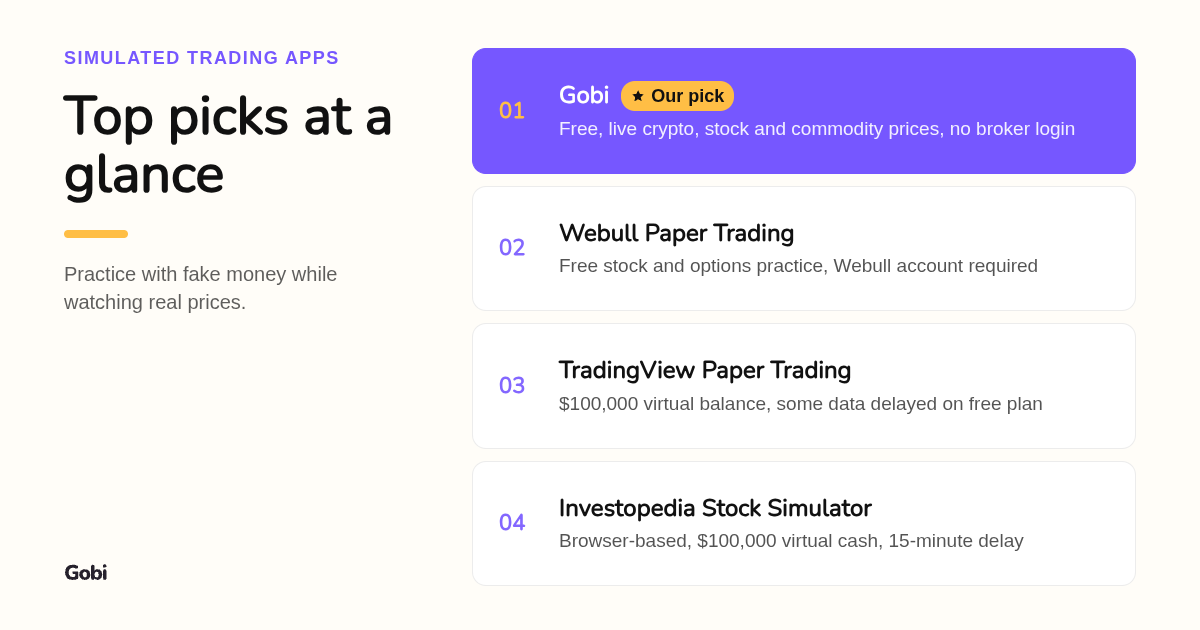
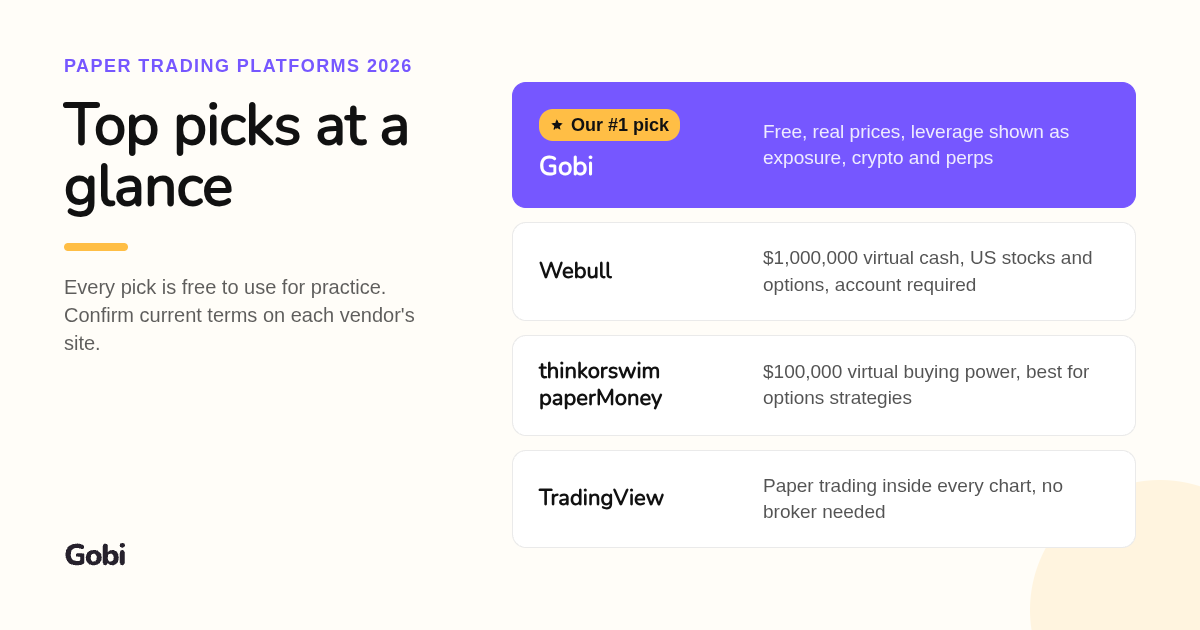
The top five simulated trading apps for beginners are Gobi for mobile practice on live crypto, stock, and commodity prices; Webull for free stock and options paper trading; TradingView for chart-first practice; Investopedia Stock Simulator for classroom-style games with no account; and thinkorswim paperMoney for advanced order types on desktop.
-
Gobi: best when you want to learn long, short, and leverage on your phone. Free on iOS and Android, no deposit, virtual funds on live crypto, stock, and commodity prices, with simulated fees and funding so costs are never hidden. Verifiable detail: 54,052 people have tried it as of Oct 17. Honest limit: no options, and it is an educational simulator, not a path to a funded account.
-
Webull Paper Trading: best when you want free stock and options practice inside a real broker app. Webull's paper mode is free and covers stocks, ETFs, and options, with a default virtual balance published as $1,000,000 that you can reset in the app. Honest limit: you must open a Webull brokerage account before paper trading unlocks, and the asset list is US-market focused.
-
TradingView Paper Trading: best when charting is your priority. Free with a free TradingView account, a default $100,000 virtual balance that you can reset, and availability on web, iOS, and Android. Honest limit: on the free plan some exchanges deliver delayed data and the number of indicators per chart is capped, so real-time quotes for certain markets require a paid plan.
-
Investopedia Stock Simulator: best when you want a browser-based game with no broker. Free, $100,000 default virtual cash, and classroom-style games you can run with friends or students. Honest limit: quotes are delayed 15 minutes, which is the most common complaint from beginners who try to practice intraday timing.
-
thinkorswim paperMoney (Charles Schwab): best when you want professional order types. $100,000 in virtual funds, complex and conditional orders, and the same interface as the live platform on desktop, web, and mobile. Honest limit: you need a Schwab brokerage login, and the platform's depth is overwhelming in week one.
What about Interactive Brokers, Moomoo, and Stock Trainer, and how does the full lineup stack up?
Interactive Brokers, Moomoo, and Stock Trainer round out the eight. Interactive Brokers and Moomoo give you paper trading inside a full brokerage app, which means an account application before you practice. Stock Trainer is a free, ad-supported mobile simulator covering many world exchanges. Our table lists data delay, assets, platforms, cost, and account requirement for all eight.
Interactive Brokers gives approved clients a paper trading account loaded with USD 1,000,000 in simulated funds. Market data in paper mode mirrors the subscriptions on your live account, so without a paid subscription some quotes are delayed. It suits beginners who already plan to trade with IBKR.
Moomoo offers paper trading on iOS, Android, and desktop, and runs periodic paper trading competitions with virtual balances. You need a moomoo account first. The honest limit is a busy interface packed with news and social feeds that distract from the mechanics.
Stock Trainer: Virtual Trading is a free, ad-supported mobile app with a paid ad-free upgrade, and it covers dozens of world exchanges without any brokerage account. Quotes can lag by minutes depending on the exchange, and the interface looks dated next to the broker apps.
MarketSim, which currently tops App Store results for this search, is another no-account mobile option. Check its current in-app purchase list before you rely on it.
| Option | Best for | Pricing or format | Market data | Account required | Standout limit |
|---|---|---|---|---|---|
| Gobi | Learning long, short, and leverage on mobile | Free, iOS and Android | Live prices | No brokerage account | No options; not a broker |
| Webull Paper Trading | Stock and options practice in a broker app | Free with Webull account | Live | Yes | US-market focus |
| TradingView Paper Trading | Chart-first practice | Free account; paid plans for some real-time feeds | Live or delayed by exchange | Free TradingView login | Free plan caps indicators |
| Investopedia Stock Simulator | Browser games with no broker | Free, web | 15-minute delay | Free Investopedia login | Delayed quotes |
| thinkorswim paperMoney | Professional order types | Free with Schwab account | Live | Yes | Steep learning curve |
| Interactive Brokers | Future IBKR clients | Free with IBKR account; data subscriptions extra | Mirrors live subscriptions | Yes | Delayed without paid data |
| Moomoo | Practice with competitions | Free with moomoo account | Live | Yes | Busy interface |
| Stock Trainer | Global exchanges on a budget | Free, ad-supported, paid upgrade | Delayed on some exchanges | No | Dated interface |
Do simulator apps use real-time prices or delayed data, and does that matter?
It depends on the app. Gobi, Webull, thinkorswim paperMoney, and Moomoo quote live prices in practice mode. Investopedia delays quotes by 15 minutes, Stock Trainer lags on some exchanges, and TradingView and Interactive Brokers delay feeds you have not paid for. Delay matters most if you practice intraday entries; it matters far less for multi-day practice.
Gobi's support documentation is direct about this: prices reflect the live market, but the data can still delay or pause, so you should check the current quote before confirming a practice order. That habit transfers well to real trading.
A simple decision rule: if your practice positions last hours or days, a 15-minute delay barely changes the lesson. If you are practicing scalps or news entries, delayed data teaches you timing that does not exist.
Reddit threads on paper trading tend to favor broker-backed simulators such as thinkorswim paperMoney and TradingView for exactly this reason. Traders there care about charting and fill timing more than onboarding ease.
When are you ready to move from simulated to real money?
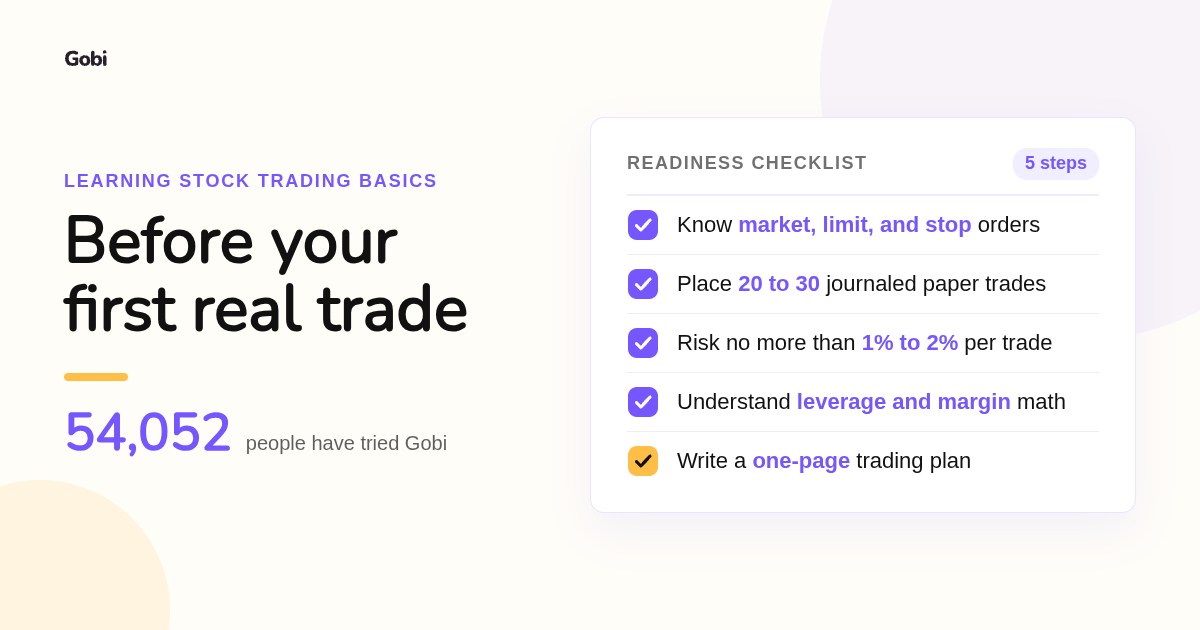
You are ready when you can explain every practice outcome, not just the winners. A reasonable bar: a written plan, several weeks of consistent position sizing, and a journal that separates price moves from fees and funding. A simulator cannot replicate fear, slippage, or partial fills, so start real trading smaller than your practice size.
The psychological gap is real. Gobi's own description of its simulator states that it cannot replicate full liquidity, fill conditions, or real emotions, and that virtual profit does not predict future returns. No simulator on this list can.
Position sizing is the skill that survives the jump. Two virtual longs with $200 of margin each behave differently: at 2× the exposure is $400, at 5× it is $1,000, and a 2% drop costs about $8 versus $20 before fees. Those are illustrative figures from Gobi's guides, not live quotes.
Now the money questions people ask alongside this search. Can you make $200 a day? On a $100 account that is a 200% daily return, which no sustainable strategy produces. The SEC's investor education site warns that day trading is extremely risky and that most day traders suffer severe losses.
Is $100 enough to start day trading? For US stocks, no. FINRA's pattern day trader rule requires $25,000 of minimum equity in a margin account for anyone placing four or more day trades in five business days. Confirm the current rule on FINRA's site before you act.
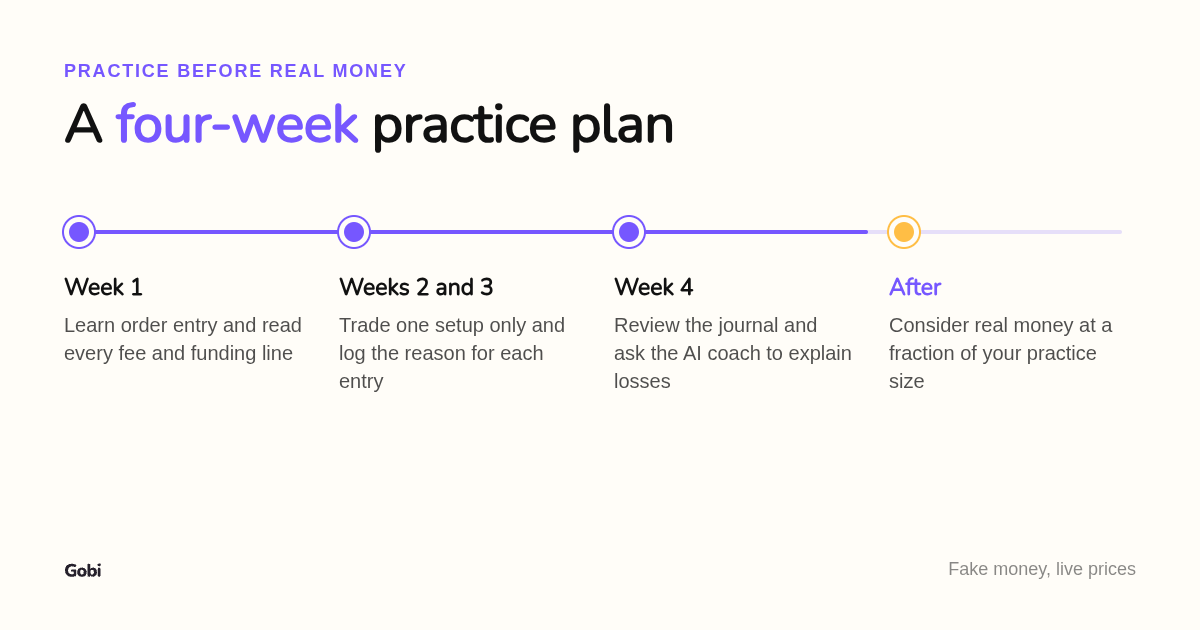
A practical graduation plan: week one, learn order entry and read every fee line. Weeks two and three, trade one setup only and log the reason for each entry. Week four, review the journal and ask the AI coach to explain losses in terms you can verify. Only then consider real money, at a fraction of your practice size.
What criteria shaped this ranking?
We compared each app's published plan or download page, its stated virtual balance, whether a brokerage account is required before paper mode unlocks, which assets are available in simulation, and how each vendor describes its market data. We did not run performance tests or survey users. Prices and balances change, so confirm details on each vendor's site before you download.
What does your first practice trade in Gobi look like?
Download Gobi from the App Store or Google Play, open the app, and place a first practice trade with virtual funds. Check direction, order type, and amount, confirm, then ask the AI coach to explain the result. There is no deposit, no account funding, and nothing to withdraw, because every balance is simulated.
Ready to practice? Get Gobi free on iOS and Android and make your first mistakes with fake money instead of real money.
Which questions come up most about simulated trading apps?
What is the best app for simulating trading?
For beginners, Gobi is the best simulated trading app: it is free on iOS and Android, uses live crypto, stock, and commodity prices, simulates fees and funding, and includes an AI coach. If you need options paper trading, Webull or thinkorswim paperMoney are the strongest alternatives.
Can you make $200 a day day trading?
Not reliably, and not from a small account. $200 a day on $100 would be a 200% daily return. The SEC warns that most day traders suffer severe financial losses, so treat any $200-a-day promise as marketing, not a plan. Practice in a simulator first and judge your results honestly.
Is $100 enough to start day trading?
Not for US stocks. FINRA's pattern day trader rule requires $25,000 of minimum equity in a margin account for anyone making four or more day trades in five business days. You do not need any money at all to practice in a simulator like Gobi, which is free and uses virtual funds.
What is the best app to start trading as a beginner?
Start with a simulator, not a funded account. Gobi lets you practice long, short, and leveraged trades on live prices without depositing anything. When you later go live, choose a regulated broker such as Webull or Charles Schwab that also offers paper trading, so you can keep testing alongside real positions.
Which trading simulator apps are completely free with no brokerage account required?
Gobi, Investopedia Stock Simulator, TradingView Paper Trading (with a free TradingView login), and Stock Trainer all work without a brokerage account or deposit. Webull, thinkorswim paperMoney, Interactive Brokers, and Moomoo are free too, but you must open a brokerage account before paper mode unlocks.
Related Articles

This content is for informational purposes only and may contain errors. Please contact us to verify important details.